
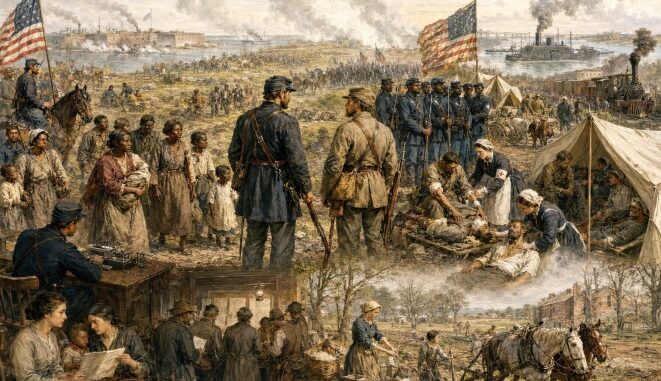

UNION, FREEDOM AND THE NATION REMADE
“The Revolution created the nation. The Civil War tested whether that nation deserved to endure.”
The secession crisis asked whether the United States was a permanent nation or a compact from which states could withdraw. Eleven slaveholding states eventually formed the Confederate States of America. Their ordinances, declarations and commissioners repeatedly identified slavery and the perceived threat to slave property as central reasons for secession. The Union refused to accept dissolution by unilateral state action. The war therefore began over secession undertaken to protect slavery, even though the federal government’s initial declared purpose was restoration of Union rather than immediate abolition. That distinction mattered-but it could not survive unchanged. Enslaved people understood that armies, geography and federal power had opened a struggle over their future. By moving toward Union lines, offering intelligence and labor, and demanding protection, they helped force freedom into the center of the war.
UNEQUAL RESOURCES, UNCERTAIN OUTCOME
The Union possessed greater population, industrial capacity, railroad mileage, finance and naval power. The Confederacy fought defensively across a vast territory, fielded formidable armies and hoped northern will would collapse or European recognition would arrive. Material advantage favored the Union; victory still required political endurance, military adaptation and staggering sacrifice.
“The new nation was on test: not only whether it could survive, but what survival would mean.
FROM SUMTER TO BULL RUN
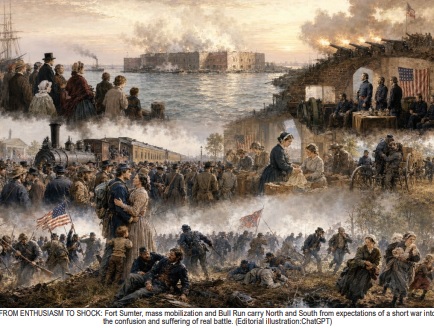 When South Carolina forces fired on Fort Sumter in Charleston Harbor on April 12, 1861, the garrison surrendered after bombardment. President Lincoln called for troops. Virginia, Arkansas, Tennessee and North Carolina then seceded, while Delaware, Maryland, Kentucky and Missouri remained in the Union despite divided populations. Holding the border states was strategically vital. Volunteers rushed to enlist amid flags, speeches and assumptions that one decisive encounter would settle the crisis. Women organized aid societies, made uniforms and sustained households and farms. Railroads moved regiments at unprecedented speed; telegraph lines connected governments and commanders. At First Bull Run-or Manassas-in July, Confederate forces drove the Union army from the field. The disorderly retreat shattered northern confidence; the victory encouraged southern hopes without ending the war. Both governments began building mass armies. A contest imagined in weeks expanded toward years.
“The first battle defeated the illusion that courage alone could shorten war.
TWO THEATERS, ONE WAR I n the East, the Army of the Potomac defended Washington and sought to destroy the Army of Northern Virginia. George B. McClellan built a powerful force but moved cautiously. Robert E. Lee assumed Confederate command in 1862, drove Union forces from Richmond’s approaches and carried war northward. Eastern battles gained attention because they lay near capitals and newspapers, but the West steadily reshaped the strategic map.
THE WESTERN RIVERS
Union forces under Ulysses S. Grant captured Forts Henry and Donelson, opening Tennessee waterways. At Shiloh in April 1862, armies suffered shocking casualties and the Union retained the field. Naval operations seized New Orleans, the Confederacy’s largest city and a key port. Control of rivers split territory, carried supplies and penetrated the Confederate interior.
TECHNOLOGY AND SCALE
Rifled muskets, artillery, trenches, railroads, telegraph, observation balloons and ironclad vessels changed operations without eliminating mud, disease or confusion. The clash of USS Monitor and CSS Virginia signaled a new naval age. Photography brought battlefield aftermath to civilians with unprecedented immediacy. Industrial capacity supported war, but human bodies absorbed its consequences.
MEDICINE
Disease killed more soldiers than battle. Crowded camps spread dysentery, typhoid, measles and pneumonia. Surgeons worked under severe limits, while improved ambulance systems and large general hospitals gradually developed. Nurses including Black and white women expanded care; the U.S. Sanitary Commission organized supplies and public-health efforts.
Modern machinery enlarged the reach of war. Medicine struggled to keep pace with its wounds.
SELF-EMANCIPATION CHANGES THE WAR From the war’s opening months, enslaved people fled to Union positions. At Fort Monroe, General Benjamin Butler refused to return three men claimed by a Confederate officer, calling them “contraband of war.” The improvised policy spread. Congress passed Confiscation Acts, and Union commanders increasingly employed escaped people while confronting questions of shelter, wages and legal status. Freedom seekers supplied intelligence, guided troops, built fortifications, cooked, nursed, farmed and sustained camps. Their movement weakened Confederate labor systems and changed the meaning of Union advance. Contraband camps could offer refuge but also brought hunger, disease, exploitation and uncertainty. Freedom emerged through Black initiative, military policy, legislation and the advance of armiesnot from one document alone.
BORDER STATES AND POLITICAL CAUTION
Lincoln feared that premature sweeping action could drive loyal slave states from the Union or fracture northern support. Abolitionists and Radical Republicans pressed for immediate emancipation. Black leaders insisted that slavery was the source of rebellion and that Black men should be allowed to fight. The president moved gradually, but war kept narrowing the space for caution.
Enslaved people did not wait outside history for freedom to be delivered. They moved toward it.
THE CIVIL WAR
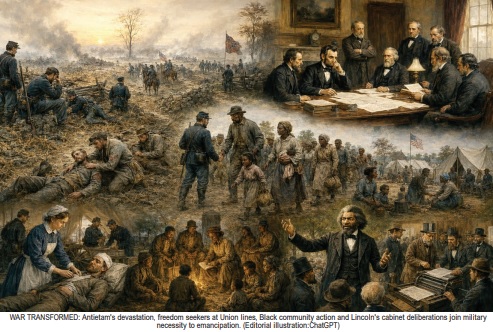 Lee’s first invasion of the North culminated at Antietam Creek in Maryland on September 17, 1862- the bloodiest single day in American military history. Union forces halted the invasion, though McClellan did not destroy Lee’s army. The strategic check gave Lincoln the opportunity to announce a preliminary emancipation policy without making it appear an act of desperation. < The Emancipation Proclamation took effect on January 1, 1863. It declared enslaved people free in areas then in rebellion, exempting loyal slave states and specified Union-occupied districts. It did not immediately liberate every enslaved person. Its power depended upon Union military success, and its constitutional basis lay in presidential war powers. Yet the proclamation changed the conflict irreversibly. It made destruction of slavery an explicit Union war aim, discouraged foreign recognition of the Confederacy and authorized Black enlistment. The document did not create the freedom struggle; it converted that struggle into national policy.
“The war for Union became a war in which Union could no longer be separated from freedom.”
BLACK MEN IN UNION BLUE
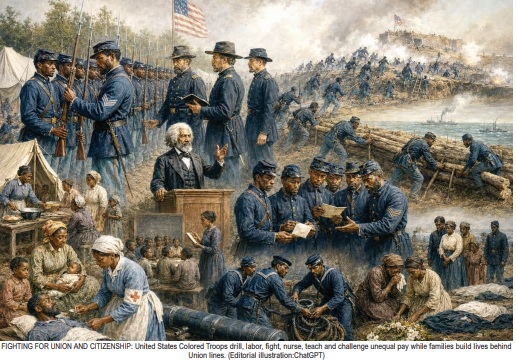 By war’s end, nearly 180,000 Black men had served in the Union Army and roughly 20,000 in the Navy. Many were formerly enslaved; others came from free Black communities. Their service added essential strength and made military sacrifice a powerful claim to citizenship. The 54th Massachusetts became famous for its assault on Fort Wagner in July 1863. Black units served at Port Hudson, New Market Heights and across the theaters, performing combat, garrison and labor duties. They faced unequal pay until 1864, discriminatory assignments and the danger that Confederate captors would execute or reenslave them. The massacre of surrendering Black troops at Fort Pillow revealed that danger. Black women supported recruitment, served as nurses and teachers, gathered intelligence and sustained refugee communities. Frederick Douglass urged enlistment while demanding equal treatment: service, he argued, joined Black freedom to the nation’s survival. The uniform did not end racism, but it transformed the political meaning of belonging.
“A country that accepted Black sacrifice could no longer honestly deny Black citizenship.
THE HOME FRONTS
Civil war entered households through death, absence, inflation, taxation, conscription and scarcity. Women managed farms, businesses and families, worked in arsenals and hospitals, organized relief and sometimes disguised themselves to serve as soldiers. Their responsibilities expanded, though legal and political equality did not follow automatically. DISSENT AND CIVIL LIBERTIES Both governments used conscription and suspended liberties. Lincoln suspended habeas corpus in areas threatened by rebellion and authorized military arrests; critics charged executive overreach. Northern Democrats divided between those supporting the war and “Peace Democrats” seeking negotiation. The 1863 New York City draft riots combined class anger with racist violence, including attacks upon Black citizens.
THE CONFEDERATE HOME FRONT
The Confederacy faced blockade, inflation, food shortages and transportation breakdown. The draft’s exemptions fueled the complaint that it was “a rich man’s war and a poor man’s fight.” Women led bread disturbances and wrote officials demanding relief. Enslaved labor remained indispensable while escape and resistance weakened the system. Desertion grew as soldiers worried about families and local survival.
NATIVE AMERICANS AND IMMIGRANTS
Immigrants served in large numbers in Union and Confederate armies, sometimes confronting nativism within the ranks. Native nations and individuals made different alliances shaped by removal, sovereignty and local divisions; Indian Territory experienced its own brutal civil conflict. The war’s national story crossed many communities without affecting them equally.
“Every battlefield had a home front, and every home front carried battles of its own.”
GETTYSBURG AND VICKSBURG
In summer 1863 Lee invaded Pennsylvania. For three days at Gettysburg, armies fought across ridges, fields and town streets. Union forces held the high ground and repulsed the great Confederate assault on July 3. Lee withdrew to Virginia. The victory ended his most ambitious northern invasion, though the Army of Northern Virginia remained dangerous. On July 4, Vicksburg surrendered to Grant after campaign and siege. The Union gained control of the Mississippi River and split the Confederacy. Together the victories altered strategic momentum, but they did not make the war short. Gettysburg alone produced tens of thousands of casualties; Vicksburg’s civilians endured bombardment, hunger and cave shelter.
GETTYSBURG ADDRESS
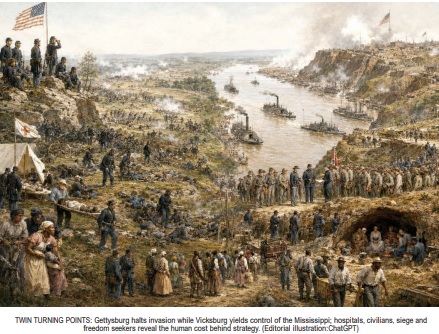 At the cemetery dedication in November, Lincoln spoke for only a few minutes. He connected the war to the Declaration’s equality principle and described a “new birth of freedom.” The speech transformed preservation into democratic renewal: government of, by and for the people must survive not merely as territory, but as an idea tested by sacrifice.
The Revolution created the nation. Gettysburg asked the living to complete its promise.”
ATTRITION, DESTRUCTION AND DEMOCRATIC ENDURANCE
In 1864 Grant became general-in-chief and pressed coordinated campaigns. The Overland Campaignfrom the Wilderness through Spotsylvania and Cold Harbor-produced relentless casualties before the armies settled into trenches around Petersburg. Grant’s strategy exploited Union advantages but imposed terrible costs. Lee’s army could replace neither men nor material at the same rate. William Tecumseh Sherman captured Atlanta and marched to the sea, destroying railroads, military supplies and infrastructure that supported Confederate war-making. His campaign hastened collapse and spread suffering among civilians. Thousands of enslaved people joined the march, seeking freedom and protection; Union policy and logistics often failed them.
THE ELECTION OF 1864
Military frustration endangered Lincoln’s reelection, but Atlanta’s fall strengthened Union morale. Soldiers voted in large numbers, and Lincoln defeated George B. McClellan. The election demonstrated that a republic could conduct a contested national vote during civil war. It also confirmed continuation of war until Union victory and emancipation were secured.
THE COST
Modern estimates place military deaths at roughly three-quarters of a million, though exact numbers remain uncertain. Hundreds of thousands more were wounded; civilians died from violence, disease and deprivation. Communities across the country carried amputations, trauma, bereavement and missing bodies for generations.
“Victory required endurance. Endurance extracted a price no victory could repay.
APPOMATTOX, ABOLITION AND MOURNING
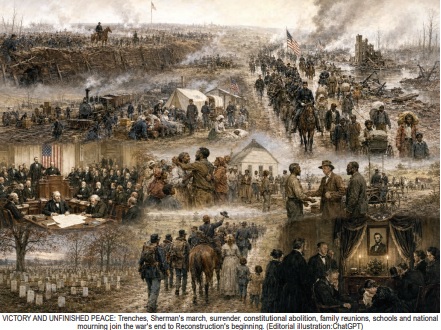 Richmond and Petersburg fell in April 1865. At Appomattox Court House on April 9, Lee surrendered the Army of Northern Virginia to Grant. Grant offered generous terms, permitting officers and men to return home and allowing many to keep horses for spring planting. Other Confederate forces surrendered in the following weeks. The Thirteenth Amendment, passed by Congress in January and ratified in December 1865, abolished slavery throughout the United States except as punishment for crime. Unlike the wartime proclamation, it changed the Constitution. Nearly four million people emerged from bondage and began searching for relatives, legalizing marriages, establishing churches and schools, negotiating labor and claiming citizenship. On April 14, John Wilkes Booth shot Lincoln at Ford’s Theatre; the president died the next morning. Victory turned immediately to mourning. Lincoln’s last public address had cautiously endorsed voting rights for some Black men. His death transferred Reconstruction to Andrew Johnson and deepened uncertainty over how freedom, reunion and justice would be secured.
“The Union survived. Slavery died in law. The struggle to make freedom real had only begun.



Be the first to comment