

FREEDOM CLAIMED, FREEDOM PROCLAIMED, FREEDOM MADE CONSTITUTIONA
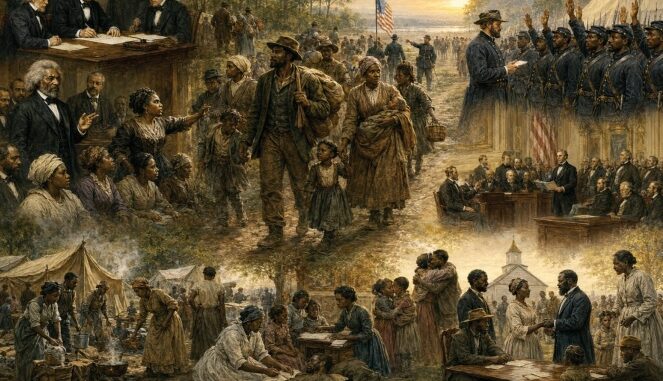
Emancipation was not a single gift bestowed from above. It was freedom claimed by enslaved people, adopted as war policy, defended by Black soldiers, and secured in the Constitution.”
FREEDOM CLAIMED
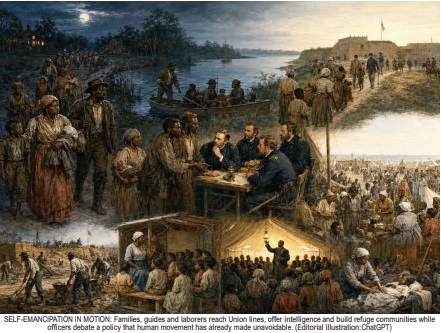
The destruction of slavery began before a final national policy existed. As Union armies entered slaveholding territory, enslaved people read military movement as opportunity. They fled farms, plantations, workshops and cities; guided troops; carried intelligence; withheld labor; protected relatives; and forced commanders to decide whether the United States would return people to those supporting rebellion. At Fort Monroe in May 1861, three men-Frank Baker, James Townsend and Sheppard Mallory-sought refuge after being used to build Confederate defenses. General Benjamin Butler refused their return, reasoning that Virginia treated them as property useful to war and that such property could be held as “contraband.” The label was dehumanizing, but the decision opened a practical path. Thousands followed.
FROM INDIVIDUAL FLIGHT TO MASS MOVEMENT
Self-emancipation was dangerous. Families traveled by night, crossed rivers, risked patrols and arrived at camps with few possessions. Some Union officers protected them; others excluded or exploited them. Yet every arrival weakened slavery’s labor system and made restoration of the old order more difficult.
Before freedom became national policy, enslaved people made it a military fact.
Congress’s Confiscation Acts gradually authorized seizure of property used in rebellion and freed certain enslaved people connected to disloyal owners. The Militia Act of 1862 permitted Black military employment and freedom for those serving, along with their families under specified conditions. Law followed events unevenly. Contraband camps became places of refuge, work, education, worship and family reconstruction. They were also overcrowded, poorly supplied and vulnerable to disease. Black women nursed, cooked, washed, taught, gathered intelligence and organized survival, often without fair pay or recognition. Men built defenses, worked docks and farms, drove teams and later enlisted.
THE PORT ROYAL EXPERIMENT
 On the South Carolina Sea Islands, planters fled after Union occupation, leaving thousands of enslaved people. Northern teachers and reformers arrived, while freedpeople cultivated land, pursued schooling and demanded control over labor and family life. The experiment exposed the central question: would freedom mean only wages under new supervision, or
“Refuge ended an owner’s immediate control. It did not by itself create security.”
THE ROAD TO PROCLAMATION
Lincoln entered office opposing slavery’s expansion but promising not to interfere where it already existed. He regarded preservation of Union as his constitutional duty and feared losing loyal slave states. Abolitionists, Radical Republicans, free Black communities and freedom seekers pressed the administration beyond that caution. Military commanders experimented. John C. Frémont in Missouri and David Hunter in the South issued emancipation orders that Lincoln revoked as premature or beyond authorized policy. Congress abolished slavery in the District of Columbia in April 1862 with compensation to loyal owners, prohibited slavery in federal territories and moved against the interstate return of fugitives by military forces.
MILITARY NECESSITY AND MORAL PURPOSE
By summer 1862 Lincoln had concluded that emancipation was necessary to weaken the rebellion, strengthen the Union and give the war a purpose equal to its sacrifice. He presented a draft to his cabinet and waited for a military success. After Antietam halted Lee’s invasion, he issued the preliminary proclamation September 22. Black abolitionists had long argued that Union and slavery could not both survive. Frederick Douglass pressed for emancipation and Black enlistment. Black churches, conventions, newspapers and women organizers linked freedom to citizenship and equality. The president’s decision was indispensable; so was the movement that made it politically and morally possible.
“Policy changed because war, principle and human action made the old policy impossible.”
FREEDOM PROCLAIMED
The final Emancipation Proclamation took effect January 1, 1863. Acting under war powers, Lincoln declared forever free the enslaved people in states and designated regions still in rebellion. It exempted loyal slave states and specified Unionoccupied areas. It therefore did not free every enslaved person on that day. Critics called the limits hypocrisy. They were also the legal structure of a military measure aimed at enemy-held territory. Wherever Confederate authority remained, the declaration required Union victory to become effective. Wherever armies advanced, enslaved people could invoke national policy and help enforce it through flight, labor, information and military service
. A CHANGE IN THE NATION’S PURPOSE
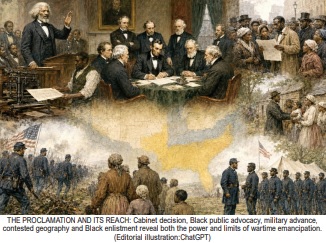 The proclamation made abolition an explicit Union war aim, authorized Black enlistment and made foreign support for the Confederacy more difficult. It announced that restored Union could not simply recreate the nation of 1860. Freedom had entered the definition of victory.
“The proclamation did not finish emancipation. It made emancipation the declared work of the Union.
FREEDOM DEFENDED IN UNIFORM
Black military service gave emancipation armed defenders. Nearly 180,000 Black men served in the Union Army and about 20,000 in the Navy. Many had escaped slavery; others came from free communities. They fought, guarded installations, built fortifications, navigated rivers, carried supplies and occupied territory where freedom had to be made real. They confronted unequal pay, discriminatory assignments, racist abuse and deadly danger if captured. After protest and refusal, Congress equalized pay retroactively in 1864 for many Black soldiers. Their families often lived in precarious camps, while Black women served as nurses, cooks, laundresses, teachers, spies and community leaders. CITIZENSHIP THROUGH SERVICE Enlistment transformed the political argument. A government that armed Black men to defend the nation could not easily return them to legal inferiority without exposing the contradiction. Military service did not automatically secure equality, but it supplied an enduring claim: those who had fought for the Republic were members of it.
JUNETEENTH
On June 19, 1865, Major General Gordon Granger announced General Order No. 3 in Galveston, stating that enslaved people in Texas were free. The date later became Juneteenth, a celebration of liberation and a reminder that freedom arrived unevenly through military authority, information and local struggle.
“Black soldiers did not merely fight within the war. Their service changed what the war could mean.”
FREEDOM LIVED
Formerly enslaved people immediately pursued what bondage had denied: family integrity, movement, education, independent worship, control of labor and recognition before law. Couples legalized marriages. Parents withdrew children and women from coerced field labor when they could. People searched newspapers, letters, military records and distant communities for relatives sold away. Schools appeared with extraordinary speed in cabins, churches and purpose-built rooms. Black teachers, churches and communities supplied initiative and resources, joined by missionary associations and the Freedmen’s Bureau. Education meant literacy, selfgovernment, biblical reading, contracts and protection from deception. LAND AND LABOR Freedom without land left many families dependent upon former enslavers. Special Field Orders No. 15 temporarily reserved coastal land for Black settlement, feeding hopes later summarized as “forty acres and a mule.” President Andrew Johnson restored much land to pardoned owners. Wage contracts and sharecropping emerged, often under coercive conditions. The struggle was no longer over whether a person could be owned, but over whether freedom would carry material independence.
“Emancipation ended ownership. Human dignity required family, learning, livelihood, safety and voice.
FREEDOM MADE CONSTITUTIONAL
Because the proclamation rested upon war powers and did not apply everywhere, national abolition required constitutional change. The Senate approved the Thirteenth Amendment in April 1864. The House initially failed to reach the necessary two-thirds majority, then passed it on January 31, 1865 after intense political effort. Ratification was completed in December. The amendment abolished slavery and involuntary servitude throughout the United States, except as punishment for crime after conviction, and gave Congress power to enforce abolition. It destroyed the constitutional basis of human property and permanently extended emancipation beyond wartime geography.
THE SHADOW OF THE EXCEPTION
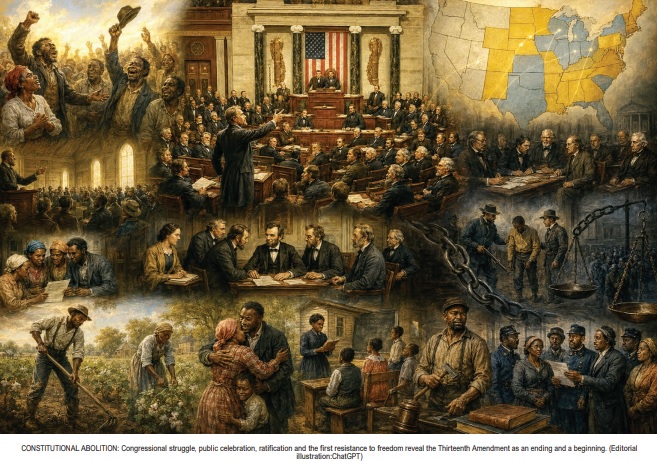 The punishment exception later intersected with discriminatory policing, convict leasing and coerced prison labor. Meanwhile, southern Black Codes restricted movement, labor and legal independence. Abolition removed slavery’s formal ownership relation; institutions could still reproduce coercion under other names. Black veterans, churches, conventions and families demanded civil rights, suffrage, land, education and protection. Their activism pointed beyond abolition toward the Fourteenth and Fifteenth Amendments and the contested project of Reconstruction.
“The Constitution abolished slavery. The nation still had to learn how to honor freedom.”
TOWARDS BUILDING A HUMANISTIC SYSTEM
Emancipation was among the greatest transformations in American history. Nearly four million people ceased to be property in law. The change came through courage from below and power from above: flight and resistance, abolitionist organizing, congressional action, presidential policy, Black enlistment, Union victory and constitutional amendment. Yet freedom could not be measured only by the disappearance of an owner’s title. A humanistic system required recognition of the whole person: the right to family, bodily security, education, worship, movement, fair labor, property, political voice and equal protection. Freedpeople understood this breadth immediately because bondage had violated every part of life. The nation’s challenge was therefore larger than abolition. It had to replace a social order built upon domination with institutions capable of respecting humanity. That work would produce remarkable democratic experiments and fierce counterrevolution. It remains the moral horizon of emancipation.
“Emancipation opened the door of freedom. Justice required building a humanistic system beyond it.



Be the first to comment