
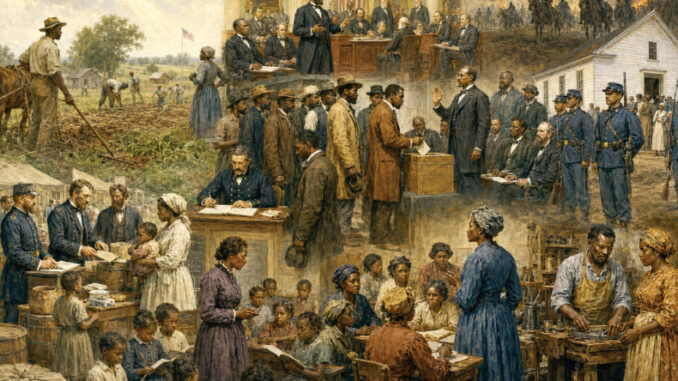

“Reconstruction asked whether emancipation would remain the absence of slavery-or become the presence of citizenship, education, political power and equal protection.”
WHAT WOULD FREEDOM MEAN?
The war ended slavery and preserved the Union, but left fundamental questions unanswered. Who would govern the former Confederate states? What rights would nearly four million freedpeople possess? Would former Confederates regain power? Would the federal government protect citizenship, or would states define freedom narrowly?
Freedpeople answered through action. They reunited families, established churches and schools, legalized marriages, formed mutual-aid societies, negotiated labor, held conventions and demanded land, safety, voting rights and equality before law. Their vision of freedom was not simply release from an owner. It was control over family, movement, work, learning and civic membership.
LINCOLN’S UNFINISHED PLAN
Lincoln favored rapid reunion under loyal state governments and began cautiously considering Black suffrage, especially for educated men and veterans. His assassination left no completed blueprint. Reconstruction became a struggle among President Andrew Johnson, Congress, southern white elites and freedpeople whose claims transformed every policy debate.
“The war destroyed slavery. Reconstruction had to decide what freedom would build.
PRESIDENTIAL RECONSTRUCTION AND BLACK CODES
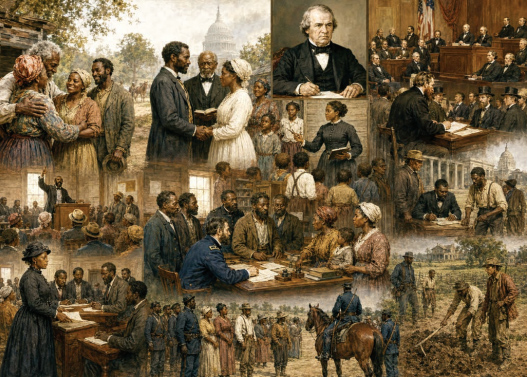
Andrew Johnson, a southern Unionist who held deeply racist views, offered broad pardons and allowed former Confederate states to reorganize quickly. New governments repudiated secession and ratified the Thirteenth Amendment, but many elected former Confederate leaders and enacted Black Codes.
The codes varied by state but sought to restrict movement, labor, contracts, property and legal independence. Vagrancy provisions threatened arrest and forced labor; apprenticeship laws could bind Black children to former enslavers. The objective was to preserve plantation labor and racial control without formal ownership.
THE FREEDMEN’S BUREAU
Created in 1865, the Bureau of Refugees, Freedmen, and Abandoned Lands distributed relief, supported schools, registered marriages, supervised contracts and adjudicated some disputes. Its agents could be essential allies or paternalistic administrators; resources were limited and local hostility intense. Freedpeople used the Bureau strategically while insisting upon their own priorities.
“Slavery had ended in law. The Black Codes attempted to rebuild its power through law.”
CONGRESS TAKES CONTROL
Congress refused to seat many representatives from Johnson’s reconstructed states and investigated conditions in the South. In 1866 it renewed and expanded the Freedmen’s Bureau and passed the Civil Rights Act, declaring U.S. citizenship and equal civil rights regardless of race. Johnson vetoed both measures; Congress overrode him, asserting a new federal responsibility.
THE FOURTEENTH AMENDMENT
Ratified in 1868, the Fourteenth Amendment established national and state citizenship for people born or naturalized in the United States, prohibited states from abridging privileges or immunities, and guaranteed due process and equal protection. Its language became a constitutional foundation for later civil-rights and liberties struggles far beyond Reconstruction.
RECONSTRUCTION ACTS
The Reconstruction Acts of 1867 placed most former Confederate states under military administration and required new constitutions, Black male suffrage and ratification of the Fourteenth Amendment. Johnson resisted congressional policy and narrowly escaped removal after impeachment by the House. The conflict clarified that reunion would occur under congressional conditions.
“Citizenship ceased to depend solely upon the state in which a person lived.”
INTERRACIAL DEMOCRACY
Black men registered and voted in large numbers. Interracial conventions drafted new state constitutions that established or expanded public-school systems, revised taxation, rebuilt infrastructure and broadened democratic participation. Republican coalitions joined freedmen, southern white Unionists and northern migrants.
More than 1,500 Black men held public office during Reconstruction-from local posts and legislatures to Congress. Hiram Revels and Blanche K. Bruce served in the U.S. Senate; Robert Smalls, once enslaved, served in Congress. Black officeholders differed in background and policy, but their presence overturned the assumption that government belonged only to white men.
BLACK WOMEN AND POLITICAL LIFE
Women remained excluded from formal voting, including Black women whose wartime and community labor had been indispensable. They organized schools, churches, aid societies, petitions, labor action and political meetings. The Fifteenth Amendment’s male suffrage language intensified fractures within the women’s-rights movement, including racism among some white suffragists. Black women continued to link race, sex, labor and citizenship.
“For a brief, consequential moment, the South attempted government by an interracial electorate.”
SCHOOLS, CHURCHES AND THE WORK OF INSTITUTION-BUILDING
Education was among freedpeople’s highest priorities. Communities raised money, built schools, hired teachers and crowded classrooms with children and adults. The Freedmen’s Bureau and missionary societies supplied aid, but Black initiative sustained the movement. Reconstruction governments created the South’s first statewide public-school systems, serving white as well as Black children, usually in segregated facilities.
Institutions that became historically Black colleges and universities expanded during this era, including Howard, Fisk, Hampton and others. They trained teachers, ministers and professionals. Black churches became independent centers of worship, education, mutual aid, convention politics and leadership.
FAMILY AND CIVIL SOCIETY
Legal marriage, family reunification and control over children were political achievements as well as personal ones. Mutual-aid societies assisted the sick and bereaved. Black newspapers interpreted events and connected communities. Veterans’ organizations and Union Leagues mobilized voters and defended Republican government.
PUBLIC INVESTMENT
Reconstruction governments have often been caricatured as uniquely corrupt. Corruption did exist, as it did nationally during the era, but these governments also rebuilt devastated states, expanded hospitals and asylums, revised legal systems and invested in roads and education. Their budgets grew partly because government was serving populations long excluded from public provision.
“Democracy became real not only at the ballot box, but in the schoolroom, church and courthouse.”
LAND, LABOR AND THE LIMITS OF FREEDOM
Political rights did not settle economic power. Most freed families received no land and possessed little capital. Johnson restored much confiscated property to pardoned owners, undermining experiments in Black landholding. Without land, many entered wage contracts, tenant farming or sharecropping on white-owned estates.
Sharecropping offered families greater control than gang labor, but crop liens, high interest, dishonest accounting and dependence upon cotton trapped many Black and white farmers in debt. Employers used violence and law to control labor. Freedom of contract meant little when bargaining power was radically unequal.
THE FREEDPEOPLE’S ECONOMIC VISION
Freedpeople sought land not as charity but as the material basis of independence. Some purchased farms, built businesses and entered skilled trades despite discrimination. Black women resisted labor systems that claimed their household work or children. Communities pooled resources through churches, cooperatives and savings institutions, though the collapse of the Freedman’s Savings Bank in 1874 destroyed many depositors’ trust and wealth.
A NATIONAL QUESTION
Reconstruction exposed a continuing American problem: legal freedom can coexist with concentrated economic power. The failure to redistribute land did not negate political achievement, but it left democracy vulnerable to employers, creditors and landlords who could punish political independence.
“Citizenship without economic security was real freedom-but freedom under siege.”
TERROR AGAINST DEMOCRACY
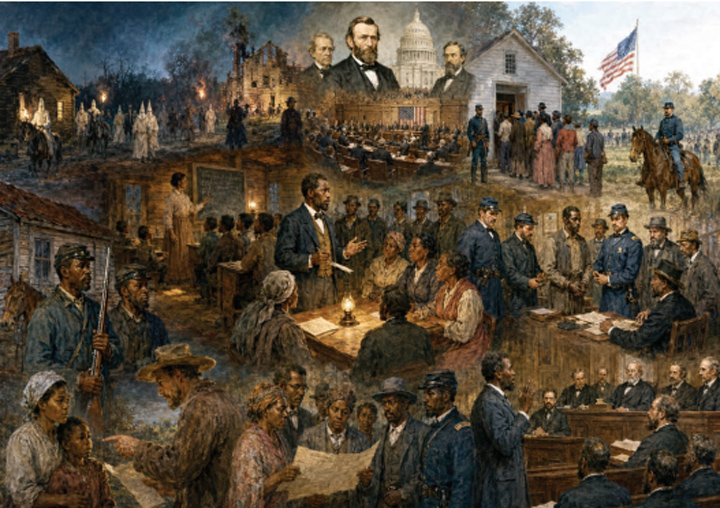
White supremacist organizations-including the Ku Klux Klan-used murder, whipping, arson, sexual violence and intimidation to destroy Republican organization, suppress Black voting and restore white rule. Officials, teachers, ministers, veterans and economically independent families were targeted because they embodied the new order.
Violence was political strategy, not random lawlessness. Employers and landlords combined physical threat with eviction, credit denial and job loss. Massacres at places including Colfax and Hamburg demonstrated that elections could become armed contests.
FEDERAL ENFORCEMENT
Congress passed Enforcement Acts in 1870 and 1871, and the Ku Klux Klan Act authorized federal prosecution and, in limited circumstances, suspension of habeas corpus. President Ulysses S. Grant used troops, marshals and courts to suppress Klan activity in parts of the South. Enforcement produced real results, but new organizations and tactics emerged as national commitment weakened.
“A constitutional right without protection can become a promise offered to the brave and surrendered to the violent.”
THE MAKING OF MODERN AMERICA
Reconstruction did not fail because interracial democracy was impossible. It was overthrown because it threatened entrenched racial and economic power, because violence proved effective, and because federal and northern commitment receded. Within severe limits, its governments and communities achieved extraordinary change.
The Reconstruction Amendments permanently altered the Constitution. The Thirteenth abolished slavery; the Fourteenth defined national citizenship and equal protection; the Fifteenth prohibited denial of voting rights on account of race, color or previous servitude. Later generations would invoke these provisions against segregation, disfranchisement and unequal law.
THE AMERICA WE SEE TODAY
Birthright citizenship, federal civil-rights enforcement, constitutional equality and a multiracial electorate are not later additions detached from the nineteenth century. They were forged in Reconstruction. Public education across the South, Black civic institutions and the principle that states may be held accountable to national rights likewise belong to its legacy.
“Reconstruction was not merely the rebuilding of the South. It was a decisive stage in the making of the America we see today.”


Be the first to comment