

Mistrust between communities accentuated by developmental disparities
“This demand is more than a decade old. Those seeking ST status say it is not only about reservation benefits but also protection of their land. This northeastern state is roughly divided into two regions — a central, fertile riverine valley constituting less than 10 per cent of the state’s land area, surrounded by hills which account for the remaining 90 per cent. This is a peculiarly skewed legacy of the British policy of separating ‘non-revenue hills’ from ‘revenue plains’ after they took control of Manipur in 1891. This was done on the pattern of the revenue administration mechanism they introduced in Assam through the Bengal Eastern Frontier Regulation, 1873. Hence, the Meiteis, who account for about 52 per cent of the state’s population, came to be restricted within the small valley.”

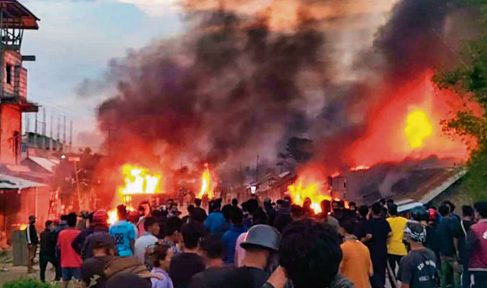
The crisis in Manipur following the outbreak of communal violence between two ethnic groups, Kukis and Meiteis, in several townships is now generally under control, but the situation remains volatile and tense as there are many people dislodged from their homes and taking shelter in relief camps on the campuses of police and paramilitary establishments. The Meiteis see themselves as getting marginalised and thus feel the need for protection through ST status.
Manipur has three major ethnic groups — Nagas, Kukis and Meiteis — the last being the largest. The former two are Scheduled Tribes (ST), and the cause of the present conflict is a demand by a growing section of the latter to also be included in the ST list.
This demand is more than a decade old. Those seeking ST status say it is not only about reservation benefits but also protection of their land. This northeastern state is roughly divided into two regions — a central, fertile riverine valley constituting less than 10 per cent of the state’s land area, surrounded by hills which account for the remaining 90 per cent.
This is a peculiarly skewed legacy of the British policy of separating ‘non-revenue hills’ from ‘revenue plains’ after they took control of Manipur in 1891. This was done on the pattern of the revenue administration mechanism they introduced in Assam through the Bengal Eastern Frontier Regulation, 1873. Hence, the Meiteis, who account for about 52 per cent of the state’s population, came to be restricted within the small valley.While the sparsely populated hills are out of bounds for them, their valley homeland follows the modern land revenue administration, and is open to settlement by any Indian. This being so, over 60 per cent of the state’s population now lives in the valley, while the hills, reserved for the Nagas and Kukis, remain sparsely populated.
In modern times, as their living space has got increasingly crowded, the Meiteis have come to be gripped by a peculiar sense of siege, especially because of layered relations with the hill tribes, which on the one hand are marked by fraternal feelings and on the other by deep mistrust. This mistrust is accentuated by the usual developmental disparities between the hills and the plains, which the residents of the hills see as the outcome of discriminatory policies.
If the Meiteis see themselves as getting marginalized in terms of land and jobs — and thus feel the need for protection through ST status — those who are already part of the ST list see this as a portent of their own slices of the reservation pie getting smaller. They also fear Meitei incursion into the hills if they too become STs. This latter apprehension is a fallacy, for even within existing ST communities, incursions into each other’s traditional territorial boundaries are forbidden, and if and when these happen, can result in violent conflicts, as evidenced by the bloody Naga-Kuki conflict in Manipur in the 1990s.A memorandum urging the state government to send a recommendation to the Centre regarding the Meiteis’ ST status was kept in cold storage for over a decade, probably in view of those within the Meitei community who did not want it, and also the opposition from Nagas and Kukis. Those demanding ST status eventually petitioned the Manipur High Court. On April 19, the court directed the state government to do the needful and forward its recommendation to the Union Government.
This was not taken kindly by the tribal groups and a series of condemnations and protests followed, earning even the ire of the HC. The May 3 rally was the climactic crescendo of these protests. The rally in Churachandpur turned violent when a rumor broke out that the Kuki war heroes’ memorial complex in a suburb bordering the valley district of Bisnupur had been burnt down by Meiteis. A mob went on the rampage, burning down several Meitei settlements around Torbung village. The memorial site was later found intact, but some say a small tyre was found burning outside the gate and this was read as a message of violent intent.There are reasons why the Kukis responded more aggressively than the Nagas. For some time now, a narrative that the Kukis are illegal migrants has been propagated by certain quarters. This is at best a half-truth. Rivals, however, took advantage of it to humiliate the Kukis by dubbing them as ‘refugees’ and it is imaginable how latent anger would have built up within the community.
Again, a peculiar landholding tradition among the Kukis, coupled with an instable subsistence farming which cannot support large populations, has meant a tendency of Kuki villages to periodically splinter and proliferate. Kuki villages are owned by chiefs. Since only one of the chief’s male children would inherit the chieftaincy of the village, other siblings and other capable villagers often part ways to establish their own villages. This has often brought them in conflict with their neighbors in the hills, the Nagas.
In recent times, even government institutions, by insinuation, have been using this tendency of the Kukis to humiliate them. Things came to such a pass that even normal government measures such as eviction drives from reserved forests or the fight against poppy plantations came to be seen as targeting the Kukis. Then, on March 10, in a very arbitrary move, the state Cabinet took the decision to pull out of a tripartite Suspension of Operations (SOO) agreement with two Kuki militant groups, the Kuki National Army and the Zomi Revolutionary Army, from among the 24 who had signed this agreement, again implying that they were party to encroachments in forests for poppy plantations and that they were of foreign origin. The SOO pact being a tripartite truce also including the Union Government, it is unlikely that this rash decision would be okayed, but the hurt the Kukis would have felt is obvious.
(The author is a senior journalist and author)


Be the first to comment