

For most of human history, Earth was the only known example of a habitable world. Even after astronomers discovered planets orbiting other stars in the 1990s, those early finds were often bizarre: giant gas planets skimming dangerously close to their stars, nothing like the familiar terrain beneath our feet. Then, in the mid-2000s, a new class of planet emerged from the data – worlds larger than Earth but smaller than Neptune. Astronomers called them Super-Earths.
Despite the dramatic name, Super-Earths are not necessarily lush paradises or superior versions of our own planet. The term refers only to their size and mass. They typically weigh between two and ten times the mass of Earth, making them the most common kind of planet discovered in our galaxy. Ironically, our own solar system contains none.
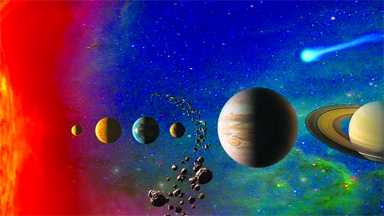
Several astronomers have remarked that Nature seems to prefer making super-Earths and yet we don’t have one in our own solar system.
This realization, that the most common worlds in the galaxy are absent from our cosmic neighbourhood, has reshaped our understanding of planet formation.
The turning point came in 2004, when astronomers using telescopes in Chile discovered a planet orbiting the nearby red dwarf star Gliese 876. This planet, Gliese 876d, was about seven times the mass of Earth. It wasn’t a gas giant. It wasn’t a tiny rocky planet either. It was something in between, the first clear example of a Super-Earth.
Astronomer Eugenio Rivera, one of the scientists involved in the discovery, later recalled the excitement of realizing they had found something entirely new. What stood out was not just the planet itself, but the realization that such worlds might be common. This was not a one-off curiosity; it was a glimpse of a population.
In the years that followed, the Kepler Space Telescope, launched in 2009, transformed this trickle of discoveries into a flood. Kepler monitored more than 150,000 stars, looking for tiny dips in brightness caused by planets passing in front of them. Many of those dips belonged to Super-Earths.
By 2013, NASA scientists announced that Super-Earth-size planets were among the most common types of planets in the Milky Way. The most striking result is just how common small planets are.
What are super-earths actually like?
Super-Earths can vary enormously. Some are rocky, like Earth, but larger. Others may be covered by deep global oceans. Some may have thick atmospheres of hydrogen and helium, resembling miniature versions of Neptune.
Gravity on these worlds would feel very different. A person standing on a Super-Earth might weigh twice or three times what they do on Earth. Mountains could be flatter, crushed under their own weight. The atmosphere, if present, might be thicker and denser.


Be the first to comment