
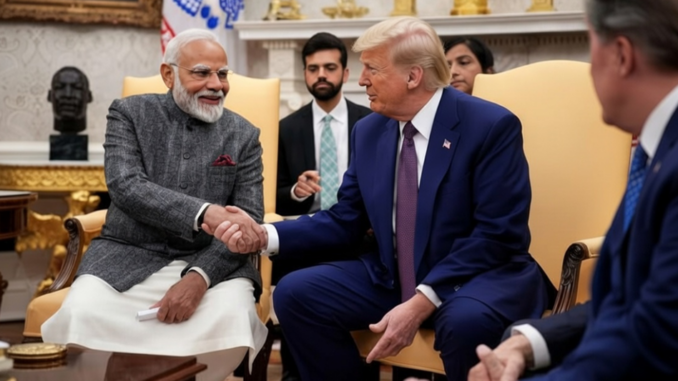

On February 2, 2026, the global trade architecture witnessed its most significant tectonic shift in years. In a move that caught global markets and diplomatic circles by surprise, U.S. President Donald Trump took to Truth Social to announce a comprehensive trade deal with India.
For The Indian Panorama, this is not merely a commercial agreement; it is the formalization of a “Mega Partnership for Prosperity”—a strategic realignment where “Make India Great Again” (MIGA) meets “Make America Great Again” (MAGA).
The Truth Social Thunderbolt: Anatomy of the Announcement
The deal broke through the noise of a stalled 11-month negotiation cycle. President Trump’s post was vintage in its delivery—direct, transactional, and underscored by personal chemistry with Prime Minister Narendra Modi.
“Out of friendship and respect for Prime Minister Modi and, as per his request, effective immediately, we agreed to a Trade Deal… the United States will charge a reduced Reciprocal Tariff, lowering it from 25% to 18%.”
— Donald J. Trump on Truth Social, Feb 2, 2026
Beyond the rhetoric, the data reveals a massive de-escalation. The effective tariff on Indian goods has plummeted from a punitive peak of 50% (which included a 25% base reciprocal tariff plus a 25% “Russian Oil Penalty” imposed in August 2025) down to a flat 18%. In exchange, India has committed to a staggering $500 billion purchase plan of American energy, technology, and agricultural products over the next five years.
The Long Walk to February: A Backstory of Brinkmanship
The road to this agreement was paved with what diplomats call “rancorous stability.” Following PM Modi’s visit to Washington in February 2025, a goal was set to reach $500 billion in bilateral trade by 2030. However, by mid-2025, the relationship hit a “tariff wall.”
The friction points were sharp:
- The Energy Pivot: Washington demanded India cease its massive intake of Russian crude, which had reached 2 million barrels per day by June 2025.
- The Dairy & Agri Deadlock:S. negotiators pushed for access to India’s sensitive dairy and poultry sectors—a political third rail for New Delhi.
- The Reciprocity Rule: President Trump repeatedly labeled India a “tariff king,” specifically targeting duties on American motorcycles, pecans, and tech.
The breakthrough came when Sergio Gor, the U.S. Ambassador to India and a close Trump confidant, arrived in New Delhi in August 2025. Gor successfully navigated the “oil dilemma” by framing a pivot to U.S. and Venezuelan crude not as a concession, but as a strategic diversification essential for India’s energy security.
Key Players: The Architects of the Accord
While the leaders took the spotlight, the heavy lifting was done by a specialized cadre of negotiators who balanced national interests against the clock.
- Team USA: Led by Jamieson Greer (USTR) and Howard Lutnick (Commerce Secretary), with Brendan Lynch acting as the chief technical negotiator. Their focus was “Buy American” and reducing the trade deficit.
- Team India: Led by Piyush Goyal (Commerce Minister) and Rajesh Agrawal (Chief Negotiator). Their mandate was to protect 140 crore citizens, specifically shielding the dairy and sensitive agriculture sectors from zero-duty imports.
The Geopolitical Ripple: Impact on South Asia
This deal fundamentally recalibrates the competitive landscape of South Asia. By securing an 18% tariff rate, India now holds a “competitiveness edge” over its neighbors.
Tariff Comparison for US Imports (2026):
- India: 18% (New Deal)
- Pakistan: 19%
- Bangladesh: 20%
- Vietnam: 20%
- China: 34% – 35%
For South Asian neighbors, this deal is a double-edged sword. While it stabilizes regional security by strengthening the India-US axis, it also forces regional competitors to either innovate or face losing market share in labor-intensive sectors like textiles and leather to a “Duty-Advantaged” India.
The Pivot: Oil, Coal, and $500 Billion
The most “fresh” insight of this deal is the massive energy realignment. India’s commitment to halt Russian oil purchases is a masterstroke of economic statecraft. In November 2025 alone, India’s imports of U.S. crude saw a 47.6% annualized jump to $1.9 billion.
The $500 billion commitment is not just a number—it is an infrastructure plan. It includes:
- Aviation: Orders for over 2,100 aircraft worth an estimated $290 billion.
- Tech: Strategic cooperation in AI, Semiconductors, and Space Tech via the iCET framework.
- Energy: Massive long-term contracts for U.S. LNG and metallurgical coal.
The “MIGA-MAGA” Future: Where We Stand Now
The US-India relationship has officially moved from a “transactional friendship” to a “structural alliance.” The deal removes the existential threat of a trade war that saw the Rupee hit an all-time low of ₹91.98/$ in late 2025. Today, the Rupee is stabilizing, and foreign capital is returning to Indian shores, with Goldman Sachs raising India’s real GDP growth forecast for 2026 to 6.9%.
The future holds a “Deep-Tech” partnership. With the SHANTI Act of 2025 paving the way for civil nuclear cooperation and American tech giants like Google and Microsoft doubling down on Indian data centers, the “limitless potential” Sergio Gor spoke of is finally being papered into reality.
A Strategic Truce is On the Cards -Not Yet!
The 2026 India-US Trade Deal represents a sophisticated geopolitical exchange. By moving away from Russian crude, New Delhi hasn’t just solved a tariff dispute; it has secured a ticket to the high table of the “Silicon Century.”
For years, India’s “Strategic Autonomy” meant maintaining a delicate balance: buying cheap Russian oil while seeking expensive American technology. However, the August 2025 “Russian Oil Penalty”—which spiked effective tariffs to 50%—proved that in the Trump-Modi era, fence-sitting has an expiration date.
By agreeing to halt Russian imports and pivot to US and Venezuelan sources, India has opted for a “Technology First” doctrine. The trade-off is clear: higher energy input costs (mitigated by the 18% tariff de-escalation) are a small price to pay for unhindered access to US semiconductor fabs, AI collaboration (iCET), and the SHANTI Act’s nuclear energy benefits.
Results Over Process: The Personal Diplomacy Factor
In Washington and New Delhi, 2026 marks the end of “diplomacy by committee.” The deal was not born in the halls of the WTO, but in the direct, transactional rapport between two leaders who prioritize immediate economic metrics over long-term bureaucratic stalling.
The “math” is simple: Trump gets a $500 billion win for the US energy and agri-sectors to flaunt on Truth Social, while Modi secures a “Made in India” explosion that bypasses the global trade slowdown. This “Results-First” approach has successfully de-hyphenated India from the “developing nation” bracket, treating it instead as a peer competitor to the world’s largest economies.
The New Indo-Pacific Security Architecture
This trade deal is the economic bedrock of the 2026 National Defense Strategy. By integrating their economies, India and the US have made conflict in the Indo-Pacific too expensive for any adversary to ignore. India is no longer just a “security partner”; it is an economic fortress fueled by American energy and tech, standing as the primary counterweight to hegemony in Asia.
The Economic Result of the Deal (2026-2027 Projections):
- FDI Inflow: Expected to hit a record $110 billion as US funds return to India.
- GDP Growth: Goldman Sachs revised India’s growth to 9% following the announcement.
- Export Revival: Sectors like Textiles, Leather, and MSME engineering are seeing a 20% surge in orders within the first 48 hours.
| Metric | Before Deal (Oct 2025) | After Deal (Feb 2026) |
| Effective US Tariff | 50% | 18% |
| Russian Oil Share | 34% of Imports | Trending to < 5% |
| USD-INR Rate | ₹91.98 | Stabilizing at ₹86.50 |
| US-India Bilateral Trade | Stagnant | Projected $500B by 2030 |
A New Era of Visibility and Strategic Integration
At The Indian Panorama, we view the 2026 Trade Deal as a strategic truce that favors the bold. By formalizing this pact, India has traded its “Russian Oil Autonomy” for “American Tech Primacy,” effectively ending a period where the threat of a 50% punitive tariff loomed over its export economy. In the world of President Trump and PM Modi, the math is simple: results over process.
This deal does not merely lower taxes; it re-anchors the Indo-Pacific. With a US tariff rate of 18%, India now holds a decisive competitive advantage over regional peers like Vietnam (20%), Bangladesh (20%), and Pakistan (19%), while leaving China isolated behind a 47% tariff wall. For the global investor, the signal is clear: India is the undisputed “Counter-China,” backed by the economic might of the world’s largest consumer market and secured by a stable, high-tech supply chain.
The $500 billion commitment—spanning Boeing jets, American LNG, and Pennsylvania coal—is the insurance policy for India’s future growth. As the Rupee stabilizes and the “Famous Five” trade pacts (including the recent EU and UK deals) come into force, India is no longer an “emerging” market; it is a global economic fortress. The era of “Strategic Autonomy” has evolved into an era of “Strategic Integration,” where India’s prosperity is inextricably linked to the leading edge of Western innovation.
Be the first to comment