

India’s Data Center Boom Raises Hard Questions on Sovereignty, Resources, and Who Really Profits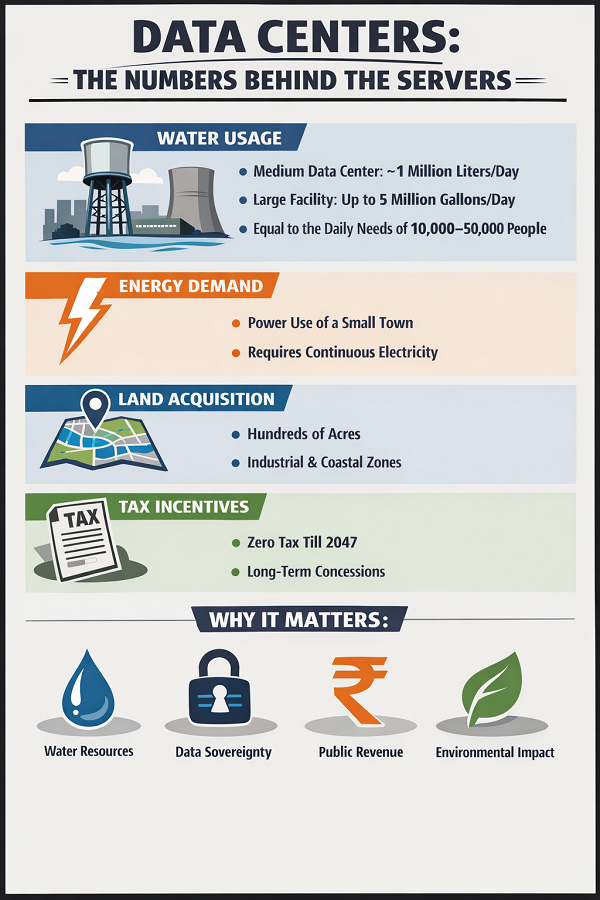

“Zero tax till 2047.”
The phrase sounds visionary — almost patriotic. It suggests foresight, confidence, and a bold leap toward a digital future. We are told that India is positioning itself as the global nerve center of data storage, artificial intelligence infrastructure, and cloud dominance.
The slogan is simple: Data is the new oil.
But there is a crucial second half to that sentence — often left unsaid.
Whoever controls the oil controls power.
And whoever controls the data controls the future.
India stands today at the epicenter of a historic technological transformation. Massive data centers are rising across Navi Mumbai, Telangana, Andhra Pradesh, Maharashtra and other industrial corridors. Government incentives, including extended tax holidays on certain services, have attracted global giants such as Amazon, Google, and Microsoft. Large domestic infrastructure players, including the Adani Group (through Adani Connex), are rapidly building capacity to match anticipated digital demand.
We are told this is development.
But development — if it is to deserve the name — must answer deeper questions beyond concrete, servers, and ribbon-cuttings.
The Questions That Matter
The debate is not whether India should host data centers. Of course it should. Digital infrastructure is critical for economic competitiveness.
The real questions are:
Who are these centers fundamentally designed to serve?
On whose land are they built?
Using whose electricity?
Drawing whose water?
Storing whose data?
And ultimately — generating profit for whom?
These are not anti-growth questions. They are responsible governance questions.
“If resources are Indian, risks are public, but profits are global — can we call it true development?”
Data Centers: The Fortresses of the 21st Century
These are not ordinary buildings.
Every Aadhaar authentication, every UPI payment, every online purchase, every Google search, every WhatsApp message — flows through the servers housed in these facilities.
Data is not passive storage.
It is behavioral intelligence.
It is economic mapping.
It is political insight.
It is predictive modeling.
In earlier centuries, power rested on territory and trade routes. Today, it rests increasingly on information flows.
Even if data is stored physically within Indian borders, the question of ownership and technological control remains critical. Localization alone does not equal sovereignty. Infrastructure ownership structures, software control layers, and backend operational oversight determine who truly commands the architecture of influence.
History teaches us a difficult lesson.
Corporations once came for spices and textiles.
Today, they come for data.
Earlier, extraction was visible.
Now, it is embedded in policy frameworks.
The Water Question: A Resource Reality Check
Perhaps the most uncomfortable aspect of this rapid expansion is rarely discussed in public forums.
A medium-sized data center can consume approximately 1 million liters of water per day for cooling systems.
Large facilities can use millions of gallons daily — equivalent to the daily needs of tens of thousands of citizens.
Meanwhile:
Bengaluru frequently faces water rationing.
Chennai has endured extreme water crises.
Hyderabad experiences seasonal water stress.
Farmers across multiple states struggle for irrigation.
Water is not an infinite resource in India.
When corporate infrastructure is guaranteed continuous supply in water-stressed regions, legitimate policy questions arise about prioritization.
Development must not mean transferring scarce public resources to private gain without transparent long-term justification.
DATA CENTERS: THE NUMBERS BEHIND THE SERVERS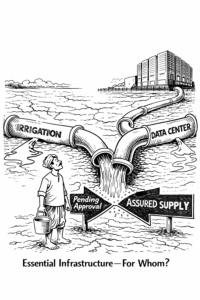
Estimated Water Usage
Medium facility: ~1 million liters/day
Large facility: Up to 5 million gallons/day
Equivalent household support: 10,000–50,000 people
Energy Demand
Large facilities can consume as much electricity as small towns
Require stable, uninterrupted power supply
Land Acquisition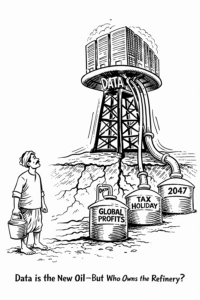
Projects often span hundreds of acres
Located near industrial corridors and coastal regions
Tax Incentives
Extended exemptions on selected services
Long-term fiscal concessions to boost sector growth
Why It Matters
Resource allocation in water-stressed states
Sovereignty over data infrastructure
Long-term public revenue considerations
Environmental sustainability accountability
We hear of renewable energy transitions, carbon neutrality targets, efficient cooling technologies.
But transparency remains limited. Public environmental audits are not easily accessible. Community-level engagement is minimal. Independent oversight data is sparse.
If these projects are genuinely sustainable, then full disclosure should strengthen their credibility — not weaken it.
Development strengthened by transparency creates trust. Development shielded by opacity creates suspicion.
The 2026 Policy Incentive: Strategic Vision or Structural Imbalance?
Tax exemptions extending as far as 2047 are not small gestures.
While India must remain competitive in attracting investment, extended fiscal concessions must be balanced against public revenue needs.
At a time when:
Small businesses face heavy compliance burdens,
Infrastructure sectors seek subsidy reform,
States struggle with fiscal pressures,
granting prolonged relief to multinational digital corporations demands careful public evaluation.
No nation thrives by ignoring opportunity. But no democracy thrives by avoiding scrutiny.
Growth — Yes. Blind Alignment — No.
This is not an argument against foreign investment.
This is not an argument against digital growth.
This is not nostalgia for a pre-technology India.
India must lead in AI.
India must host cloud infrastructure.
India must secure its digital backbone.
But ambition must travel with accountability.
If:
Resources are domestic,
Environmental burden is local,
Cyber risks are national,
Public incentives are generous,
then oversight must be equally robust.
“Corporations maximize return. Nations must maximize public good.”
The Core Concern
There is a line separating partnership from dependency.
There is a difference between investment and influence.
There is a distinction between hosting infrastructure and surrendering leverage.
India’s digital future should be bold — but sovereign.
The age of servers must not become the age of silent extraction.
Because in the digital century, extraction is no longer visible cargo leaving ports. It is invisible value flowing through fiber-optic cables.
Final Reflection
Nations are strengthened — not weakened — by asking difficult questions.
Confident democracies invite scrutiny.
Visionary leadership welcomes transparency.
Enduring development ensures fairness.
If India structures its digital expansion wisely, data centers can become pillars of technological leadership and economic prosperity.
But if policy tilts excessively toward concentrated corporate benefit without sustained public oversight, we risk repeating historical patterns — in modern form.
History does not repeat itself identically.
It evolves.
Once, extraction arrived by ship.
Now, it arrives by server.
The responsibility lies not in rejecting progress, but in shaping it.
Because when land, water, electricity and policy converge around one sector, the guiding compass must remain national interest.
And in a democracy, asking questions is not obstruction. It is duty.
(Dave Makkar is a social activist. He can be reached at davemakkar@yahoo.com)



Be the first to comment