
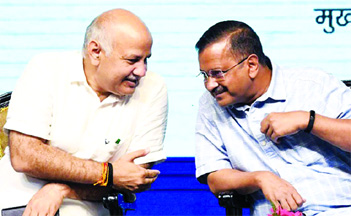

New Delhi (TIP): A Delhi court on Friday, Feb 27, acquitted former Delhi chief minister Arvind Kejriwal, his then deputy Manish Sisodia and others, including K Kavitha, Bijay Nair and Durgesh Pathak, in the alleged excise policy scam. The Rouse Avenue Court ruled that there was no evidence of criminal conspiracy or wrongdoing in the formulation of the excise policy. Special Judge (PC Act) Jitender Singh passed the order closing the case initiated by the Central Bureau of Investigation (CBI) against all the accused.
“There was no overarching conspiracy or criminal intent in the excise policy,” the judge said.
The case stemmed from a complaint by L-G VK Saxena in 2022 to the CBI and subsequently the probe agency had registered a First Information Report.
The probe agency had said that the Aam Aadmi Party (AAP) and its leaders received kickbacks from liquor manufacturers due to manipulation of the policy. The Enforcement Directorate (ED) also later registered a case under the Prevention of Money Laundering Act (PMLA).
The Delhi government had implemented the new excise policy on November 17, 2021, but scrapped it at the end of September 2022 amid allegations of corruption.
The profit margin of wholesalers was increased from 5 per cent to 12 per cent under the new policy, the probe agencies alleged.
The new policy resulted in cartelisation and those ineligible for liquor licences were favoured for monetary benefits, the agencies alleged. However, Sisodia denied any wrongdoing and claimed the new policy would have led to an increase in the city government’s revenue. The court held that the excise policy case did not disclose any larger conspiracy or criminal intent.
It observed that the prosecution’s case failed to withstand judicial scrutiny, noting that the CBI had attempted to build a conspiracy narrative based largely on conjecture.
On this basis, the court found that no prima facie case was established against any of the 23 accused.
The court also criticised the agency’s reliance on approver statements, cautioning that such an approach undermines constitutional safeguards.
The judge remarked that granting pardon to an accused and then using that person’s testimony to bridge investigative gaps or implicate additional persons was improper, adding that permitting such practices would amount to a serious violation of constitutional principles.


Be the first to comment