

Jaipur, the capital of Rajasthan, is a city where history, architecture, and vibrant culture blend seamlessly to create a timeless travel experience. Known as the Pink City for the distinctive terracotta hue of its old buildings, Jaipur offers visitors a glimpse into the grandeur of Rajput royalty alongside the lively rhythms of modern life. From magnificent palaces and imposing forts to bustling bazaars and traditional cuisine, Jaipur stands as one of India’s most fascinating travel destinations.
Founded in 1727 by Maharaja Sawai Jai Singh II, Jaipur was one of the first planned cities in India. Its broad avenues and symmetrical layout reflect the ruler’s interest in astronomy and architecture. Today, Jaipur forms an important part of the famous Golden Triangle tourist circuit along with Delhi and Agra, attracting travelers from across the world.
Places To Visit
Amer Fort
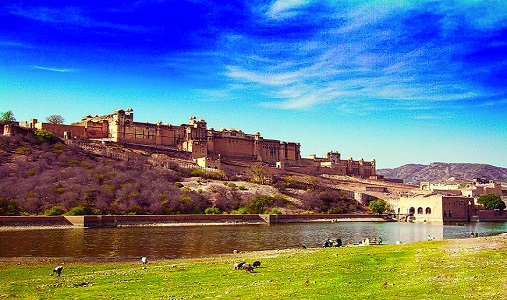
Cradled on the top of a hill near Jaipur lies the Amer Fort, one of the most magnificent palaces in India. Also commonly known as the Amber Fort, this majestic building with its maze-like passages and serpentine staircases is an architectural masterpiece and with significant importance in Indian history. Only 11 kilometres away from Jaipur, Amer Fort is clad in pink and yellow sandstone and is a part of an extensive complex. Built by one of the most trusted generals of Akbar, Maharaja Man Singh I in the year 1592, Amer Fort served as the main residence of the Rajput Rulers.
The Amer Fort through its large ramparts, several gateways and paved paths overlooks the Maotha Lake in the town of Amer, which used to serve as the capital of the erstwhile Jaipur princely state. The fort is big enough that it will take you at least two to three hours to explore it in detail, and you can also choose to avail of the audio guides to lead you through this fascinating building while explaining the history of the place. Getting an elephant ride up the stairs to the Amber Fort is also a popular tourist activity. The fort sees over five thousand visitors daily and rightfully, the Amer Fort was inducted into UNESCO World Heritage Site list as part of the “Hill Forts of Rajasthan” along with five other forts.
Hawa Mahal
The massive edifice of Hawa Mahal stands at the intersection of the main road in Jaipur, Badi Chaupad and was built by Maharaja Sawai Pratap Singh in the year 1799. Hawa Mahal derives its name from its unique structure, which is a mesh of small windows that allowed cool wind to enter the palace and hence kept the palace comfortable during the hot summer months. The main reason behind the palace’s construction was to allow the women of the royal house to observe the festivities on the streets whilst being unseen from the outside as was the custom of the land. It is located right on the edge of the City Palace Jaipur and extends right to the ‘zenana’.
Hawa Mahal is a structure made of red and pink sandstone and has a pyramidal structure which almost resembles a crown. It has been embellished with 953 tiny windows, also known as ‘Jharokhas’ and embellished with gorgeous latticework. From within, the Hawa Mahal palace is based on five floors each of which has a uniquely decorated chamber. A charming fountain welcomes you inside the main palace, from whereon you can make your way up to the different floors. The top of the palace offers a brilliant view of the City Palace, Jantar Mantar and the ever-busy Siredeori Bazar. There is a small museum as well which holds some rich relics and miniature paintings.
Jantar Mantar
Located near the City Palace in the regal city of Jaipur, Jantar Mantar is the largest stone astronomical observatory in the world. Owing to its rich cultural, heritage and scientific value, Jantar Mantar in Jaipur has also been featured on UNESCO’s list of World Heritage Sites. This ancient study boasts of nineteen instruments built out of stone and brass and was built by Raja Sawai Jai Singh in 1727-33. The intelligent construction and placement of these instruments allowed the observers to note the position of heavenly bodies with their naked eye alone. Time has failed to lay dust upon this engineering marvel and it still works as well as it used to in the olden times.
Nahargarh Fort
Nahargarh Fort, situated on the outskirts of Jaipur, is known for breathtaking views of the city and for its extended wall that connects it to Jaigarh Fort. Embellished with delicate carvings and stonework, the Nahargarh Fort is an impregnable structure and together with its two neighbouring forts – Amer and Jaigarh once stood as the strong defence of Jaipur city. The Fort was built by Maharaja Sawai Jai Singh II in the year 1734 as a retreat. The Padao Restaurant is also a must-visit if you’re near Nahargarh Fort from where you’re sure to enjoy a panoramic view of the city of Jaipur.
Galta ji Temple
Located on the outskirts of the regal city of Jaipur, Galtaji Temple is a prehistoric Hindu pilgrimage site. Outlined by the striking Aravalli hills, it consists of several shrines, holy kunds, pavilions and natural springs. This majestic temple is situated at the heart of a hilly terrain that is bounded by a beautiful gorge that attracts tourists here every year. Galtaji Temple was built using pink colour sandstone and is a vast temple complex housing varied shrines. Located inside the City Palace, the walls of this temple are beautifully adorned with carvings and paintings that make this place worth visiting. The Galtaji temple is unique in its architecture and has been constructed like a palace.
It is situated in the Aravalli hills and is bound by thick plush trees and bushes. This remarkable building is decorated with painted walls, round roofs and pillars. Apart from the kunds, this pre-historic Hindu pilgrimage place also has temples of Lord Ram, Lord Krishna and Lord Hanuman within the temple. One of the main tourist destinations of Jaipur, the temple complex boasts of natural freshwater springs and seven holy ‘kunds’ or water tanks. Among these kunds, the ‘Galta Kund’, is the holiest one and is believed never to get dry.
I got what you mean ,saved to bookmarks, very nice site.