
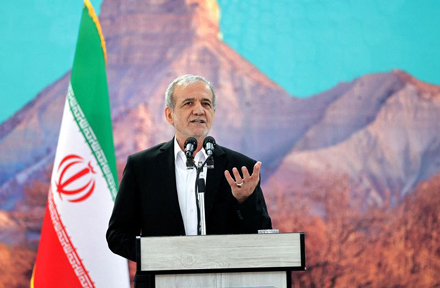

As US President threatens to bomb Iran into the Stone Age, Pezeshkian writes a letter
“The US President is not merely wreaking havoc but is seeking to shape a post-war Iran, ensuring that its economic recovery and reconstruction will be long and painful. As such, his rhetoric needs to be taken with deadly seriousness. Clearly, “regime change” is no longer on the US-Israel agenda, but wishing to send Iran back to the “Stone Age” is playing itself out before the entire world. This is an assault on a people who just two months ago were, quite ironically, assured by Trump that “help is on its way”.”
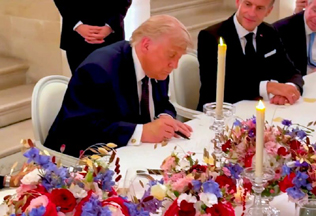
Two contrasting messages were sent on April 1 by the principal protagonists of the ongoing war in West Asia. One was a much-anticipated speech by US President Donald Trump, while the other was a “Letter to American People” by Iranian President Masoud Pezeshkian.
In a made-for-television address, Trump eventually had nothing new to say as he rehashed his social media posts and media comments. There was no mention of unblocking the Strait of Hormuz, under the chokehold of Iran’s Revolutionary Guard Corps Navy (IRGC-N), nor of inserting US ground troops, massed in their thousands across the region, into Iran.
The strait, through which one-third of global energy flows, remains under the IRGC’s control. Financial and commodity indices, monitored closely by Trump, are steadily trending upwards, while countries from Australia to Egypt are facing fuel shortages and shutdowns. The entire global economy is on edge, with the International Monetary Fund (IMF) predicting a recession. Till date, Trump has been cleverly manipulating markets, aligning his comments to shape them. No longer, it seems. Stock markets are now moving more in line with battlefield developments rather than Trump’s comments.
Pezeshkian’s letter — penned in English, not Farsi — was circulated widely on social media. Given the country’s official stance of hostility towards the US, this is an unusual, perhaps even brave, message. Both sides have previously exchanged letters at the highest levels, but such a public outreach by a sitting Iranian President has no historical precedent. After all, the two countries broke off diplomatic ties in 1979 following the kidnapping of US diplomats stationed in Tehran. Pezeshkian is now seeking to set the record straight on Iran-US relations, that these were “not originally hostile”, and goes on to lay the blame for the current conflict entirely on the US and Israel.
Pezeshkian’s plea is mature and subtly goes beyond a US audience. He addresses the world by saying that attacking Iran’s vital infrastructure constitutes a war crime, that these “generate instability, increase human and economic costs, and perpetuate cycles of tension, planting seeds of resentment that will endure for years”. Chronologically, it needs to be noted, Iran’s strikes on infrastructure in the region, as opposed to military targets, were usually reactive and not proactive.
In his address, Trump doubled down on a globally unpopular war. He appeared reasonable while simultaneously renewing his trademark threats, declaring, “We are going to hit them (Iran) extremely hard over the next two to three weeks. We are going to bring them back to the stone ages where they belong. In the meantime, discussions are ongoing… We have all the cards; they have none.”
An unfazed Iran, confident that it currently holds the upper hand, taunted US troops to “come closer.” One Iranian analyst succinctly noted that an aerial assault from 36,000 feet is vastly different from “manly” combat at six feet.
Trump’s address is also replete with contradictions. He claims completion of “core strategic objectives,” but elsewhere in the same address, he says that “we will continue until our core objectives are fully achieved”. This contradiction is deliberate, not random.
It is directed at a target audience of critical importance to him, electorally and financially. The former is an increasingly nervous MAGA base, which he has assuaged by saying “we are winning, bigly”. The latter is a band-aid, a placebo, to the six Persian Gulf countries witnessing, in real time, the devastation of the entire foundations on which their economies were built.
The US President’s coarse and insulting language towards Saudi Crown Prince Mohammed bin Salman and the Kuwaitis simplifies complex issues to a populist base unconcerned with niceties.
Trump is essentially signaling a further escalation, which could last several more weeks. In recent days, the US and Israel have sharply expanded their bombing campaign, going beyond military targets to strike at the very heart of Iran’s society and industrial base. They have bombed two of Iran’s steel plants, a pharmaceutical factory, civilian installations, gymnasiums and residential areas. The Mobarakeh steel plant in Isfahan is, in fact, the largest in West Asia. As one analyst describes it, “Steel sits at the core of infrastructure, construction and industrial circulation. Damage it, and the effects cascade far beyond one sector”.
The US President is not merely wreaking havoc but is seeking to shape a post-war Iran, ensuring that its economic recovery and reconstruction will be long and painful. As such, his rhetoric needs to be taken with deadly seriousness. Clearly, “regime change” is no longer on the US-Israel agenda, but wishing to send Iran back to the “Stone Age” is playing itself out before the entire world. This is an assault on a people who just two months ago were, quite ironically, assured by Trump that “help is on its way”.
Trump is also casually papering over a military quagmire into which he has drawn the entire US CENTCOM (Central Command), and, for us in India, the US PACOM (Pacific Command), a theatre of vital importance. US military assets are being relocated from East Asia to replenish the losses in West Asia. Till date, the Iranians have destroyed half a dozen THAAD radar systems, decapitated the US’s most complex radar array at the Al-Udaid base in Qatar and with pinpoint precision destroyed E3 Sentry surveillance aircraft, KC 135 air refueling tankers and other surveillance aircraft. This is just a small inventory of what the Iranians have managed to destroy, apart from the devastating damage inflicted on US bases.
Meanwhile, ongoing mediation talks, being brokered by Pakistan, Egypt, Saudi Arabia and Turkey, don’t appear to be making much headway. So also is the Pakistan-China “5-point initiative”. The latter is heavy on optics and light on substance, a classic diplomatic feint, which will please none and achieve nothing.
The reality is that the US and Iran are locked in maximalist positions. Iran’s Foreign Minister Abbas Araghchi made this abundantly clear, saying that Iran has neither been consulted nor is it in any way engaged in the mediation. Araghchi also says these are not negotiations but merely an exchange of messages.
He rejected any claims of a ceasefire, saying that Iran seeks a complete and perpetual cessation of all hostilities and compensation for damages. The danger, as always with the Iranians, is their tendency to overplay their hand and not know when to fold their cards.
(Gaddam Dharmendra is a nonresident senior fellow at Carnegie India. He joined the Indian Foreign Service in 1990 and served in various capacities in Indian Missions across the world and at the Ministry of External Affairs, South Block. His overseas assignments include stints at Indian Missions in Tehran, Dushanbe, Washington D.C., and Dhaka.)

Be the first to comment