

In a world often defined by divisions-of class, caste, religion, and privilege-Sikhism offers a profoundly simple yet revolutionary response: serve all, feed all, and see the Divine in all. At the heart of this vision lie two foundational pillars-seva (selfless service) and langar (the community kitchen). Together, they form one of the most powerful expressions of equality and compassion in human history.
More than rituals, seva and langar are living practices-quietly transformative, deeply spiritual, and radically inclusive.
The Spirit of Seva: Service Without Self
The concept of seva in Sikhism is rooted in humility, compassion, and the complete absence of ego. It is not charity in the conventional sense; it is an act of devotion-an offering to the Divine present in every human being.
The origins of this philosophy can be traced to Guru Nanak Dev Ji, who emphasized that true spirituality lies not in renunciation, but in active engagement with the world through honest living and service to others. For him, feeding the hungry, helping the needy, and uplifting the downtrodden were not social duties alone-they were sacred acts.
Seva takes many forms within Sikh practice:
– Preparing and serving food in langar
– Cleaning Gurdwaras (kar seva)
– Volunteering in humanitarian efforts
– Supporting those in times of crisis
What distinguishes seva is its intention. It is performed without desire for recognition or reward, dissolving the ego and fostering a deep sense of unity with humanity.
The Birth of Langar: A Vision of Equality
The institution of langar-one of Sikhism’s most enduring contributions to humanity-was established by Guru Nanak Dev Ji and later expanded and institutionalized by Guru Amar Das Ji.
At a time when rigid caste hierarchies governed Indian society, the idea of people from all backgrounds sitting together to share a meal was nothing short of revolutionary. Langar dismantled these barriers with quiet defiance.
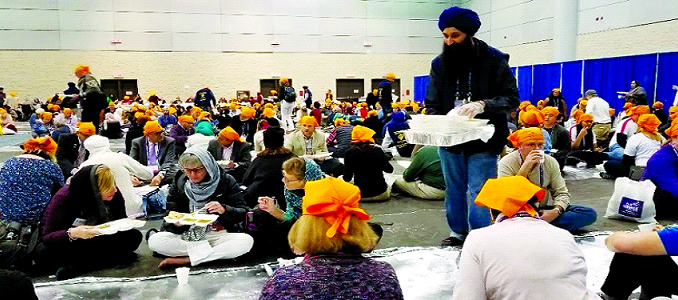
Every person, regardless of social status, wealth, gender, or religion, is welcomed to sit in a single row-pangat-and partake in the same simple, vegetarian meal. No one is served differently. No one is considered superior.
In this act of shared food, equality is not preached-it is practiced.
The Living Tradition: Langar in Every Gurdwara
Today, langar is an inseparable part of every Gurdwara across the world. From small village shrines to grand institutions, the community kitchen remains open to all, every day.
At Harmandir Sahib-the Golden Temple-langar serves tens of thousands of people daily, making it one of the largest free kitchens in the world. Here, volunteers from all walks of life come together to cook, serve, and clean, embodying the spirit of seva.
The meal itself is intentionally simple-typically consisting of roti, dal, vegetables, and kheer. The simplicity ensures that the focus remains on equality and nourishment rather than indulgence.
But beyond food, langar offers something far deeper: dignity, belonging, and a sense of shared humanity.
Seva in Action: Beyond the Gurdwara
While langar is the most visible expression of seva, the spirit of service extends far beyond the walls of the Gurdwara.
In times of natural disasters, humanitarian crises, and global emergencies, Sikh communities have consistently risen to serve. Whether it is distributing food during floods, organizing relief during pandemics, or feeding the homeless in cities around the world, seva becomes a powerful force for good in action.
Organizations inspired by Sikh values have taken langar to the streets-serving meals at refugee camps, hospitals, and disaster zones-demonstrating that compassion knows no boundaries.
The Philosophy Behind the Practice
Seva and langar are not isolated practices; they are deeply rooted in the teachings of the Guru Granth Sahib.
The scripture repeatedly emphasizes:
– The futility of ego and pride
– The importance of humility and compassion
– The interconnectedness of all beings
– The presence of the Divine in every individual
To serve others, therefore, is to serve God. To feed the hungry is to honor the Divine within them.
This philosophy transforms everyday actions into spiritual practice. Washing dishes, kneading dough, or serving water becomes a form of meditation-an expression of love and devotion.
Breaking Barriers: Equality in Practice
Perhaps the most radical aspect of seva and langar is their challenge to social hierarchies.
Historically, Guru Amar Das Ji required even kings and nobles to sit in the langar before meeting him. This act reinforced a simple yet profound truth: in the eyes of the Divine, all are equal.
Even today, this principle continues to resonate. In a langar hall, distinctions dissolve. Wealth, status, and identity fade away, replaced by a shared human experience.
In a world still grappling with inequality, this model offers a powerful blueprint for social harmony.
A Global Symbol of Compassion
As Sikh communities have spread across the world, so too has the tradition of langar. From London to Vancouver, from New York to Nairobi, Gurdwaras serve as centers of nourishment and refuge.
Langar has become a global symbol of compassion-recognized not only as a religious practice but as a humanitarian model. It demonstrates that feeding people is not just about addressing hunger; it is about restoring dignity and building community.
A Quiet Revolution
Seva and langar may appear simple on the surface-acts of service and shared meals-but their impact is profound. They challenge deeply ingrained social structures, nurture humility, and create spaces where equality is lived rather than merely spoken.
In every roti prepared, every plate served, and every floor cleaned, the spirit of Sikhism comes alive-not in grand declarations, but in quiet, consistent acts of kindness.
In a divided world, seva and langar stand as a gentle yet powerful revolution-reminding us that the path to the Divine begins with serving humanity.



Be the first to comment