
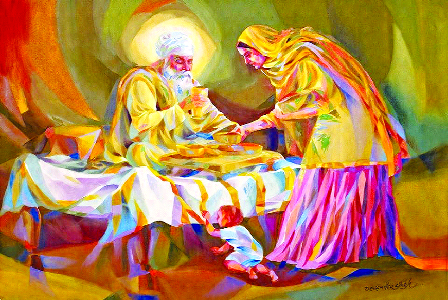

Sikhism stands as one of the most progressive spiritual traditions in the world when it comes to gender equality. From its very inception in the 15th century, the faith has upheld the dignity, agency, and spiritual sovereignty of women. Rooted in the teachings of Guru Nanak Dev Ji and carried forward by successive Gurus, Sikhism rejects all forms of gender discrimination and affirms that women are equal participants in both spiritual and temporal life. The Sikh vision of womanhood is not one of subordination, but of strength, wisdom, leadership, and divine grace.
The Foundational Vision: Guru
Nanak’s Radical Equality
The foundation of gender equality in Sikhism lies in the revolutionary teachings of Guru Nanak Dev Ji (1469-1539). At a time when women in South Asia were subjected to practices such as purdah (veiling), sati (widow immolation), and denial of education, Guru Nanak openly challenged these norms.
One of his most powerful proclamations remains central to Sikh philosophy:
“So kyo manda aakhiye jit jamme rajaan”
Why call her inferior, from whom kings are born?
This statement is not merely poetic-it is a theological assertion that women are the source of life and deserve reverence, not marginalization. Guru Nanak emphasized that both men and women are equal before the Divine and equally capable of achieving spiritual liberation (mukti).
Scriptural Affirmation: Equality in the Guru Granth Sahib
The Sikh holy scripture, the Guru Granth Sahib, reinforces the principle of equality. It contains no injunctions that restrict women’s participation in religious or social life. On the contrary, it speaks of the soul (atma) beyond gender, emphasizing devotion, humility, and remembrance of God (Naam) as the true markers of spiritual progress.
The Guru Granth Sahib rejects caste, ritual hierarchy, and gender bias, establishing a universal spiritual framework where all human beings are equal manifestations of the Divine.
Women in Early Sikh History: Leadership and Courage
Sikh history offers numerous examples of women who embodied courage, resilience, and leadership.
Mata Khivi: Seva and Institution Building
Mata Khivi played a pivotal role in the development of the langar (community kitchen). Under her supervision, the langar became a powerful institution promoting equality, where people of all backgrounds sat together and shared food. Her contributions are so significant that she is the only woman mentioned by name in the Guru Granth Sahib.
Bibi Bhani: Devotion and Legacy
Bibi Bhani, the daughter of Guru Amar Das and wife of Guru Ram Das, is remembered for her deep devotion and service. Her lineage continued the Guru tradition, as she was the mother of Guru Arjan Dev Ji.
Mai Bhago: Warrior Saint
Mai Bhago stands as a symbol of martial valor and spiritual strength. During a critical moment in Sikh history, she rallied deserters and led them into battle alongside Guru Gobind Singh. Her bravery in combat and unwavering faith embody the Sikh ideal of the saint-soldier.
Institutional Equality: Reforms
of the Sikh Gurus
Subsequent Gurus institutionalized gender equality through concrete reforms:
– Guru Amar Das strongly opposed practices like sati and purdah, advocating widow remarriage and women’s participation in religious life. He appointed women as preachers and leaders of congregations (manjis), a radical move for the time.
– Guru Gobind Singh further reinforced equality through the creation of the Khalsa in 1699. Women were given the surname “Kaur” (meaning princess or sovereign), symbolizing dignity and independence, while men took “Singh” (lion). This eliminated caste markers and affirmed equal identity.
The Khalsa and the Saint-Soldier Ideal
The Khalsa tradition emphasizes the concept of the Sant-Sipahi (saint-soldier), which applies equally to women. Sikh women are encouraged to cultivate spiritual discipline alongside courage and readiness to defend justice.
Initiated Sikh women (Amritdhari Kaurs) are expected to uphold the same code of conduct as men, including wearing the Five Ks (articles of faith). This reinforces the idea that women are not passive participants but active defenders of righteousness (dharma).
Women in Sikh Religious Practice
In Sikhism, there are no restrictions on women’s participation in religious activities. Women can:
– Lead prayers (Ardas)
– Perform kirtan (devotional singing)
– Read from the Guru Granth Sahib
– Conduct ceremonies, including marriages (Anand Karaj)
– Serve in gurdwara management committees
This inclusivity reflects the core Sikh belief that spiritual authority is not determined by gender but by devotion and understanding.
Contemporary Realities: Progress and Challenges
While Sikh teachings advocate equality, the lived realities of Sikh women sometimes reflect broader societal challenges. In regions like Punjab, cultural practices influenced by patriarchy may still affect women’s roles in family and society.
Issues such as gender bias, female foeticide, and unequal access to opportunities persist, not because of Sikh doctrine, but due to social conditioning. However, Sikh women across the world continue to challenge these barriers.
Prominent Sikh women today are making their mark in diverse fields-politics, academia, military service, and activism-carrying forward the legacy of equality envisioned by the Gurus.
Symbolism of “Kaur”: Identity and Sovereignty
The surname “Kaur” is more than a title-it is a declaration of independence and self-respect. Introduced by Guru Gobind Singh, it signifies that every Sikh woman is a sovereign individual, not defined by marital status or lineage.
This naming convention dismantled patriarchal structures that tied a woman’s identity to her father or husband, giving her an autonomous spiritual and social identity.
Feminine Spirituality in Sikh Thought
Sikhism often uses the metaphor of the soul-bride longing for union with the Divine Husband (Waheguru). This symbolism elevates feminine qualities such as love, devotion, and surrender as universal spiritual ideals applicable to all, regardless of gender.
Thus, femininity in Sikhism is not limited to women-it becomes a spiritual paradigm for all seekers.
A Living Legacy of Empowerment
Women in Sikhism are not peripheral figures; they are central to its spiritual and historical narrative. From the egalitarian teachings of Guru Nanak Dev Ji to the martial courage of Mai Bhago, Sikh tradition celebrates women as equal partners in the journey of faith and justice.
The Sikh vision of society is one where women are leaders, warriors, nurturers, and spiritual guides. While challenges remain in practice, the doctrinal foundation is unequivocal: women are equal, powerful, and indispensable.
In a world still grappling with gender inequality, Sikhism offers a timeless and transformative model-one where equality is not an aspiration, but a sacred truth.


Be the first to comment