
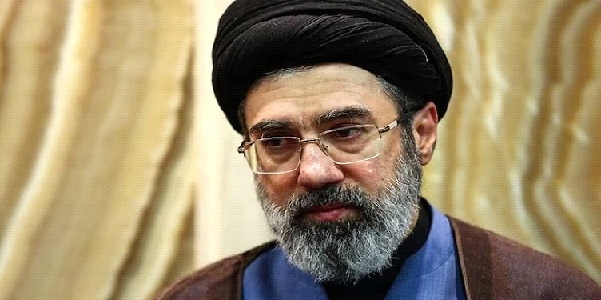

Tehran (TIP): Iran’s supreme leader is alive, conscious and engaged — but largely unseen, unheard and increasingly sidelined.
A detailed report by The New York Times reveals that Mojtaba Khamenei, who took over after the killing of his father, has been gravely injured and is now operating from hiding, with limited ability to communicate.
“Though Mr. Khamenei was gravely wounded, he is mentally sharp and engaged,” four senior Iranian officials familiar with his condition told the newspaper.
The physical damage, however, is extensive. One of his legs has been “operated on three times” and he is awaiting a prosthetic. He has also undergone surgery on one hand and is slowly regaining function. More visibly, “his face and lips have been burned severely, making it difficult for him to speak,” the report said, adding that he will eventually need plastic surgery.
The injuries have directly shaped how power is exercised at the top.
Khamenei has not made any public appearance or broadcast message since assuming leadership. According to the report, this is a conscious decision — he “does not want to appear vulnerable or sound weak” at a critical moment.
Instead, communication has taken on an almost covert form. “Messages to him are handwritten, sealed in envelopes and relayed via a human chain in cars and on motorcycles until they reach his hide-out,” the report noted. His responses travel back the same way.
Even senior officials are keeping their distance. “Senior government officials do not visit him, fearing that Israel may trace them to him and kill him,” the report said.
With access restricted and communication slowed, decision-making has shifted decisively to the military.
A network of commanders from Iran’s Islamic Revolutionary Guards Corps has emerged as the dominant force on matters of war, diplomacy and national security, according to the report.
“Mojtaba is managing the country as though he is the director of the board,” said Abdolreza Davari, a former adviser to ex-president Mahmoud Ahmadinejad. “The generals are the board members they collectively make all the decisions.”
Analysts say this marks a clear shift from the highly centralised system under his father, where ultimate authority rested with a single figure. Now, while the supreme leader still signs off on key decisions, the initiative lies with military commanders.


Be the first to comment