
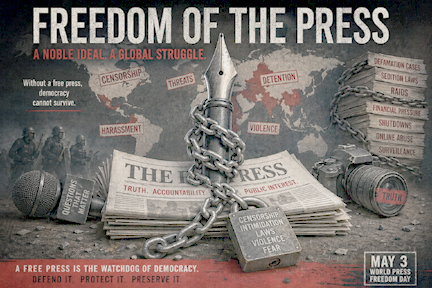


Every year, on May 3, the world observes World Press Freedom Day – a day meant not for ritualistic celebration, but for reflection. It is a day to ask a difficult question: what remains of the freedom of the press in a world that loudly proclaims democracy while quietly eroding its foundations? The answer, unfortunately, is deeply troubling. The idea of a free press—so noble in principle, so essential to democracy—is today one of the most challenged ideas, even in the very democracies that once championed it.
The concept of press freedom is rooted in the evolution of modern democratic thought. From the Enlightenment philosophers to the framers of constitutions, a free press was considered indispensable to informed citizenship and accountable governance. It was the press that challenged monarchies, exposed corruption, and amplified the voice of the ordinary citizen. In the United States, the First Amendment enshrined it as a fundamental right. Across Europe, it became synonymous with the struggle for civil liberties. The press was not merely a chronicler of events, it was the watchdog of democracy.
Yet, alongside this noble tradition runs a darker history—one of censorship, intimidation, and control. Governments have rarely been comfortable with a truly independent press. Even in the early days, laws were enacted to silence dissenting voices. The relationship between the press and those in power has always been uneasy: tolerance when convenient, suppression when threatened. In recent decades, this uneasy balance has tilted decisively toward control.
Today, a glance at the global landscape reveals a steady decline in press freedom. Institutions such as Reporters Without Borders, which publishes the World Press Freedom Index, have consistently documented this downward trend. What is particularly alarming is that the erosion is no longer confined to authoritarian regimes. Democracy, the self-proclaimed guardians of liberty—are increasingly adopting methods that undermine the very freedoms they once upheld.
Consider India, the world’s most populous democracy. Despite its constitutional guarantees and a vibrant media tradition, it now finds itself ranked behind countries such as Pakistan and Bangladesh in global press freedom indices. This is not a mere statistical anomaly; it is indicative of a deeper malaise. Journalists face mounting pressure, legal intimidation, and financial scrutiny. Critical voices are often targeted, and an atmosphere of fear encourages self-censorship. The message is subtle but clear: dissent comes at a cost.
India’s predicament is not unique. Across continents, governments are developing sophisticated tools to control the narrative. In some countries, repression is blatant journalists are jailed, assaulted, or worse. In others, the methods are more refined: regulatory overreach, strategic allocation of government advertising, and concentration of media ownership in the hands of a few. The digital revolution, once hailed as a force for democratization, has added new layers of complexity. Surveillance, misinformation, and algorithmic manipulation have become powerful instruments in shaping public perception.
Even the United States, long regarded as a beacon of press freedom, is not immune. While its constitutional protections remain intact, the climate surrounding the media has grown increasingly hostile. Journalists are often vilified, public trust in media institutions has declined, and political polarization has blurred the line between fact and opinion. The press, instead of being a unifying force of truth, is frequently caught in the crossfire of ideological battles.
Europe presents similar concerns. In countries like Hungary and Poland, questions about media independence have been raised repeatedly. Governments have sought to influence public broadcasters and marginalize critical outlets. Even in established democracies, journalists face legal and physical threats that challenge the assumption of an unassailable free press.
What unites these diverse examples is a common intent: control over information. In an age where perception shapes reality, governments understand the power of narrative. A compliant press can legitimize authority; an independent one can question it. It is this very capacity to question that makes the press indispensable—and inconvenient.
Equally troubling is the normalization of hostility toward the press. Language that once would have been considered unacceptable is now commonplace. Journalists are labeled as biased, anti-national, or enemies. Attacks—both verbal and physical—are increasingly tolerated. When such attitudes gain legitimacy, they erode not just the safety of journalists but the very credibility of the institution.
To be fair, the media itself is not without fault. Sensationalism, partisanship, and lapses in ethical standards have contributed to declining public trust. In some cases, the press has blurred the line between reporting and advocacy, weakening its own moral authority. Yet, these shortcomings cannot justify repression. A flawed press is still preferable to a controlled one. The remedy lies in reform, not restriction.
The consequences of a compromised press are profound. Without independent journalism, democracy becomes performative. Elections may continue, institutions may function, but the citizen is deprived of the information necessary to make informed choices. A silenced press creates an uninformed public, and an uninformed public is easily manipulated.
On this World Press Freedom Day, the need for introspection is urgent. Governments must move beyond rhetoric and demonstrate genuine commitment to press freedom. Laws that stifle dissent must be revisited. Journalists must be protected, not persecuted. Media independence must be safeguarded against both political and corporate pressures.
Citizens, too, bear responsibility. A free press survives only when it is valued and defended by the people. Supporting credible journalism, demanding accountability, and resisting misinformation are essential acts of democratic participation.
The global community must also act. Press freedom is not a local issue; it is a universal principle. Institutions such as the United Nations must strengthen their advocacy and ensure that violations are not ignored.
Ultimately, the struggle for press freedom is a struggle for truth itself. It is a continuous battle against forces that seek to obscure, distort, and control information. The resilience of this ideal lies in the courage of journalists, the integrity of institutions, and the vigilance of citizens.
The idea of a free press may be under siege, but it is not defeated. Its survival depends on our collective will to defend it. For without a free press, democracy is not merely weakened—it is hollowed out from within.
And that is a cost no society can afford.



Be the first to comment