
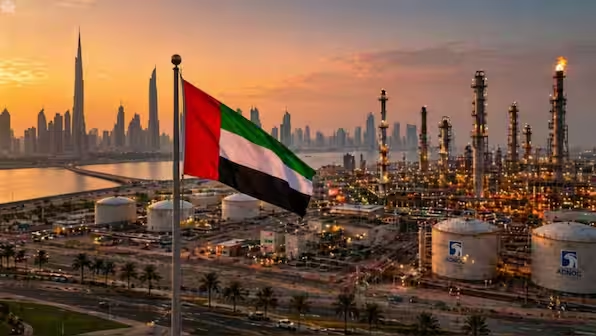

The UAE’s departure from OPEC reflects a strategic bet that its national interests are better served by acting as an independent, high-capacity producer rather than as a disciplined member of a constrained cartel.
“The UAE’s departure from OPEC is not merely a technical adjustment, but a deliberate declaration of an independent energy policy. It reflects a strategic bet that its national interests are better served by acting as an independent, high-capacity producer rather than as a disciplined member of a constrained cartel. This move definitely weakens OPEC, reducing its market power and challenging the future cohesion of the oil producers’ group. The long-term significance lies in a potential decrease in OPEC’s relevance, with the UAE establishing a model where key producers might priorities national economic visions over collective market management.”

The United Arab Emirates (UAE) has announced its withdrawal from the Organization of the Petroleum Exporting Countries (OPEC) and the wider OPEC+ alliance, effective 1 May 2026, marking a significant and historic shift in global energy dynamics. The UAE’s departure is driven by a desire for greater autonomy, frustration with production constraints, and evolving regional geopolitics. The decision follows a comprehensive review of its national energy strategies and is aimed at maximizing its economic interests in a rapidly changing market.
A Strategic Shift Towards Independence
The UAE’s decision is fundamentally driven by a long-term strategic and economic vision, aiming to maximize its domestic energy production and accelerate investment unconstrained by cartel quotas. For decades, the UAE was a pillar of the organization, but disagreements have long existed over production limits, where the UAE sought higher, more aggressive output targets. This move allows the UAE to unlock its vast oil resources to serve its own financial objectives rather than the collective interests of the OPEC group.
Pursuit of Strategic and Economic Independence
The primary driver for the UAE’s exit is the pursuit of long-term economic autonomy, specifically the ambition to maximize revenues from its massive investments in oil production capacity. The UAE has invested heavily to boost its capacity to 5 million barrels per day by 2027. Under the OPEC+ framework, such capacity has often been constrained by quota limits, which the UAE deemed harmful to its national interest. By exiting, the UAE gains the flexibility to increase production without collective constraints, allowing it to capitalize on high oil prices and market demand.
Geopolitical Tensions and the Iran Conflict
The timing of the decision, announced on 28 April 2026, is closely tied to the regional turmoil caused by the ongoing war in Iran. The UAE grew increasingly frustrated with its fellow OPEC members, believing they did not do enough to protect it from Iranian missile and drone attacks during this conflict. Furthermore, the disruptions in the Strait of Hormuz, which affected oil shipping, led to a “frostier” relationship with regional neighbors, making membership in a group that included Iran untenable, especially as Iran threatened the UAE’s oil infrastructure.
Weakening of OPEC and Market Dynamics
The departure is a major blow to OPEC and the wider OPEC+ alliance, which manages roughly 90 per cent of the world’s oil supplies. As a top-10 global producer, the UAE’s move threatens the bloc’s ability to control global oil prices. By operating outside the cartel, the UAE can increase its exports, injecting more supply into a market that has been reeling from volatility. This could weaken the leverage of leading members, particularly Saudi Arabia, which has relied on strict quotas to sustain prices.
Cold Relations with Saudi Arabia and Regional Competition
The departure reflects a widening rift with Saudi Arabia, the de facto leader of OPEC. Once close allies, the relationship between Abu Dhabi and Riyadh has turned cold, characterized by public disagreements on economic issues and regional influence. As Saudi Arabia, under Crown Prince Mohammed bin Salman, has aggressively pursued economic diversification to compete with the UAE, frictions have grown. The UAE feels that its interests are no longer aligned with Riyadh’s strategic direction within the cartel.
A Shift Towards a New Energy Reality
The UAE’s exit also signals its strategy for a post-oil economy. While expanding its oil capacity, the UAE is using these revenues to fund its “Net Zero 2050 Strategy” and diversify into sectors such as technology and renewable energy. Leaving OPEC allows it to manage this transition on its own terms, free from the constraints of a cartel that generally seeks to keep prices high and supply restricted.
The UAE’s departure from OPEC is not merely a technical adjustment, but a deliberate declaration of an independent energy policy. It reflects a strategic bet that its national interests are better served by acting as an independent, high-capacity producer rather than as a disciplined member of a constrained cartel. This move definitely weakens OPEC, reducing its market power and challenging the future cohesion of the oil producers’ group. The long-term significance lies in a potential decrease in OPEC’s relevance, with the UAE establishing a model where key producers might priorities national economic visions over collective market management.
(The writer is a retired Indian diplomat and had previously served as ambassador in Kuwait and Morocco and as Consul General in New York. Views expressed in the above piece are personal and solely those of the author. They do not necessarily reflect Firstpost’s views.)


Be the first to comment