
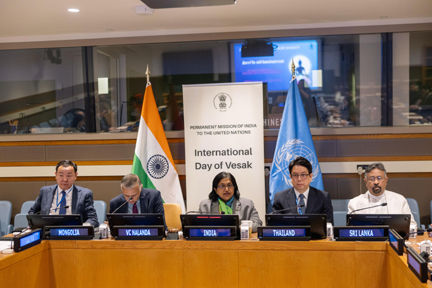

NEW YORK (TIP): Permanent Mission of India, with the participation of the Permanent Missions of Bhutan, Cambodia, Japan, Lao PDR, Mongolia, Nepal, Republic of Korea, Sri Lanka, Thailand, and Viet Nam organized a panel discussion on 30 April 2026 in the UN to commemorate the International Day of Vesak. The discussion focused on the theme “Leveraging Buddhist Heritage for Strengthening Global Peace and Cooperation” – deliberating on how the shared Buddhist heritage in the region can help shape international cooperation in today’s era of discord and conflict.
In her welcome remarks, Cd’A Ambassador Yojna Patel recalled the deep civilizational bond among people from the Indian Ocean to the Indo-Pacific through shared traditions of Buddhist art and culture, architecture, flow of ideas and values. She outlined India’s efforts to revitalize and strengthen the ties through development of the Buddhist tourism circuit, support and collaboration to preserve and restore Buddhist heritage sites, monasteries, conservation of archaeological sites, and pilgrimage infrastructure in neighboring partner countries leading to an organic evolution of a transnational spiritual corridor.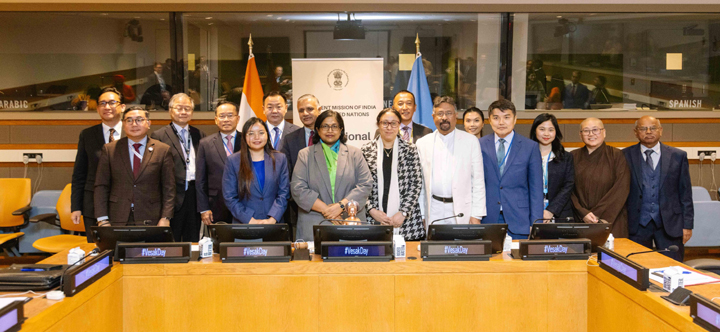
Vice Chancellor of Nalanda University, Prof. Sachin Chaturvedi delivered the keynote address. By highlighting interdependence and collective welfare as central tenets of Buddhism that are relevant to current global governance, he called for a shift from sectoral and quantitative development models to integrated, human-centric approaches to achieve Sustainable Development Goals. He linked Buddhist philosophy to ethical development, sustainability, and global systems thinking.
Speakers from participating countries highlighted how Buddhist values remain deeply relevant in today’s complex global landscape. Member States highlighted themes of compassion, moderation and dialogue drawing on their own traditions — from Bhutan’s Gross National Happiness framework to Sri Lanka’s emphasis on peaceful conflict resolution. Japan, Thailand and Viet Nam stressed the importance of human dignity, while the Republic of Korea highlighted Buddhism’s resonance among younger generations. Mongolia, Lao PDR and Cambodia reaffirmed the values and principles of Lord Buddha, while Nepal emphasized on “Middle Path” as a framework for moderation and peaceful co-existence. Collectively, the discussions reaffirmed that Buddhist heritage can serve as a unifying force for fostering trust, people-to-people connections, and cooperative approaches to peace and development.
It may be recalled that the United Nations General Assembly adopted resolution 54/115 in 1999, officially recognizing the International Day of Vesak on the first full moon in May every year. This day is commemorated annually at the UN Headquarters to recall the teachings of Lord Buddha and his message of compassion, peace and goodwill.
(Based on a press release issued by the PMI)


Be the first to comment