

On Sunday, May 10, much of the world will pause, if only for a moment, to celebrate one of the most sacred relationships known to humanity — the relationship between a mother and her child. Flowers will be offered, greeting cards exchanged, and affectionate messages shared across continents. Yet no bouquet, no poem, no monument, and no language has ever fully succeeded in capturing the grandeur of a mother’s love.
For a mother is not merely a biological reality. She is an emotion. She is memory. She is sacrifice clothed in tenderness. She is the first school, the first shelter, the first prayer, and often the last refuge of a troubled soul.
Before humanity built temples, it knew the sanctity of a mother’s lap.
The history of civilization itself is, in many ways, the history of motherhood. Every prophet, philosopher, scientist, emperor, saint, poet, reformer, and revolutionary once rested in the arms of a mother. The world celebrates great men and women, but behind almost every greatness stands a mother who silently shaped character, nourished courage, and taught compassion.
The scriptures of the world overflow with reverence for motherhood. In the ancient Indian tradition, the mother is placed even above heaven. The Sanskrit phrase “Matru Devo Bhava” — “Let the mother be revered as God” — is among the loftiest declarations in human philosophy. Hindu scriptures repeatedly describe the mother as the embodiment of unconditional love and divine grace.
The Mahabharata and the Ramayana are filled with examples of mothers whose strength and sacrifice shaped history. Kunti, the mother of the Pandavas, bore unimaginable suffering with dignity. Mother Yashoda symbolizes nurturing love so pure that even Lord Krishna, regarded as God incarnate, became eternally associated with her maternal affection.
In Sikhism too, motherhood occupies a sacred place. Guru Nanak taught compassion, equality, and service — values first cultivated in the atmosphere of the home by mothers. Sikh history reveres Mata Gujri for her courage and spiritual strength during times of immense persecution. The Sikh tradition recognizes women not merely as caretakers but as pillars of moral and spiritual resilience.
Christianity offers perhaps one of the most universally recognized symbols of motherhood in Mary, Mother of Jesus, whose image has inspired humanity for centuries. Her silent suffering, unwavering faith, and acceptance of pain have become eternal metaphors for maternal sacrifice.
Islam, too, places mothers on the highest pedestal. A famous saying of Prophet Muhammad declares: “Paradise lies beneath the feet of mothers.” Few statements in human history elevate motherhood with such poetic reverence and moral clarity.
Across cultures, religions, and civilizations, one truth shines unmistakably: humanity has always understood that the hand that rocks the cradle shapes the destiny of nations.
And yet, despite all our praise for mothers, modern society often fails them.
We live in an age of astonishing technological advancement but shrinking emotional spaces. Families are increasingly fragmented. Loneliness has become a silent epidemic. Elderly mothers are too often left isolated in nursing homes or apartments filled with memories but devoid of companionship. In the rush for success, careers, wealth, and status, many children forget the woman who once sacrificed sleep so they could dream.
There is perhaps no tragedy greater than neglecting one’s mother.
A mother’s sacrifices are mostly invisible. She gives without accounting, loves without conditions, and forgives without limit. Her work rarely receives salaries, awards, or headlines. She absorbs anxiety silently and often carries the burdens of the family without complaint. Her tears are usually hidden, her fears unspoken.
And yet, when the storms of life arrive, it is often the mother who remains the final lighthouse.
Philosophers across centuries have reflected upon this extraordinary force called motherhood. Abraham Lincoln famously said, “All that I am, or hope to be, I owe to my angel mother.” Napoleon Bonaparte declared, “Give me good mothers and I will give you a great nation.”
Indeed, nations are not built first in parliaments or battlefields. They are built in homes.
The moral health of society depends greatly upon the values transmitted by mothers — kindness, honesty, discipline, empathy, and courage. When mothers nurture humanity, civilization flourishes. When mothers suffer neglect, societies slowly lose their soul.
Motherhood is also not confined merely to childbirth. There are women who mother through compassion, teaching, healing, mentoring, adoption, and service. Teachers who shape young minds, nurses who comfort the sick, social workers who rescue abandoned children, and women who dedicate their lives to humanity all partake in the spirit of motherhood.
The world today desperately needs more maternal values.
At a time when violence, hatred, wars, and divisions scar humanity, the qualities associated with motherhood — patience, compassion, nurturing, forgiveness, and sacrifice — are perhaps the very medicine civilization requires. The future of humanity may well depend upon restoring these values to the center of public life.
Mother’s Day, therefore, should not become merely a commercial occasion of flowers and social media greetings. It should become a moral reminder.
- A reminder to call our mothers more often.
- A reminder to care for aging mothers with dignity.
- A reminder to lighten their burdens.
- A reminder that while we may outgrow childhood, we never outgrow the need for a mother’s love.
And for those whose mothers are no longer physically present, Mother’s Day becomes a day of remembrance — a quiet conversation with memory, gratitude, and tears. Mothers never truly leave us. They continue to live in our conscience, our values, our language, our prayers, and our humanity.
A mother’s love survives even death.
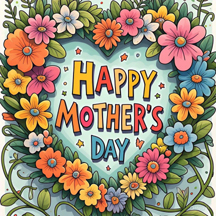
As the world celebrates Mother’s Day this Sunday, let us rise above ritual and rediscover reverence. Let us not merely say “Happy Mother’s Day,” but strive to create a society where mothers are respected, protected, cherished, and never abandoned.
For in honoring mothers, humanity honors its own highest self.
And perhaps that is why, among all the words humanity has ever spoken, one word remains forever the softest, the purest, and the holiest: Mother.

Be the first to comment