
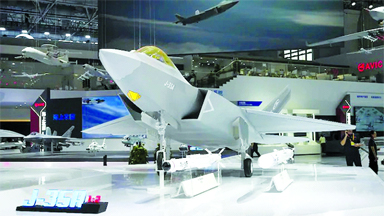

Islamabad (TIP): China’s push into the global fifth-generation fighter jet market appears to be gathering momentum, with Pakistan emerging as the likely first overseas customer for the newly unveiled J-35AE stealth combat aircraft.
The export version of China’s next-generation fighter was recently showcased by Chinese defence manufacturers, sparking intense discussion among military analysts and strategic experts across Asia. The aircraft, developed by China’s Shenyang Aircraft Corporation under the Aviation Industry Corporation of China (AVIC), is being viewed as Beijing’s latest attempt to challenge Western dominance in advanced combat aviation exports.
The J-35AE is an export-oriented variant of the J-35 stealth fighter, China’s second fifth-generation aircraft after the J-20. While the Chinese military version is expected to serve the People’s Liberation Army Air Force and Navy, the AE variant has been specifically designed for foreign buyers.
Pakistan, one of China’s closest defence partners, is widely believed to be at the front of the queue.
Over the past two decades, China and Pakistan have steadily deepened military cooperation through joint aircraft production, missile systems, naval projects and technology transfers. The Pakistan Air Force already operates several Chinese-origin platforms, including the JF-17 Thunder, jointly developed by the two countries, and the more advanced J-10C fighter jets acquired in recent years.
Defence observers say the possible induction of the J-35AE would represent a major leap in Pakistan’s aerial warfare capabilities.
The stealth fighter is expected to feature reduced radar visibility, advanced avionics, internal weapons bays, modern electronic warfare systems and long-range combat capability. Though official technical details remain limited, analysts believe the aircraft is intended to rival platforms such as the American F-35 in export markets where Western fighters are either unavailable or politically restricted. Reports in Chinese and international defence media suggest Islamabad could initially seek a limited number of aircraft before gradually expanding the fleet. However, neither Beijing nor Islamabad has publicly confirmed the scale or timeline of any potential deal.
The development is being closely monitored in India, where defence planners have long assessed the growing military cooperation between China and Pakistan as a strategic challenge.
Experts note that if Pakistan acquires a stealth fighter capability before India fields its own indigenous fifth-generation aircraft, it could temporarily alter the regional air combat balance. India is currently pursuing its Advanced Medium Combat Aircraft (AMCA) programme while also expanding its Rafale fleet and modernising existing fighter squadrons.
Military analysts caution, however, that the introduction of fifth-generation aircraft alone does not automatically transform battlefield realities. Pilot training, maintenance ecosystems, stealth coatings, networking capabilities, weapon integration and operational readiness all play crucial roles in determining actual combat effectiveness.
There are also questions regarding the J-35AE’s engine performance, production rates and long-term reliability, as many aspects of the aircraft remain shrouded in secrecy.
The unveiling of the J-35AE also highlights China’s broader ambition to become a dominant player in the international defence market.
For years, advanced stealth fighters have largely remained under the control of the United States and its allies. Washington’s F-35 programme, despite its enormous success, remains inaccessible to many countries due to geopolitical restrictions, alliance considerations and export controls.



Be the first to comment