
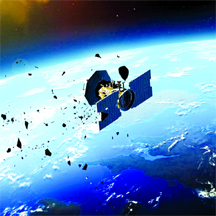

A new study has found that the Sun may be playing a far bigger role in the growing space junk crisis than previously understood, by making old satellites and debris fall toward Earth much faster during periods of heightened solar activity.
Scientists from the Isro’s Space Physics Laboratory at the Vikram Sarabhai Space Centre in Thiruvananthapuram have shown for the first time that solar activity can predict how rapidly objects in low Earth orbit lose altitude.
Their findings, published in Frontiers in Astronomy and Space Sciences, could reshape how future satellite missions are planned amid rising congestion in space.
The research reveals that once the Sun’s activity reaches about 67% of its peak during its 11-year solar cycle, orbiting debris begins descending significantly faster.
“Here we show that space debris around Earth loses altitude much faster when the Sun is more active,” said lead author Ayisha M Ashruf. “For the first time, we find that once solar activity passes a certain level, this loss of altitude happens noticeably more quickly.”
The discovery comes at a crucial time. Low Earth orbit, or LEO, the region between roughly 400 km and 2,000 km above Earth, has become increasingly crowded with satellites, discarded rocket parts and fragments from past collisions.
The zone is home to Earth-observation spacecraft and internet mega-constellations such as SpaceX’s Starlink network. Scientists warn that even a single collision in orbit could trigger a chain reaction of impacts, producing thousands of additional fragments that threaten operational satellites and future missions. The team tracked the movement of 17 pieces of space debris launched in the 1960s and monitored their orbital decay over 36 years across solar cycles 22 to 24. These objects orbit Earth every 90 to 120 minutes at altitudes between 600 km and 800 km. Unlike active satellites, which perform orbital corrections using onboard fuel, space junk simply responds to atmospheric conditions. This made the debris ideal for studying how solar activity affects Earth’s upper atmosphere.
During periods of intense solar activity, the Sun emits stronger ultraviolet radiation and charged particles. These emissions heat and expand the thermosphere, the upper layer of Earth’s atmosphere, increasing atmospheric density at orbital heights. That creates more drag on satellites and debris, slowing them down and pulling them closer to Earth.

Be the first to comment