
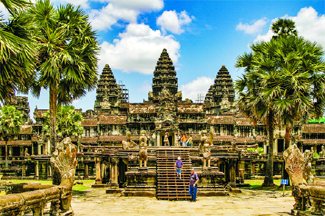

Before sunrise breaks over the Cambodian jungle, thousands of years of history lie hidden in darkness. The silhouettes of towering stone spires rise slowly above a vast moat, reflected perfectly in still waters. The air is heavy with humidity, incense and birdsong. Somewhere in the distance, Buddhist monks chant softly while travellers stand silently waiting for dawn. Then the sky erupts into gold.
As sunlight washes over the ancient temple complex of Angkor Wat, it becomes immediately clear why this monument is considered one of humanity’s greatest achievements. The sheer scale is staggering, the artistry almost unimaginable, and the atmosphere profoundly spiritual. More than a tourist destination, Angkor Wat is an entire world – a sacred landscape where religion, mythology, architecture, empire and nature exist together in breathtaking harmony.
For travellers, historians, photographers and spiritual seekers alike, Angkor Wat is not simply a place to visit. It is a place to feel.
The Rise of a Great Civilization
To understand Angkor Wat, one must first understand the astonishing civilization that created it.
Between the 9th and 15th centuries, the Khmer Empire dominated much of mainland Southeast Asia, controlling territories that now include modern-day Cambodia, Thailand, Laos and Vietnam. At its height, the empire was among the world’s most sophisticated civilizations, possessing advanced engineering, enormous urban centres, complex irrigation systems and extraordinary artistic traditions.
The city of Angkor itself may once have supported nearly a million inhabitants, making it one of the largest pre-industrial urban centres in human history. Long before many European capitals emerged, Angkor was already a thriving metropolis of canals, reservoirs, temples and royal palaces.
The empire’s rulers believed deeply in the divine authority of kingship. Khmer monarchs were seen not merely as political leaders but as earthly representatives of the gods. Monumental temple construction became both an act of devotion and a symbol of imperial power.
It was within this atmosphere of ambition and spiritual devotion that King Suryavarman II commissioned Angkor Wat in the early 12th century.
Why Angkor Wat Was Built
Unlike many Buddhist temples of Southeast Asia, Angkor Wat was originally constructed as a Hindu temple dedicated to Vishnu, the preserver god of Hindu cosmology. Scholars believe the temple may also have served as the king’s state temple and eventual funerary monument.
Every aspect of Angkor Wat was designed with cosmic symbolism in mind.
The temple’s five central towers represent the peaks of Mount Meru, the mythical home of the gods in Hindu belief. The surrounding moat symbolizes the cosmic ocean, while concentric galleries reflect the structure of the universe itself.
Even the temple’s orientation is unusual. Most Khmer temples face east, but Angkor Wat faces west – a direction associated with Vishnu and sometimes linked with death in Hindu tradition. Historians continue debating whether this orientation supports the theory that the temple was intended partly as a mausoleum for the king.
Construction required extraordinary manpower and engineering skill. Millions of sandstone blocks, some weighing several tons, were transported from quarries located more than 50 kilometres away. Labourers, sculptors, priests and architects worked for decades to create the monument.
The result was one of the most magnificent religious structures ever built.
The Greatest Religious Monument on Earth
Angkor Wat covers over 400 acres, making it the largest religious monument in the world. Yet despite its vastness, its design remains remarkably harmonious and balanced.
Visitors approach the temple via an elevated sandstone causeway crossing the enormous moat. As they draw closer, the iconic towers dominate the skyline with increasing majesty.
The temple’s walls contain nearly 2,000 apsaras – celestial dancers carved with astonishing individuality. No two are exactly alike. Their jewellery, hairstyles and expressions differ subtly, reflecting the incredible skill of Khmer artisans.
The bas-reliefs of Angkor Wat are among the finest examples of narrative sculpture anywhere in the world. Stretching across vast galleries, these carvings depict epic battles, mythological scenes and royal processions in remarkable detail.
Among the most celebrated panels is the “Churning of the Ocean of Milk,” where gods and demons pull upon the serpent Vasuki to churn the cosmic ocean and obtain the elixir of immortality. The scene contains hundreds of figures carved with extraordinary dynamism and precision.
Another gallery portrays scenes from the Ramayana and Mahabharata, the great Hindu epics that shaped much of South and Southeast Asian culture.
Walking through these corridors feels like entering a stone library of mythology.
From Hindu Temple to Buddhist Sanctuary
Over time, Cambodia gradually transitioned from Hinduism to Buddhism, especially Theravada Buddhism, which remains dominant today. Rather than being abandoned, Angkor Wat evolved alongside these religious changes. Buddhist statues replaced some Hindu imagery, monks began inhabiting the temple, and Angkor Wat transformed into an active Buddhist pilgrimage site. This continuous religious use helped preserve the monument when many other temples around Angkor fell into ruin.
Temples Beyond Angkor Wat
The Angkor region contains dozens of extraordinary temples, each offering its own mood, symbolism and architectural character.
Angkor Thom: The Great Royal City
Built by King Jayavarman VII in the late 12th century, Angkor Thom served as the final great capital of the Khmer Empire. Massive gates guarded by rows of stone gods and demons lead into the ancient city.
At its centre stands the mesmerising temple of Bayon.
Bayon is famous for its gigantic smiling stone faces. More than 200 serene faces gaze calmly in every direction, creating an atmosphere that feels mystical and almost dreamlike.
Historians continue debating whom the faces represent. Some believe they depict Avalokiteshvara, the Buddhist bodhisattva of compassion, while others argue they are idealized portraits of King Jayavarman VII himself.
The shifting expressions of the faces change with the light, giving the temple an eerie and unforgettable beauty.
Ta Prohm: Nature’s Cathedral
Perhaps no temple captures the imagination more powerfully than Ta Prohm. Here, giant tree roots cascade over ruined walls, twisting through doorways and embracing ancient stones like living sculptures. Massive silk-cotton trees rise dramatically above crumbling galleries, creating scenes that appear almost unreal.
Unlike other restored monuments, Ta Prohm was intentionally preserved in a semi-ruined state to showcase the dramatic relationship between nature and architecture. The temple gained international fame after appearing in the film Tomb Raider, but its true magic lies in the atmosphere of rediscovery it evokes. Visitors walking through Ta Prohm often feel as though they have stumbled upon a forgotten civilization hidden deep within the jungle.
Banteay Srei: The Jewel of Khmer Art
Located farther from the main Angkor complex, Banteay Srei is often described as the artistic masterpiece of Khmer architecture. Constructed from pink sandstone, the temple glows warmly in sunlight. Its carvings are extraordinarily intricate, featuring floral motifs, mythological scenes and decorative details of astonishing delicacy. Because of the refinement of its artistry, scholars nicknamed it the “Citadel of Women,” believing only female hands could have created carvings so delicate – though this interpretation remains symbolic rather than historical.



Be the first to comment