
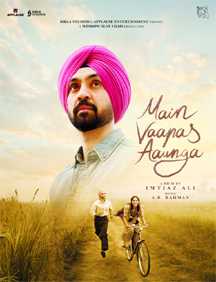

Imtiaz Ali’s Main Vaapas Aaunga (I Will Return) offers a timely and thoughtful counter to the spate of hyper-jingoistic films currently flooding Bollywood. When history’s borders are being redrawn in the heart, Ali has made a film against the current—one that seeks to remind people that a collective trauma demands contemplation, not a justification for renewed hatred.
It is a pleasure to see Naseeruddin Shah as Ishar Singh Grewal, a man abandoned by fate and history. His family did not understand his idiosyncrasies because they were unaware of the wounded flower in his heart. Grewal is torn apart, like millions of others, by the Partition of 1947. Heartbreakingly clueless Muslim and Sikh characters from Punjab hear about Partition in the film like a storm brewing from the political centre, one that will soon engulf them. Even if they were among the apolitical elites, they appear more humane than the elite political class that orchestrated the communal carnage and the subaltern foot soldiers who carried it out. History does not always conform to neat moral divides and ideological correctness.
It was largely Jinnah and the Muslim League’s gift of death to the subcontinent. Holding political formations responsible is separate from blaming communities. Everyone knows Hindus, Muslims, and Sikhs were all guilty of gruesome violence. Main Vaapas Aaunga is a great reminder that if communities lose their moral compass and commit brutal violence against each other in the name of nationalism, they legitimise state power and allow it to control and manipulate this communal pathology. The actual event of Partition—and who was primarily responsible for it—must be separated from the longer narrative. Hamid Dalwai made the point in Muslim Politics in India that Jinnah did not fight Savarkar and Golwalkar, but rather “accused Gandhi of being a Hindu communalist”.
When the Sikhs in Main Vaapas Aaunga come to know that India is going to be divided, their central bewilderment says it all: how can neighbourhoods comprising all communities suddenly become inhabitable for some? The Partition of India was the ruthless destruction of the neighbourhood. I have argued in my book on Gandhi that a nation at war is understandable, even if tragically and reprehensibly so. As a territorial idea, the nation is open to the possibility of war. But if a neighbourhood goes to war, it goes against its own existence. The neighbourhood is the moral fulcrum of human society. Gandhi mourned the death of neighbourhoods when he walked through the devastated streets of Calcutta, Noakhali, and Bihar. It was necessary for the League to destroy neighbourhoods in order to justify and fortify the discourse of Partition. Muslims, Hindus, and Sikhs played into this logic.
A nervous Sikh character in the film says, “Refugees don’t have the right to be angry.” I felt the same sense of frustrated vulnerability as a traumatised adolescent in Assam after being designated a “foreigner”. Refugees are people who are exploited and harmed due to their displaced political status even if they have citizenship rights. Having lost their original neighbourhood, their lives and livelihoods are at the mercy of ethnonational majorities.


I always was interested in this subject and stock still am, regards for putting up.
Thank you for sharing superb informations. Your web site is so cool. I am impressed by the details that you have on this website. It reveals how nicely you understand this subject. Bookmarked this website page, will come back for more articles. You, my pal, ROCK! I found just the info I already searched everywhere and simply could not come across. What a great website.
magnificent submit, very informative. I wonder why the opposite specialists of this sector don’t notice this. You must continue your writing. I am sure, you have a great readers’ base already!