
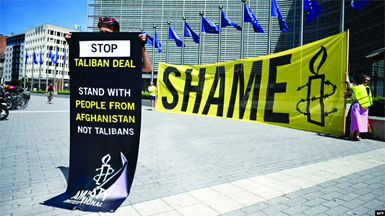

Brussels (TIP): A Taliban delegation held closed-door talks with European Union officials and representatives of 15 EU countries in Brussels, with discussions centred on diplomatic services and what the Taliban called a “dignified return process” for Afghans being sent back from Europe. The meeting comes as a growing number of governments in the 27-member bloc want faster and higher deportations of Afghans whose asylum claims are rejected or who commit crimes in their host countries.
The talks also drew sharp criticism from rights groups and activists, who said any engagement with the Taliban should focus on human rights and accountability rather than returns. No EU country recognises the Taliban government, and Belgian authorities stressed that allowing the meeting to take place did not amount to recognition or legitimacy.
Abdul Qahar Balkhi, spokesperson for the Taliban Foreign Ministry, described the visit as “historic” and said it was the first time a delegation from the Islamic Emirate had held talks with the EU and EU nations in Brussels. Balkhi, who led the five-member delegation, said the talks focused on “trust-building measures”, the Taliban’s diplomatic presence in the EU and a “dignified return process”. The meeting was held at an undisclosed location in the Belgian capital, where the EU and NATO are headquartered.
The European Commission said it co-chaired the meeting with Sweden. A Commission spokesperson, Markus Lammert, said the talks were held after pressure from a clear majority of EU member states, including 20 countries that signed a letter in October seeking tougher migration policies and more deportations. He said the Commission had been asked to coordinate “technical talks” on returns, adding: “This does not mean recognition.” The meeting in Brussels followed earlier contact in January, when the Commission sent a mission to Kabul, where it also has staff.
Rights groups said the meeting risked harming Afghans both in Europe and Afghanistan. “Any engagement with the Taliban needs to prioritize protecting human rights and accountability – not deporting people to danger there,” said Fereshta Abbasi of Human Rights Watch. She added, “EU countries are undermining their credibility by condemning Taliban abuses and pursuing accountability on one hand, while cooperating with the Taliban to forcibly return Afghans on the other.” Nobel Peace Prize laureate Malala Yousafzai said on Monday that she was “deeply shaken” by the talks. “Europe must not legitimise a regime responsible for one of the worst human rights crises in the world. Any engagement with the Taliban must begin and end with the rights of Afghan women and girls,” she wrote on X.
Belgium said Taliban delegates were given visas after security screening with limited territorial validity, allowing them 24 hours in Belgium and no travel to other Schengen countries. Belgian Foreign Minister Maxime Prvot said Belgium had complied with EU requests to issue the visas. “Making a meeting possible in the framework of our host-state policy does not amount to recognition, does not amount to legitimacy, and does not constitute an invitation by the Belgian government,” he said. As neither Belgium nor the EU officially recognises the Taliban government, the meeting was not held at an official Belgian or EU site.


Be the first to comment