

Satellites don’t always stay in orbit. As they get closer to Earth, atmospheric drag can pull them lower and lower until they burn up, with solar activity speeding up the process.
NASA’s Swift Space Observatory is facing that fate — its orbit is decaying, and if left alone, it will be destroyed in a matter of months.
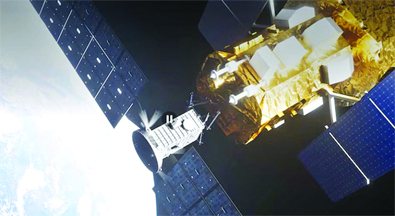
But in a first-of-its-kind mission, Katalyst Space, a startup, is teaming up with NASA to try and rescue Swift using the company’s newly developed robotic spacecraft, LINK.
“This is a historic mission, you know, some would call it the first of its kind, a robotic spacecraft that can go and capture an unprepared satellite,” said Robert Lamontagne, vice president of strategic partnerships at Katalyst Space. Swift’s original orbit was around 370 miles above the Earth’s surface. But over the years, it’s fallen to less than 250 miles, according to NASA. Now it’s a race against the clock to keep Swift from falling even further and burning up in Earth’s atmosphere.
To save the satellite before time runs out, the Arizona-based company built its 935-pound rescue spacecraft in just 250 days. LINK was designed to physically interact with Swift despite the observatory not being designed for this kind of operation.
“Over the last nine months, we have gone from a clean sheet to a spacecraft that is currently integrated on a rocket, on an airplane ready to go to college for launch,” added Kieran Wilson, the principal investigator for LINK at Katalyst Space. “This is an absolutely unprecedented development timeline for this program.”
If all goes as planned, LINK will be launched into space on Saturday aboard a Northrop Grumman Pegasus XL rocket, which will be launched from a Lockheed L-1011 TriStar carrier aircraft taking off from Kwajalein Atoll in the South Pacific.
Once in orbit, it will take about three weeks for LINK to rendezvous with and capture the 22-year-old observatory. Over two to three months, the spacecraft will use its thrusters to raise Swift into a more stable orbit.
The two will then separate as LINK lowers itself back into Earth’s atmosphere, where it will burn up, keeping it from adding to the rest of the space debris in our orbit.


Be the first to comment