


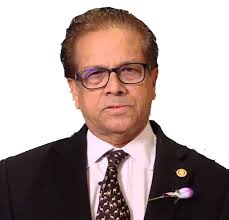
Ophthalmologist, Educator, Author, and Humanitarian
Founder President, Eye Foundation of America
Clinical Professor, West Virginia University
Adjunct Professor Wilmer Eye Institute
Johns Hopkins University
It is a privilege to write this Foreword for America at 250, a special commemorative edition of The Indian Panorama marking the 250th Anniversary of the Independence of the United States of America.
Anniversaries invite us to celebrate. Milestones invite us to reflect. The 250th anniversary of American Independence offers an opportunity to do both.
Two and a half centuries ago, a group of visionaries embarked upon an audacious experiment in human governance. They proclaimed that liberty was not the privilege of a few but the birthright of all; that governments derived their legitimacy from the consent of the governed; and that human dignity must remain central to the political order. Those ideas, revolutionary in their time, continue to resonate across the world today.
America’s journey since 1776 has been neither simple nor flawless. It has witnessed triumphs and setbacks, prosperity and hardship, unity, and division. Yet through wars, economic crises, social transformations, and technological revolutions, the nation has demonstrated a remarkable capacity for renewal. Its greatest strength has not been the absence of challenges but the ability to confront them and continue moving forward.
As a physician, I have spent much of my professional life helping individuals regain their sight. Over the years, I have often reflected on the profound importance of vision—not merely the ability to see with our eyes, but the ability to perceive possibilities, to recognize responsibilities, and to remain faithful to enduring values.
Nations, too, require vision.
Abraham Lincoln reminded us “As our case is new, so we must think anew and act anew”. Vision is not merely the preservation of ideas; it is their renewal for each generation.
A nation that loses sight of its founding ideals risks losing its direction. A society that forgets its history risks misunderstanding its future. The celebration of America’s 250th anniversary therefore provides an important moment to revisit the principles that have guided the Republic and to consider how those principles may continue to serve future generations.
The story of America is, in many respects, the story of human aspiration. People from diverse backgrounds, cultures, faiths, and national origins came together in pursuit of opportunity, freedom, and a better life. Through their labor, creativity, sacrifice, and perseverance, they helped build one of the most dynamic societies in human history.
Among those who contributed to this remarkable journey are generations of immigrants. They arrived carrying hopes, talents, traditions, and dreams. They enriched the nation while being enriched by it. Their contributions to science, medicine, education, business, public service, the arts, and civic life have become inseparable from the American story itself.
Nani Palkhiwala, one of India’s most respected Constitutional thinkers observed that a nation’s greatest asset is not its wealth but its people. The American experience has repeatedly demonstrated the truth of that insight.
The Indian American community represents one such chapter in this larger narrative. Over the decades, Indian Americans have made meaningful contributions in virtually every field of human endeavor. They have excelled as physicians, scientists, engineers, educators, entrepreneurs, public servants, and community leaders. More importantly, they have strengthened the bonds of friendship and understanding between the world’s two largest democracies.
My own journey has allowed me to witness firsthand the opportunities that America offers and the responsibilities that accompany those opportunities. Through the Eye Foundation of America and our efforts to eliminate avoidable blindness, particularly among children and underserved populations, I have seen how knowledge, compassion, and service can transform lives. Thousands of individuals who once faced darkness have been able to experience the gift of sight. Such experiences reinforce a simple but powerful truth: the highest purpose of achievement is service.
That lesson applies not only to individuals but also to nations.
The true measure of a nation’s greatness is not merely its wealth, military strength, or technological advancement. It is reflected in its commitment to human dignity, its concern for the vulnerable, its respect for freedom, and its willingness to use its resources and knowledge for the betterment of humanity.
As America enters its next quarter millennium, it faces challenges familiar to every generation. Questions of social cohesion, economic opportunity, technological change, global responsibility, and democratic resilience will continue to shape the national conversation. Yet there is reason for optimism. The same spirit of innovation, adaptability, and self-correction that has sustained America for 250 years remains very much alive.
The theme of this commemorative edition—”We, the People”—beautifully captures the essence of the American experiment. It reminds us that the nation’s enduring strength resides not merely in its institutions but in its citizens. Governments may change, leaders may come and go, but the ultimate custodians of democracy are the people themselves.
I commend The Indian Panorama, its Publisher and Editor Prof. Indrajit S. Saluja, and all those who have contributed to this ambitious and thoughtful project. By bringing together history, reflection, scholarship, and community perspectives, this volume serves not only as a celebration of America’s past but also as an invitation to think seriously about its future.
May the 250th anniversary of American Independence inspire renewed appreciation for liberty, deeper commitment to service, greater respect for diversity, and stronger faith in the power of democratic institutions.
The story of America is still being written.
As America enters its third century of Independence, it has an opportunity not only to celebrate its achievements but also reaffirm the principles that made those achievements possible – Liberty, Opportunity, Pluralism, Personal responsibility, and respect for human dignity. These ideals remain as relevant today as they were in 1776.
May I leave you with a final thought by saying – The temporary storms of the present should not obscure the larger horizon. A true MAITRI between America – the world’s most powerful democracy and India – the world’s most populated democracy – can serve not only the interests of two nations but also the cause of peace and human progress throughout the world.
VK Raju


Be the first to comment