

Onus on Opposition to corner the BJP in the upcoming session of Parliament

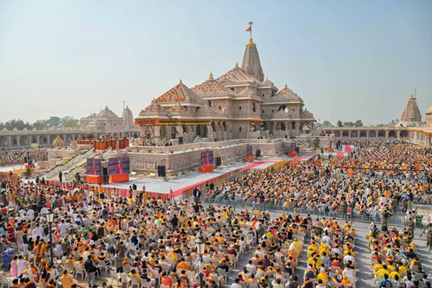
The history of Ayodhya’s Ram Mandir — one of India’s most iconic places of worship — is shrouded in intrigue, communal conflict, opposing interpretations of past chronicles and intra-religious as well as political rivalry. The last aspect became more pronounced as the temple reshaped the country’s political destiny, with the Rashtriya Swayamsevak Sangh (RSS) pulling the strings.
At the temple site stood the Babri Masjid, constructed in the 16th century on the orders of the Mughal Emperor Babur. It functioned as a mosque, although even then Ayodhya’s Hindu clerics spread the word that it was built on Rama’s “birthplace”. To bolster the belief, an idol of an infant Rama was placed inside the mosque’s central dome on the night of December 22-23, 1949, by Abhiram Das, a sadhu of the powerful Nirmohi Akhara, and his aides, signaling a virtual takeover of the mosque, which was then shut for prayers.
Decades later, an RSS-sponsored campaign led by the Vishwa Hindu Parishad (VHP) was adopted and weaponized by the BJP to counter “divisive” caste politics in the Mandal era. The judiciary stamped the seal of endorsement in 2019, declaring the site to be a temple, 27 years after the mosque was razed.
Few questioned the dubious circumstances that culminated in the appropriation and conversion of a mosque site. The Opposition parties which ventured into tricky terrain — the Samajwadi Party (SP) was upfront, while the Congress joined half-heartedly — were eclipsed in the elections that heralded the arrival of the BJP as a major force in the 1990s.
Months before the 2027 Assembly polls in Uttar Pradesh, the epicenter of temple-mosque polemics and clashes, it seems that for once the RSS, the BJP and the VHP are in a fix over an episode ostensibly of their own making. There is no Nehru, Muslim community, or the Opposition to blame for the alleged embezzlement of donations and theft of jeweler that came to the temple as offerings from Rama’s devotees.
It’s not that the temple project was ever short of funds. Every campaign that the VHP launched in the prelude to its consecration in 2024 saw money and material pour in, but there was never an insinuation of malfeasance. Not until June 5 this year, when some temple employees were caught by security guards with cash in their pockets. An employee accused the State Bank of India (where the money was deposited) staff of miscounting the cash and deleting the CCTV footage to avoid being caught.
Things got murkier after Santosh Dubey, a former kar sevak, alleged on social media that several gold bricks that came as contributions had disappeared. The Sangh could not dismiss Dubey’s voice. Vinay Katiyar, previously a BJP big leaguer who was the Faizabad MP and UP party chief, stated that while “thousands had made sacrifices for Rama”, money was never stolen.
In the tangled web of claims and counter-claims that the temple was enmeshed in after the “Pran Pratishtha” ceremony in January 2024, the crux lies in who now calls the shots in its administration and functioning: Delhi or Lucknow?
The Sangh-BJP’s dilemma in framing a cogent and credible response was reflected in a statement by the UP Speaker, Satish Mahana, in the Assembly on Wednesday. Mahana remarked that those who questioned “corruption” in the temple’s management had “put a question mark over the entire Hindu community”, but added that he was not defending the thieves.
The RSS finally sought to put a lid on the controversy as its general secretary, Dattatreya Hosabale, emphasized, “It is essential to ensure that anyone found guilty after the investigation faces severe punishment.” Those were harsh words, especially after the Parivar’s long-time savant, S Gurumurthy, who chairs the Vivekananda International Foundation (a strategic think tank), claimed in an article that the Ram Mandir Trust’s “unprecedented actions also clearly imply that this was a low-level theft, not a high-level scam”. It was an attempt at whitewashing the offence.
The Trust, which was headed by a former PMO official and PM Modi confidant Nripendra Misra, ensured that two key members — general secretary Champat Rai and trustee Anil Mishra — resigned once the needle of suspicion pointed towards them.
While Modi, who saw to it that the Trust was controlled by Delhi, remained silent, CM Yogi Adityanath swung into action. He constituted a special investigation team whose preliminary report became the basis for the arrest of eight persons and the resignations of Rai and Mishra. Yogi — whose mentor Mahant Avaidyanath once spearheaded the temple Trust — doubled down to steer the narrative from the theft to Hindutva by recalling the firing and killing of kar sevaks during the rule of Akhilesh Yadav’s father Mulayam Singh Yadav in 1990. He alleged that as CM, Akhilesh allowed Muslims to recite prayers at a spot close to the Ram Temple; he also accused the Congress, an SP ally, of employing tactics to delay the temple’s construction.
Amplifying or deflating an issue depends as much on the ruling establishment’s skill in countering the charges levelled against it as the Opposition’s ability to inflate its campaign to a degree where the party in power is ambushed. That hasn’t happened so far. Doubtless, the SP, playing for high stakes, raised and sustained the theft issue for a while, but when Adityanath flagged Hindutva, Akhilesh became defensive.
It’s not as if the Ayodhya region is a no-go for the SP or the Opposition. The SP’s Awadhesh Prasad wrested the Lok Sabha seat from the BJP in 2024; the SP also won the Ayodhya Assembly seat in 2012, ending the BJP’s long run.
The Opposition, especially the SP and the Congress, faces its first major test on the temple theft issue in the monsoon session of Parliament. Already crumbling under pressure from the BJP, some of the present and erstwhile INDIA constituents are being worked upon to support the 131st Constitution Amendment Bill, which fell through during Parliament’s sitting in April. The Opposition suspected that under the guise of bringing in women’s reservation in Parliament and the legislatures, the proposed legislation would pave the way for delimitation and gerrymandering of constituencies to help the ruling party.
As of now, an objective assessment from UP is that while the BJP’s credibility has been dented by the temple theft, Modi and Yogi can be counted on to salvage the situation before the Assembly polls.
(Radhika Ramaseshan is a senior journalist based in New Delhi and former Political Editor at The Telegraph. Her X handle is @Radrama)

Be the first to comment