

The film does not frame its narrative around separatism or religious identities
“The context of the movie is indeed the “Khalistan movement” in Punjab. Yet, as the title, Punjab ’95, suggests, the movie is not about the violence over the “Khalistan movement”. Nor does it give centrality to any popular leaders associated with the militancy movement. It barely ever mentions their names. The word “Khalistan” is hardly mentioned in the movie, too. The plot also does not center on Operation Bluestar or the anti-Sikh violence of 1984. Instead, the context of its narrative is the police excesses in Punjab under the direct patronage of the local state.”
After nearly four years of waiting before the Central Board of Film Certification, Honey Trehan’s movie starring Diljit Dosanjh in the lead role, Punjab ’95, was released on an OTT platform in the first week of July under the altered title, Satluj. For the Indian audience, it was available for only two days. Many in India knew about the movie and the troubles its makers were having with the censor authorities about its certification. However, after its brief online release, the movie has gained unprecedented popularity, particularly among Sikhs and Punjabis.
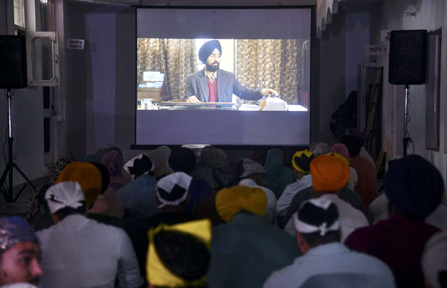
The movie is no longer available for screening in cinemas or on the OTT platform. But its pirated/downloaded version is doing the rounds and it is being screened in gurdwaras and community centers across villages and cities in Punjab and other states in northwest India. The Delhi Sikh Gurdwara Management Committee organized its screening at Rakab Ganj Gurdwara, located in the center of the national capital.
How do we make sense of such extraordinary enthusiasm among a cross-section of Punjabis for what is essentially a mainstream Bollywood film?
Not about “Khalistan”
For those who have lived through the 1980s, the movie evokes memories of the “Khalistan movement”. The decade witnessed violence of different kinds: mindless killings of innocents by militants, the tragic assault on the Golden Temple by the Army in June 1984, the murder of Prime Minister Indira Gandhi by her Sikh bodyguards in October 1984, followed by large-scale violence against Sikhs in Delhi, that killed thousands of residents and altered the lives of entire families within the capital city. Many other cities also reported the killings of Sikhs in November 1984. The crisis continued for around 15 years: from the late 1970s to the early 1990s.
The context of the movie is indeed the “Khalistan movement” in Punjab. Yet, as the title, Punjab ’95, suggests, the movie is not about the violence over the “Khalistan movement”. Nor does it give centrality to any popular leaders associated with the militancy movement. It barely ever mentions their names. The word “Khalistan” is hardly mentioned in the movie, too. The plot also does not center on Operation Bluestar or the anti-Sikh violence of 1984. Instead, the context of its narrative is the police excesses in Punjab under the direct patronage of the local state.
As is widely known, in 1988, the Punjab government appointed KPS Gill as the Director General of Police of Punjab and gave him a free hand to deal with the militants, with the assurance that he would not be asked any questions about his methods. With unlimited power at his disposal, he pursued a policy of ruthless suppression. The Punjab police soon gained the upper hand vis-à-vis the militants.
However, the police repression did not stop after confronting militant violence. A section of the police personnel turned it into a bloody enterprise. Killing a militant fetched a reward, monetary and otherwise. Those who could show a higher number of militants killed by their guns were given quick out-of-turn promotions.
When no militants were left to be killed, they began abducting innocent young men, demanding ransom from their parents for their release. Many young men, mostly Sikhs, were killed during this period.
The police kept no records of these killings. The victims just disappeared. Their bodies were quietly cremated or simply thrown into canals criss-crossing the state. The movie claims that the number of such killings could have been as high as 25,000.
It was in this context that a bank officer, Jaswant Singh Khalra, decided to follow up on the disappearance of someone he knew well. As he explores the case, he uncovers an entire system of unjust and unrecorded killings. While he succeeds in bringing to light the disappearance of young men and exposing the direct role of the Punjab police in them, he himself becomes its victim.
Khalra is advised against pursuing the case and is threatened with dire consequences, but he persists with his mission. As a consequence, he, too, is kidnapped, tortured, and eventually killed by the police.
Not about separatism
Popular narratives on the Punjab crisis of the 1980s present it as a struggle for secession from the Indian Union. Though the movement never received popular support, the militants did think along those lines.
However, the film does not frame its narrative around separatism or religious identities. A large majority of the policemen shown in the movie are also turban-wearing Sikhs, as are their victims. The movie avoids presenting it purely as a Sikh cause. Instead, it focusses on unveiling the ‘truth’. As the main protagonist puts it somewhere in the movie: we are not ‘attwadis’ (terrorists), we are ‘satwadis’ (protectors of truth/righteous).
The movie portrays Khalra’s struggle in the language of rights, as enshrined in the Indian Constitution. He is also shown to have full faith in the Indian judicial system and seeks an inquiry by a Union government agency. The movie also shows how a cigarette-smoking (a taboo for the Sikhs) police officer from a central agency eventually exposes the crimes of the Punjab police, leading to the marginalization of the top cop.
Produced jointly by Ronnie Screwvala, Abhishek Chaubey, and Honey Trehan, Satluj clearly belongs to the mainstream of Bollywood cinema in terms of its plot and cinematography. Though it does not have a romantic love angle anywhere in the story, its genre is typical of a biopic of a celebrated hero. Police brutality has often been a part of Hindi movies as well as those made in other languages in India and abroad.
Its political message is also not out of the ordinary. It is merely asking for justice and judicial accountability, which have long been recurring themes everywhere. Nowhere does it challenge the legitimacy of the Indian state, its foundational imagination, or its structure.
On the contrary, it calls for strict adherence to the constitutional mandate. It shows how a deviation, even when motivated by good intentions, can produce disastrous outcomes. And how a move of this kind could transform institutions, such as the police force, into a rent-seeking, anti-citizen, oppressive agency. It is surprising that its certification from the authorities concerned in India has become an issue.
For the Sikhs and Punjabis, it is a movie that they see as truthfully presenting their experiences of the 1980s and 1990s. It depicts their memories of suffering and pain without labelling them anti-national (“Khalistani”). It is their story in a language that doesn’t “target” them. The binary it presents is not that of terrorist/separatist versus nationalist, but that of ‘attwadis’ versus ‘satwadis’.
Perhaps most importantly, they have endorsed the movie because even when it presents them as suffering, they are not shown merely as victims languishing in hopelessness. Its protagonist is loved because he shows the courage to fight back, even when he knows that it would lead to his ‘shahadat’ (martyrdom).
(Surinder S Jodhka is a sociologist who worked formerly with JNU)



Be the first to comment