
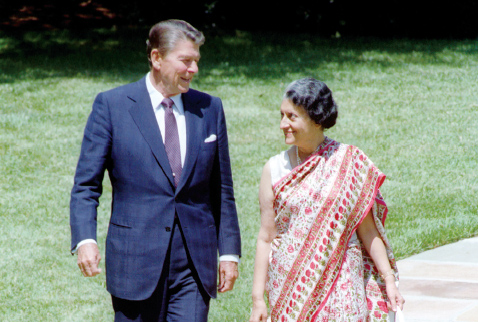

How two democracies overcame decades of mistrust to build one of the world’s most consequential bilateral relationships
-
BY TIP TEAM
Few bilateral relationships have undergone as dramatic a transformation over the past three decades as that between India and the United States. Once marked by deep suspicion, conflicting geopolitical priorities, and ideological distance, the partnership today spans defense, technology, trade, education, healthcare, and people-to-people ties. Yet, even as cooperation has reached unprecedented levels, differences persist over trade, strategic autonomy, Russia, and regional security. For Indian Americans, this relationship carries special significance. More than five million people of Indian origin now call the United States home, making them one of the country’s most successful immigrant communities. They have become an indispensable bridge connecting the world’s oldest democracy with its largest, ensuring that bilateral ties extend well beyond diplomacy into business, academia, medicine, innovation, and culture. The evolution of India-U.S. relations is therefore not simply a story of governments changing policies. It is the story of two democracies gradually discovering that while their national interests are not identical, they increasingly overlap in ways that make partnership both desirable and necessary.
A DIFFICULT BEGINNING
When India became independent in 1947, many American policymakers hoped the new nation would naturally align with the Western bloc during the emerging Cold War. Those expectations quickly proved misplaced. Prime Minister Jawaharlal Nehru believed India’s newly won independence would be incomplete if the country became part of any military alliance. Instead, India adopted the doctrine of non-alignment, seeking the freedom to make decisions based on its own national interests rather than those of Washington or Moscow. This philosophy became one of the defining pillars of Indian foreign policy and remains influential even today. For Washington, however, the Cold War was increasingly viewed through ideological lenses. American policymakers wanted nations to choose sides in the global contest against communism. India’s refusal to do so often frustrated successive U.S. administrations, even though many American leaders continued to recognize India’s democratic importance. Economic differences further widened the gap. Independent India embraced a state-led development model, emphasizing public sector industries, import substitution, and strict regulation of foreign investment. American businesses found India’s market difficult to access, while Indian policymakers remained wary of excessive dependence on foreign capital and multinational corporations.
THE PAKISTAN FACTOR
Perhaps no single issue complicated bilateral ties more than America’s close relationship with Pakistan. Beginning in the 1950s, Pakistan became a key American ally in Cold War alliances such as SEATO and CENTO. Large quantities of American military assistance flowed into Pakistan, alarming Indian policymakers who feared that sophisticated weapons supplied for Cold War purposes could eventually be used against India. Those fears appeared justified during the wars of 1965 and 1971. The Bangladesh Liberation War of 1971 became a particularly painful chapter in Indian strategic memory. While India supported Bangladesh’s struggle for independence, the Nixon administration tilted decisively toward Pakistan, even dispatching the USS Enterprise into the Bay of Bengal. Although American policymakers viewed their decisions through the prism of Cold War strategy and relations with China, many Indians interpreted them as evidence that Washington fundamentally misunderstood India’s security concerns. The Afghan war of the 1980s reinforced these perceptions. Pakistan again became indispensable to American strategy, receiving extensive military and financial assistance despite concerns over its nuclear weapons program and support for extremist groups. For New Delhi, the message seemed clear: Washington’s regional priorities consistently favored Islamabad whenever larger geopolitical interests were involved.
RUSSIA AND INDIA’S STRATEGIC AUTONOMY
Another enduring difference involved India’s relationship with the Soviet Union, and later Russia. Unlike many Western countries, India never regarded Moscow primarily through ideological lenses. Soviet support for India’s industrialization, heavy manufacturing, defense modernization, and diplomatic Project Sponsored by Group of Companies backing at the United Nations created a relationship built on practical national interests rather than shared political systems. Over decades, Soviet equipment became deeply embedded in India’s military infrastructure, a dependence that continues to shape defense policy today. This historical legacy helps explain why India has continued to maintain close relations with Russia even while expanding strategic cooperation with the United States. From India’s perspective, maintaining diversified international partnerships reflects strategic autonomy— not geopolitical indecision. Washington has often found this balancing act frustrating, but over time many American administrations came to appreciate that India’s foreign policy would always differ from that of formal U.S. allies.
THE CHINA EQUATION
If Pakistan complicated bilateral relations during the Cold War, China has increasingly become the central strategic factor bringing India and America closer together. India’s initial hopes of peaceful coexistence with China collapsed after the 1962 border war. Although diplomatic and economic ties later improved, repeated military standoffs—from Sumdorong Chu to Doklam and the deadly Galwan Valley clashes of 2020—have reinforced Indian concerns about China’s long-term strategic intentions. At the same time, China’s growing influence across South Asia through infrastructure investments, military cooperation, and the Belt and Road Initiative has increased India’s security anxieties. Washington’s own concerns about Beijing’s expanding military, technological, and economic influence have gradually aligned with New Delhi’s strategic outlook, creating an important foundation for cooperation in the Indo-Pacific.
A TURNING POINT
Ironically, the Cold War’s end transformed the relationship far more than decades of diplomacy had managed to accomplish. The collapse of the Soviet Union deprived India of its principal strategic partner while simultaneously triggering a severe balance-of-payments crisis. Facing economic necessity, Prime Minister P. V. Narasimha Rao launched sweeping market reforms beginning in 1991. Trade barriers were lowered, licensing requirements dismantled, and foreign investment encouraged across multiple sectors. These reforms fundamentally altered India’s economic relationship with the United States. American companies suddenly viewed India not merely as a developing country but as an emerging market with enormous longterm potential. Rao also recognized that geopolitical realities had changed. During his landmark 1994 visit to Washington, he called for freeing India-U.S. relations from “the distortions induced by the Cold War” and building cooperation based on converging interests rather than historical differences. Although his visit received relatively little media attention in the United States, history would later recognize it as an important milestone in reshaping bilateral relations.
THE NUCLEAR TESTS AND DIPLOMATIC RESET
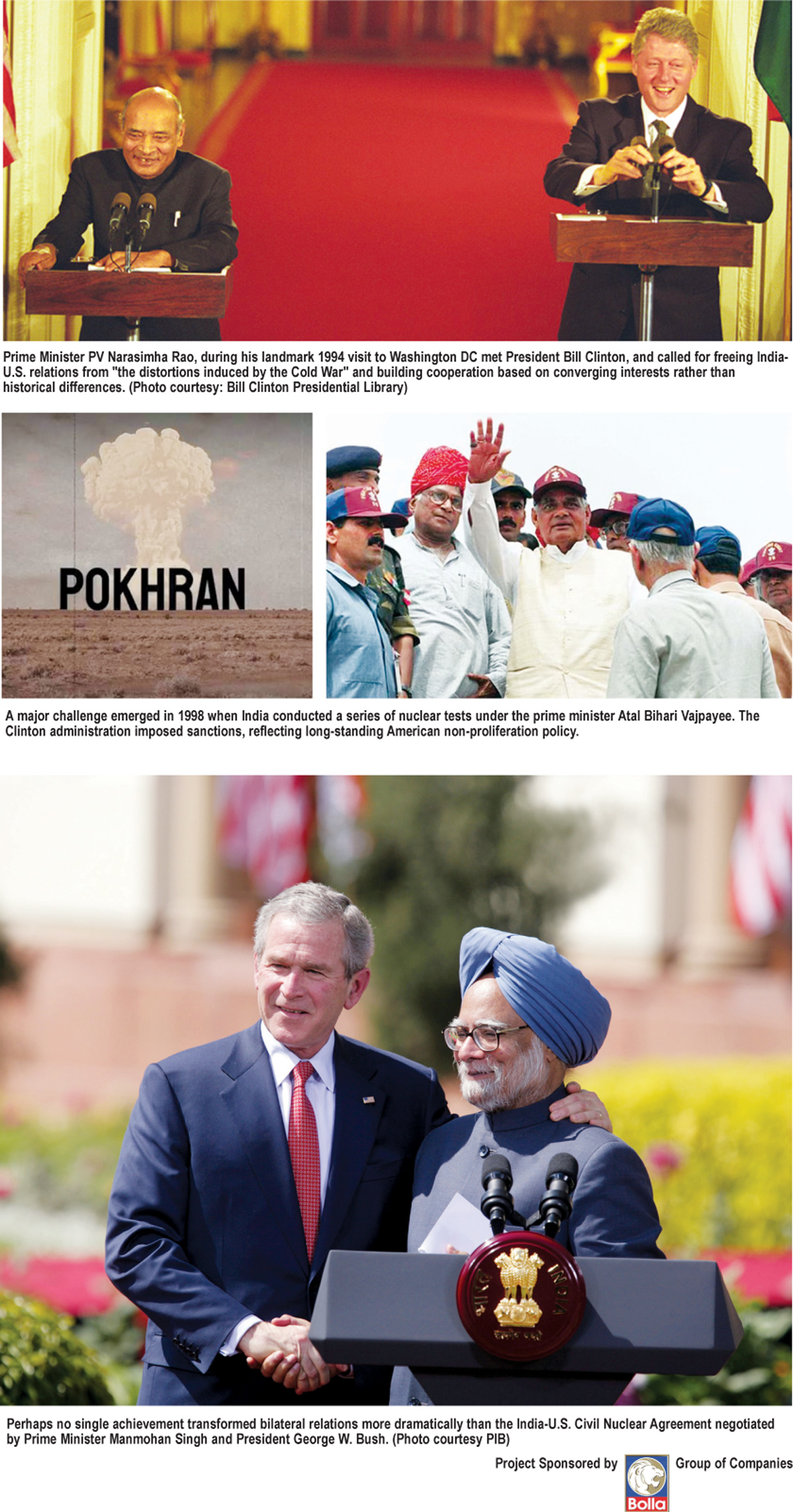 Another major challenge emerged in 1998 when India conducted a series of nuclear tests. The Clinton administration imposed sanctions, reflecting long-standing American non-proliferation policy. Yet instead of allowing relations to deteriorate further, both governments embarked on an intensive diplomatic dialogue. Indian External Affairs Minister Jaswant Singh and U.S. Deputy Secretary of State Strobe Talbott held eleven rounds of discussions covering nuclear doctrine, regional security, strategic stability, and the broader future of bilateral relations. These conversations gradually transformed mutual perceptions. American officials developed a deeper understanding of India’s security concerns, while Indian policymakers began recognizing that Washington increasingly viewed India as an emerging strategic partner rather than merely a proliferation challenge.
CLINTON’S HISTORIC VISIT
President Bill Clinton’s 2000 visit to India marked the true beginning of the modern strategic partnership. It was the first presidential visit to India in twenty-two years and symbolized Washington’s recognition that India’s growing economy, democratic stability, and geopolitical importance required a fundamentally new approach.Structured dialogue resumed, sanctions began to ease, commercial engagement accelerated, and political trust gradually deepened. Successive administrations—Republican and Democratic alike—continued building upon this foundation, demonstrating that closer ties with India had become one of the few enduring bipartisan priorities in American foreign policy.
THE CIVIL NUCLEAR BREAKTHROUGH
Perhaps no single achievement transformed bilateral relations more dramatically than the India-U.S. Civil Nuclear Agreement negotiated by Prime Minister Manmohan Singh and President George W. Bush. For more than three decades after India’s first nuclear test, New Delhi had remained largely isolated from the global nuclear order. The 2008 agreement ended that isolation. Equally important, it reflected an extraordinary level of political trust. Washington effectively acknowledged India’s responsible nuclear record without requiring it to join the Nuclear Non-Proliferation Treaty as a nonnuclear weapon state—an unprecedented diplomatic accommodation. The agreement fundamentally altered perceptions on both sides. The United States increasingly viewed India as a long-term strategic partner, while New Delhi shed much of the Cold War suspicion that had long characterized its approach toward Washington. That transformation laid the foundation for the remarkable expansion of cooperation in defense, commerce, technology, education, healthcare, and innovation that would define the next two decades.
FROM STRATEGIC CONVERGENCE TO STRATEGIC REALISM
The transformation of India-U.S. relations during the first decade of the twenty-first century created a momentum that few observers could have imagined during the Cold War. What began as cautious engagement gradually evolved into a comprehensive strategic partnership encompassing defense, technology, trade, energy, education, and regional security. Yet the very success of the relationship has also raised expectations, making differences more visible when they arise. Today, the central question is no longer whether India and the United States should work together. That debate has largely been settled. The challenge is whether the two democracies can sustain a mature partnership while accepting that their national interests will sometimes diverge. The relationship has entered what might best be described as an era of strategic realism—one in which cooperation remains deep but neither side expects complete alignment.


Be the first to comment