

Invokes ‘Yuva Shakti,’ self-reliance and Vande Mataram as India looks toward the centenary of Independence
NEW DELHI (TIP): Prime Minister Narendra Modi led India in celebrating its 80th Independence Day on Saturday, August 15, using his address from the historic ramparts of the Red Fort to set out an ambitious vision for transforming the country into a developed nation—Viksit Bharat—by 2047, when India completes 100 years of Independence.
The celebration, built around the twin themes of “150 Years of Vande Mataram” and “Yuva Shakti for Viksit Bharat@2047,” combined the solemn remembrance of India’s freedom struggle with a forward-looking emphasis on youth, economic strength, technological capability and national self-reliance.
It was Modi’s 13th consecutive Independence Day address as Prime Minister, placing him alongside Jawaharlal Nehru as the only Indian prime ministers to have delivered at least 13 consecutive Independence Day speeches from the Red Fort.
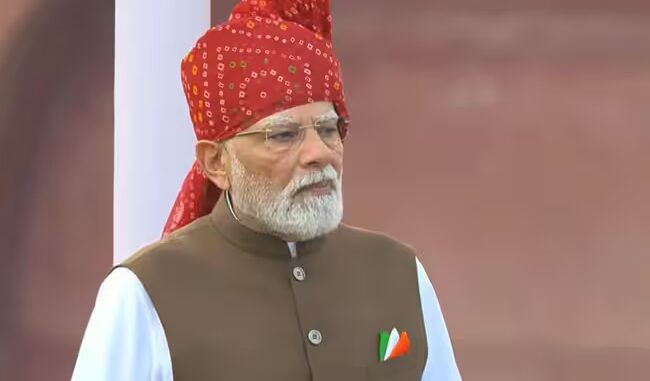
For the occasion, Modi continued what has become a distinctive Independence Day tradition, wearing a striking red tie-and-dye turban, associated with the textile traditions of Rajasthan and Gujarat, along with a tricolor-inspired pocket square.
The morning began with the traditional ceremonial reception and Guard of Honour before the Prime Minister unfurled the National Flag at the Red Fort. The unfurling of the Tricolor was accompanied by the ceremonial 21-gun salute, while Indian Air Force helicopters showered flower petals over the venue.
This year’s ceremony, however, carried special historical symbolism.
For the first time as part of the Independence Day celebrations at the Red Fort, “Vande Mataram” was rendered from the ramparts, marking the continuing commemoration of 150 years of India’s National Song. The government had designated the anniversary of Bankim Chandra Chattopadhyay’s celebrated composition as a central theme of the national celebration.
The patriotic invocation continued throughout the ceremony. Approximately 2,500 NCC cadets and My Bharat volunteers were positioned at Gyanpath, with the day’s arrangements designed around the Vande Mataram and Viksit Bharat themes.
Modi himself invoked the song’s emotional place in India’s national consciousness, declaring that “every heart is beating with the rhythm of Vande Mataram.”
At the beginning of his address, the Prime Minister paid homage to the generations of freedom fighters whose sacrifices brought nearly two centuries of colonial domination to an end.
Their courage and sacrifice, Modi said, remained an inspiration for the country’s present generation as it undertakes another national mission—not now the struggle to win freedom, but the effort to build a developed India by the centenary of Independence.
That connection between the sacrifices of the past and the ambitions of the future ran through much of the address.
The freedom generation had given India political independence; Modi’s message to today’s generation was that it now carried the responsibility of giving that independence its fullest economic, technological and social expression.
The road to Viksit Bharat
The centerpiece of the Prime Minister’s speech was his government’s long-term national objective of Viksit Bharat by 2047.
Modi presented the coming 21 years as a period in which India must accelerate development, strengthen domestic capabilities and reduce strategic dependence on other countries.
He placed particular emphasis on self-reliance, arguing that India’s future economic strength would depend not simply upon higher growth but upon its ability to build capabilities in strategic sectors.
Among the areas he highlighted were critical minerals, energy and semiconductor chips—sectors increasingly important not only to economic competitiveness but also to national security and technological sovereignty.
The message was unmistakable: India’s ambition to become a developed country cannot rest solely upon the size of its economy. It must be accompanied by technological depth, industrial capability and greater resilience in strategic supply chains.
Youth at the center of the 2047 mission
The official Independence Day theme placed Yuva Shakti—Youth Power— at the heart of the Viksit Bharat project.
That emphasis reflected a demographic reality as much as a political message. The generation that will inherit India at 100 is already being educated, trained and employed today. For Modi, therefore, the 2047 objective is inseparable from the ambitions, skills and energies of young Indians.
The Prime Minister portrayed India’s approximately 140 crore people—and particularly its young citizens—as the force capable of carrying the country toward new levels of development.
His message was essentially one of national scale: a country of India’s population, entrepreneurial energy and technological aspirations must think beyond incremental progress and set goals commensurate with its potential.
From ‘Fragile Five’ to a more confident economy
Modi also returned to the economic comparison that has figured prominently in his government’s political narrative—the contrast between the India his government inherited in 2014 and the India it says exists today.
He recalled the period when India was counted among the so-called “Fragile Five” emerging economies, arguing that the country had since strengthened its economic foundations and considerably accelerated development.
The characterization inevitably belongs within the larger political debate over India’s economic performance. The government points to infrastructure expansion, digitization, financial inclusion, manufacturing, investment and India’s increased global economic weight as evidence of transformation, while critics continue to raise questions about employment, inequality, household pressures and the distribution of the benefits of growth.
But from the Red Fort, Modi’s emphasis was firmly on confidence: India, he argued, should no longer think of itself as a country condemned to follow technological and economic transformations created elsewhere.
His 2047 prescription was for an India increasingly capable of creating, producing and competing on its own strength.
Solidarity with flood-affected families
The sweep of the Prime Minister’s address from past achievement to future ambition was interrupted by acknowledgement of a painful present reality.
Modi expressed solidarity with families affected by recent floods and assured those facing loss and displacement of government support and assistance in rehabilitation.
The reference brought a human dimension to a speech otherwise dominated by national goals and economic transformation—an acknowledgment that the measure of development must ultimately include the country’s capacity to stand beside citizens in moments of calamity.
The audience assembled at the Red Fort was itself intended to symbolize the government’s conception of popular participation in India’s development journey.
Approximately 5,000 special guests from different parts of the country were invited to witness the celebrations. They represented diverse walks of life, including women entrepreneurs, sanitation workers, street vendors, farmers, innovators, start-up founders and young achievers. More than 1,500 invitees from States and Union Territories were expected in traditional attire, creating a vivid representation of India’s cultural diversity.
The choice of guests reflected an effort to move the national ceremony beyond political and official elites and give visible representation to citizens whom the government identifies as participants in India’s development story.
From the memory of freedom to the responsibility of 2047
If one theme connected the different strands of Modi’s 13th Red Fort address, it was the idea that India’s 80th Independence Day should be regarded not merely as another anniversary, but as a milestone on the road toward 2047.
The Prime Minister looked backward to the sacrifices that won freedom but devoted much of his attention to what the present generation must do with that inheritance.
Vande Mataram provided the historical and emotional bridge. Yuva Shakti represented the generation being asked to carry the responsibility forward. And Viksit Bharat@2047 supplied the destination.
Whether India can fulfill that extraordinarily ambitious promise will depend on much more than declarations from the Red Fort. It will require sustained economic growth, employment for its young population, improvements in education and health, technological innovation, stronger institutions, social cohesion and the ability to ensure that development reaches citizens across regions and economic classes.
But on India’s 80th Independence Day, Modi sought to leave the country with a message of confidence rather than hesitation: that the India approaching the centenary of its freedom should aspire not merely to become richer, but stronger, more self-reliant, technologically capable and fully developed.
From the ramparts from which India’s prime ministers have addressed the nation since the dawn of Independence, the horizon was fixed firmly on 2047.
And the generation being summoned to reach it was India’s youth.

Be the first to comment