
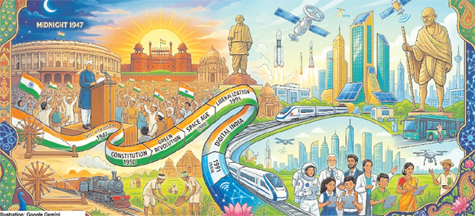

From 1947 to the India of Tomorrow: Building a Nation, Shaping a Future
India’s story is one of extraordinary transformation. On 15 August 1947, a nation emerged from nearly two centuries of colonial rule, carrying the immense burdens of Partition, poverty, illiteracy, food insecurity and weak infrastructure — but also an unshakable belief in its own destiny.
The freedom struggle had brought together remarkably different visions and voices. Gandhi made non-violence and mass mobilization powerful instruments of resistance; Nehru championed modern institutions and scientific temper; Patel helped unite a fragmented political landscape; Ambedkar gave the Republic its constitutional foundation; and revolutionaries such as Bhagat Singh, Rajguru, Sukhdev, Kartar Singh Sarabha and Subhas Chandra Bose represented the courage and sacrifice of another strand of the struggle. Together with millions of ordinary Indians, they made independence possible.
The years after 1947 became a vast experiment in nation-building. India adopted universal adult franchise, built democratic institutions, reorganized its states, expanded education and industry, strengthened agriculture and developed an independent scientific and technological base. Wars, political upheavals, the Emergency, communal violence, economic crises and social tensions repeatedly tested the Republic.
Then came another turning point. The economic reforms of 1991 opened India to a more competitive and interconnected world. Liberalization, the IT revolution, entrepreneurship and expanding infrastructure reshaped the economy and created new possibilities for millions.
Today, India stands as a major global economy, nuclear power, space faring nation, technology hub and influential democracy. Digital infrastructure, scientific achievements and a globally connected population have transformed everyday life.
Yet India’s journey remains unfinished. Employment, inequality, education, healthcare, environmental pressures, social cohesion and the quality of democratic institutions remain defining challenges.
India @ 80 is therefore not merely a celebration of how far the nation has travelled. It is a reflection on what was built, what was achieved and what must still be created — as India looks towards the next chapter of its extraordinary journey.



Be the first to comment