

From Non-Alignment to Strategic Autonomy: India and the World
India’s foreign policy since independence has been shaped by a central paradox. The country emerged in 1947 determined to protect its sovereignty and avoid becoming an instrument of any great power, yet it was born into a world increasingly divided between competing blocs. The Cold War, wars with neighbours, the rise of China, the disintegration of the Soviet Union, globalisation, terrorism, the emergence of the United States as the dominant power and the rise of a multipolar world have repeatedly forced India to rethink how it engages with the outside world.
The broad principle, however, has remained remarkably consistent: India seeks strategic space to make its own decisions.
Under Jawaharlal Nehru, that principle was expressed through non-alignment. In the post-Cold War period, it evolved into what is now commonly described as strategic autonomy. India has developed partnerships with countries that may themselves be rivals, while avoiding formal military alliances.
India’s foreign policy today is consequently neither isolationist nor alliance-driven. It is an increasingly active form of multi-alignment: cooperation with the United States and Europe in technology and security; deep defence and energy ties with Russia; intense competition and engagement with China; neighbourhood diplomacy across South Asia and the Indian Ocean; and a growing role in the Global South.
The journey from 1947 to the present is therefore not a story of abandoning old principles. It is a story of adapting them to a changing world.
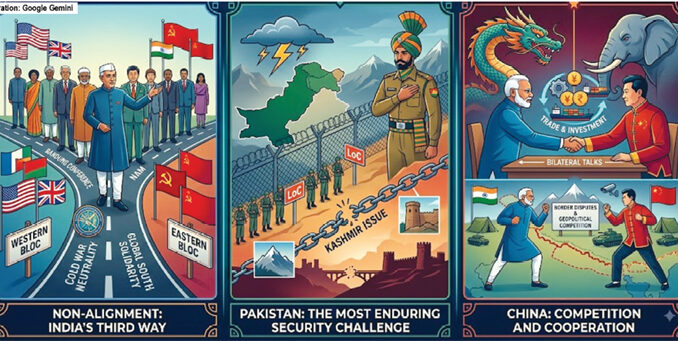
- NON-ALIGNMENT: INDIA’S THIRD WAY
Nehru and the Cold War
When India became independent, the international system was dominated by two superpowers—the United States and the Soviet Union.
Washington and Moscow were competing for political influence, military alliances and ideological legitimacy across the world.
India had little interest in becoming part of that confrontation.
Jawaharlal Nehru believed that newly independent countries should retain the freedom to determine their own policies.
Non-alignment was therefore not intended to mean neutrality in every international dispute.
India could take a position on an issue while refusing to become permanently attached to either bloc.
This distinction was important.
India opposed colonialism and apartheid, supported national liberation movements and frequently advocated disarmament and peaceful coexistence.
The Bandung Spirit
The emergence of Asian and African countries from colonial rule created a new diplomatic constituency.
The 1955 Bandung Conference became a landmark in the development of Afro-Asian solidarity.
India worked alongside leaders such as Indonesia’s Sukarno, Egypt’s Gamal Abdel Nasser, Yugoslavia’s Josip Broz Tito and Ghana’s Kwame Nkrumah in developing a diplomatic space for countries that did not want their foreign policies dictated by the superpowers.
The Non-Aligned Movement formally emerged in 1961.
India became one of its principal voices.
Non-Alignment and National Interest
Non-alignment also served India’s practical interests.
India needed economic assistance, technology and military equipment from multiple sources.
Remaining outside military blocs gave New Delhi greater diplomatic flexibility.
But non-alignment was never without contradictions.
India developed increasingly close defence and strategic relations with the Soviet Union, particularly from the 1970s onward.
The Indo-Soviet Treaty of Peace, Friendship and Cooperation signed in 1971 reflected the strategic circumstances of the time.
Yet India continued to resist the idea of becoming a formal Soviet ally.
The larger principle survived:
India would cooperate with major powers without surrendering its freedom of decision.
- INDIA AND ITS NEIGHBOURS
A Foreign Policy Begins at Home
For India, foreign policy has always begun with its neighbourhood.
India shares land borders with Pakistan, China, Nepal, Bhutan, Bangladesh and Myanmar, while Sri Lanka and the Maldives lie in its immediate maritime neighbourhood.
Afghanistan, though not sharing a border with present-day India, has historically remained an important part of India’s wider regional strategic environment.
The neighbourhood has therefore been central to India’s security calculations.
Pakistan: The Most Enduring Security Challenge
India’s relationship with Pakistan has been shaped by the legacy of Partition.
The two countries fought wars in 1947–48, 1965 and 1971, while the 1999 Kargil conflict further demonstrated the volatility of the relationship.
The central disputes have included Jammu and Kashmir, terrorism, cross-border militancy and military confrontation.
India and Pakistan have also experienced periods of dialogue.
The Simla Agreement of 1972 and the Lahore Declaration of 1999 represented attempts to establish a framework for peaceful relations.
Yet terrorism and security concerns have repeatedly disrupted diplomatic engagement.
India’s position in recent years has emphasised that terrorism and dialogue cannot proceed simultaneously without addressing the security threat.
China: Competition and Cooperation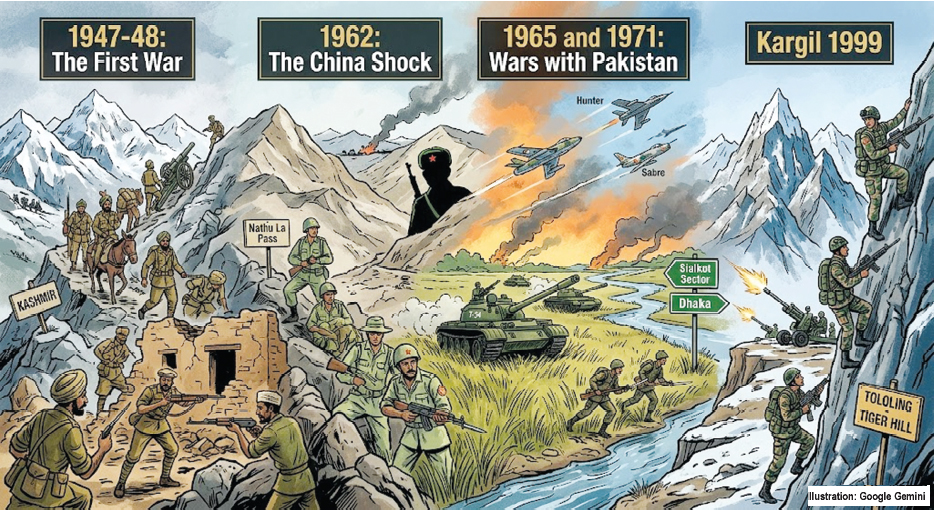
China represents India’s most consequential long-term strategic challenge.
The two countries share a long and disputed border.
The 1962 war left a deep imprint on Indian strategic thinking.
For decades thereafter, both sides attempted to maintain peace along the border while expanding economic relations.
Trade increased dramatically.
However, the military standoff that began in eastern Ladakh in 2020 fundamentally altered the relationship.
Border tensions remain a central concern.
At the same time, China is India’s largest or among its largest trading partners depending on the year and measurement, making the relationship economically complex.
India’s China policy therefore combines military preparedness, diplomatic engagement, economic risk management and broader partnerships with other countries.
Bangladesh: From Conflict to Partnership
The creation of Bangladesh in 1971 transformed India’s eastern neighbourhood.
India supported the Bangladesh liberation struggle and played a decisive military role in the 1971 war.
The relationship subsequently developed across trade, connectivity, energy, security and river-water cooperation.
Bangladesh has become one of India’s most important partners in South Asia.
Connectivity projects linking India’s Northeast with Bangladesh have also acquired major strategic significance.
Nepal and Bhutan
India’s relationship with Nepal is shaped by geography, history, culture, economic ties and extensive people-to-people connections.
Yet the relationship has also experienced political tensions, including disagreements over borders and perceptions of Indian influence.
Bhutan has traditionally enjoyed a particularly close relationship with India.
Hydropower cooperation, economic assistance and security coordination form important pillars of the partnership.
Sri Lanka and the Indian Ocean
Sri Lanka occupies a strategically vital position close to major Indian Ocean shipping routes.
India’s relationship with Colombo includes trade, investment, security and cultural connections.
The experience of India’s intervention during the Sri Lankan civil war in the late 1980s remains an important chapter in the bilateral relationship.
Today, maritime security and India’s concern about growing external strategic influence in Sri Lanka have acquired greater importance.
The Maldives and the Indian Ocean
The Maldives is strategically important because of its location near major Indian Ocean sea lanes.
India has provided assistance during political, economic and humanitarian crises.
The relationship has also reflected the changing balance of regional politics, including the growing involvement of China.
For India, the Maldives is not simply a small island neighbour.
It is part of the strategic geography of the Indian Ocean.
The Neighbourhood First Approach
India has increasingly emphasised a Neighbourhood First approach.
The objective is to strengthen connectivity, trade, energy links, development partnerships and security cooperation.
But India’s neighbourhood diplomacy faces competition from other powers, domestic political sensitivities within neighbouring countries and historical perceptions of Indian dominance.
The challenge is therefore to be the region’s largest power without appearing to behave like a hegemon.
- INDIA’S WARS AND STRATEGIC TRANSFORMATION
1947–48: The First War
Independent India’s first major security crisis came almost immediately after Partition.
Conflict erupted over Jammu and Kashmir in 1947.
The war established Pakistan as India’s principal military adversary for decades and brought Kashmir to the centre of Indian security policy.
1962: The China Shock
The war with China in 1962 was a turning point.
India’s military preparedness proved inadequate, and the conflict exposed serious weaknesses in defence planning.
The experience transformed Indian strategic thinking.
Defence spending increased.
The armed forces expanded.
Mountain warfare capabilities received greater attention.
The country began to approach national security with a more realistic assessment of military power.
1965 and 1971: wars with Pakistan
The 1965 war with Pakistan further reinforced the importance of military preparedness.
The 1971 war was fundamentally different.
India supported the Bangladesh liberation movement and eventually intervened militarily.
The war resulted in the creation of Bangladesh and represented one of India’s most decisive military victories.
The experience reinforced India’s confidence in its ability to shape regional outcomes.
Kargil 1999
The Kargil conflict demonstrated that even in the nuclear age, limited conventional conflict remained possible.
India’s military response was carefully calibrated to remain within the Line of Control.
The war reinforced the importance of intelligence, surveillance, high-altitude warfare and military preparedness.
From Conventional Wars to New Security Threats
India’s security concerns have expanded beyond traditional warfare.
Terrorism, cyber threats, drones, maritime insecurity, space security and disinformation now form part of the strategic landscape.
The military has therefore been adapting from an essentially land-focused security model towards a more integrated approach involving land, sea, air, space and cyber capabilities.
Pakistan: From Partition to a New Era of Strategic Confrontation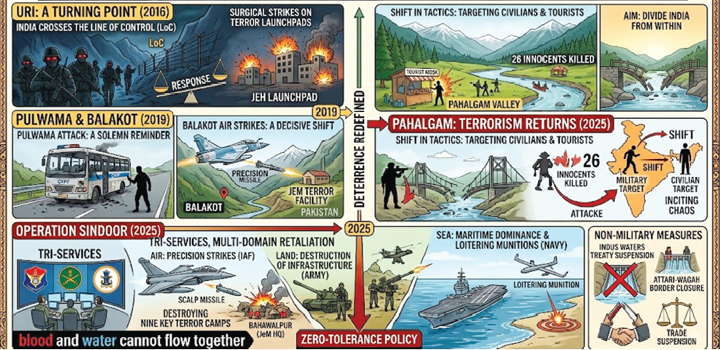
India’s relationship with Pakistan has been the most enduring and difficult security challenge of the republic’s history. Born out of the trauma of Partition in 1947, the relationship has been marked by wars, territorial disputes, cross-border terrorism, diplomatic initiatives and repeated breakdowns in dialogue.
The first India-Pakistan war began in 1947–48 over Jammu and Kashmir. Another war followed in 1965, while the 1971 conflict transformed the map of South Asia with the creation of Bangladesh. The Kargil conflict of 1999 demonstrated that even after both countries became declared nuclear powers, limited conventional warfare remained possible.
In the decades that followed, terrorism and cross-border militancy became the defining features of India’s security concerns with Pakistan.
Uri: A Turning Point in India’s Response
The September 2016 terrorist attack on an Indian Army camp at Uri in Jammu and Kashmir, in which 19 soldiers were killed, became an important turning point.
India subsequently announced that its forces had conducted “surgical strikes” across the Line of Control against terrorist launch pads. The operation marked a significant change in the public articulation of India’s counter-terrorism doctrine.
The message was that terrorist attacks originating across the Line of Control could result in a direct military response.
The episode was followed by a period in which India’s response to terrorism increasingly emphasised deterrence and the costs of cross-border attacks.
Pulwama and Balakot
The February 2019 suicide bombing in Pulwama, Jammu and Kashmir, in which 40 CRPF personnel were killed, triggered another major escalation.
India conducted an air strike on what it described as a Jaish-e-Mohammed terrorist training camp at Balakot in Pakistan’s Khyber Pakhtunkhwa province.
The episode was significant because it demonstrated that India’s response to terrorism could extend beyond the Line of Control.
The subsequent aerial confrontation between India and Pakistan brought the dangers of escalation between two nuclear-armed states into sharp focus.
At the same time, the episode reinforced a transformation in India’s security doctrine: terrorism was increasingly being treated not simply as a law-and-order problem but as a national-security challenge requiring military, diplomatic and intelligence responses.
Pahalgam: Terrorism Returns to the Centre
The terrorist attack in Pahalgam in April 2025 marked another grave moment in India-Pakistan relations. The attack, which targeted civilians and resulted in the deaths of 26 people, generated widespread outrage across India.
New Delhi attributed responsibility to Pakistan-based militant networks and announced a series of measures against Pakistan.
The attack became the immediate backdrop to the most significant India-Pakistan military confrontation in years.
Operation Sindoor
In May 2025, India launched Operation Sindoor, striking what it described as terrorist infrastructure in Pakistan and Pakistan-occupied Jammu and Kashmir following the Pahalgam attack.
The operation represented another stage in the evolution of India’s counter-terrorism posture.
Unlike earlier responses that were primarily associated with cross-border strikes or a limited military action, Operation Sindoor was presented by India as a broader demonstration of its determination to respond to terrorism at its source.
The military confrontation that followed involved missile, drone and other attacks and raised concerns about escalation between two nuclear-armed neighbours.
The episode also highlighted how warfare in South Asia is changing. Traditional ground forces remain important, but precision weapons, drones, air defence systems, intelligence, surveillance and information warfare have become increasingly central to military strategy.
Operation Sindoor therefore belongs to a larger evolution that began with the 2016 Uri response and continued through the 2019 Balakot strike.
From Dialogue to Deterrence
India’s Pakistan policy has consequently evolved through several stages.
The early decades were dominated by conventional wars and the Kashmir dispute. The later decades increasingly centred on terrorism and cross-border militancy. India’s responses since Uri have placed greater emphasis on deterrence and the possibility of direct military retaliation.
Diplomacy has not disappeared.
India has repeatedly maintained that peaceful relations with its neighbours remain desirable, but it has increasingly linked meaningful engagement with the need for an environment free from terrorism.
The challenge is particularly complex because India and Pakistan are both nuclear-armed states.
Any military confrontation carries risks beyond the immediate battlefield.
This has made crisis management, communication and international diplomacy important even as India’s military posture has become more assertive.
A Relationship Still Defined by Unresolved Questions
Kashmir remains the central territorial dispute, but the relationship now encompasses a much wider range of issues: terrorism, border security, water, trade, military modernisation, nuclear deterrence and regional geopolitics.
For India, Pakistan remains an immediate security concern, but the strategic environment has also changed dramatically.
China’s growing relationship with Pakistan, developments along India’s northern borders and the changing geopolitics of the Indian Ocean have made the India-Pakistan relationship part of a much larger regional equation.
The story from Uri to Pulwama and Balakot, and from Pahalgam to Operation Sindoor, illustrates a fundamental transformation in India’s approach: from primarily absorbing terrorist attacks and pursuing diplomatic pressure towards a policy that places greater emphasis on deterrence, retaliation and the direct cost of terrorism.
Yet the ultimate objective remains the same as it was at independence—lasting peace and security in the subcontinent.
For India, the difficult task is to combine firmness against terrorism with responsible management of escalation, while keeping open the possibility of a future in which relations with Pakistan are defined not by violence and confrontation but by stability and peace.
FROM NON-ALIGNMENT TO STRATEGIC AUTONOMY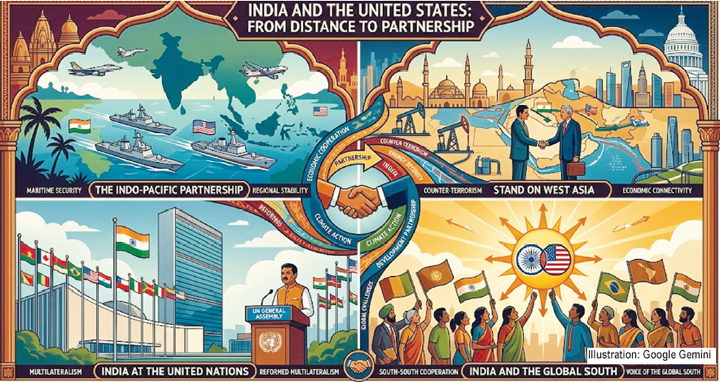
The Cold War Ends
The collapse of the Soviet Union in 1991 transformed India’s international environment.
The old Cold War structure disappeared.
India simultaneously faced an economic crisis and a rapidly changing global order.
Foreign policy had to adapt.
The language of non-alignment gradually became less central.
The concept of strategic autonomy emerged as a more appropriate description of India’s approach.
The principle remained similar: India should preserve the freedom to make independent decisions.
But the world had changed.
India was no longer simply trying to avoid choosing between two superpowers.
It was attempting to engage with several centers of power simultaneously.
The Era of Multi-Alignment
India could cooperate with the United States while maintaining defense ties with Russia.
It could participate in the Quad while remaining a member of BRICS and the Shanghai Cooperation Organization.
It could deepen relations with Israel while maintaining strong partnerships with Arab countries.
It could develop ties with Europe while expanding engagement with Southeast Asia.
This approach is sometimes described as multi-alignment.
The objective is not to balance every country against another.
It is to create a broad network of partnerships that increases India’s strategic options.
- INDIA AND THE UNITED STATES: FROM DISTANCE TO PARTNERSHIP
From Suspicion to Strategic Convergence
India and the United States began the post-independence era with significant differences.
During the Cold War, Washington’s alliances with Pakistan and India’s close relationship with the Soviet Union complicated bilateral relations.
The relationship began changing substantially after the end of the Cold War.
Economic reforms opened India further to global markets.
The two countries increasingly discovered common interests in trade, technology and security.
The Nuclear Turning Point
The 2005 India-US civil nuclear agreement became a major milestone.
The agreement helped bring India into the global civilian nuclear framework despite its position outside the Nuclear Non-Proliferation Treaty.
It also reflected a larger strategic transformation.
Washington increasingly viewed India as an important partner in the Indo-Pacific.
The Indo-Pacific Partnership
Defense cooperation expanded dramatically.
The two countries conduct military exercises, share strategic information and cooperate on maritime security.
India joined the Quad with the United States, Japan and Australia.
Technology has become another major pillar.
Semiconductors, critical technologies, space, telecommunications, artificial intelligence and defense manufacturing are increasingly important areas of cooperation.
The relationship is no longer simply about balancing China.
It has developed into a broad strategic partnership.
Yet India continues to preserve its autonomy.
New Delhi has not entered a formal military alliance with Washington.
The relationship therefore represents the essence of India’s contemporary foreign policy:
deep partnership without formal alignment.
- INDIA AND THE WORLD: THE RISE OF A GLOBAL POWER
From Regional Actor to Global Stakeholder
India’s international profile has expanded alongside its economy and population.
The country is now an important participant in global trade, technology, finance, energy, climate diplomacy and security discussions.
India’s membership of the G20, BRICS, SCO, Quad and other forums reflects its increasingly multi-dimensional diplomacy.
Its growing economic weight has strengthened its influence.
Its large diaspora has also become an important bridge between India and the rest of the world.
The Indo-Pacific
The Indo-Pacific has become central to India’s strategic outlook.
India supports a free, open, inclusive and rules-based maritime order.
The Indian Ocean is particularly important.
India’s geography places it near some of the world’s busiest maritime trade routes.
The country has therefore invested in naval capabilities, maritime domain awareness, coastal security and partnerships with Indian Ocean states.
Act East
India’s engagement with Southeast Asia has also expanded.
The Act East Policy built upon earlier efforts to strengthen relations with ASEAN and the wider Asia-Pacific.
Connectivity, trade, defence and cultural links have become increasingly important.
India’s Northeast has acquired greater strategic relevance as a bridge to Southeast Asia.
West Asia
India’s relationship with West Asia has evolved significantly.
The Gulf region is crucial for energy supplies, trade and the Indian diaspora.
India maintains important relations with Saudi Arabia, the United Arab Emirates, Qatar, Oman and other Gulf countries.
At the same time, India has developed a strong strategic partnership with Israel.
Maintaining relationships across these competing regional interests requires careful diplomacy.
- INDIA AT THE UNITED NATIONS AND THE GLOBAL SOUTH
A Voice for Developing Countries
India was among the founding participants in the United Nations system.
Its foreign policy has consistently emphasised sovereignty, peaceful coexistence, development and opposition to colonialism.
India has contributed extensively to UN peacekeeping operations.
Indian troops and personnel have served in numerous missions around the world.
For decades, India has also advocated reform of the UN Security Council.
New Delhi argues that the existing structure does not adequately reflect the geopolitical realities of the 21st century.
India seeks a permanent seat on an expanded Security Council.
The Global South
India has increasingly positioned itself as a voice for developing countries.
Issues such as food security, energy access, climate finance, development funding and technology transfer have become central to this diplomacy.
During India’s G20 presidency in 2023, the African Union was admitted as a permanent member of the grouping.
India also convened the Voice of Global South Summit, seeking to bring developing-country concerns into wider global discussions.
This reflects an evolution of India’s traditional developing-world diplomacy.
India no longer sees itself merely as a representative of poorer nations.
It increasingly seeks to act as a bridge between developed and developing economies.
INDIA’S RELATIONS WITH THE UNITED STATES, CHINA, RUSSIA AND OTHER MAJOR POWERS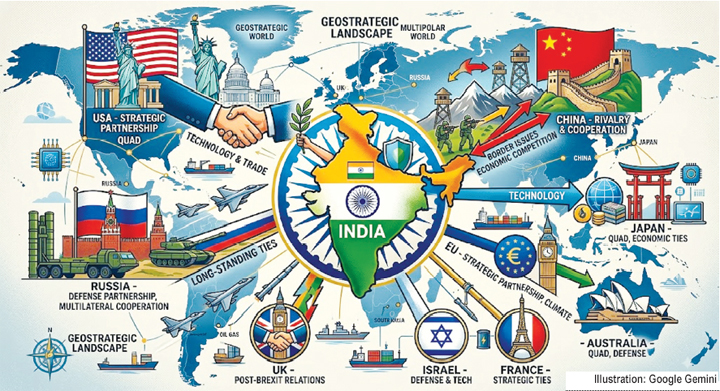
The United States: Technology and Strategic Partnership
The United States has become one of India’s most important strategic partners.
Defence cooperation, advanced technology, investment, education, space, clean energy and trade have deepened the relationship.
The two countries increasingly cooperate on Indo-Pacific security and emerging technologies.
Yet disagreements remain, including over trade, tariffs, immigration, human-rights concerns and India’s continued defence relationship with Russia.
The relationship is therefore strong but not without friction.
China: The Central Strategic Challenge
China is simultaneously India’s largest neighbour, a major economic partner and its principal long-term strategic competitor.
The unresolved boundary dispute remains the core security problem.
The 2020 border crisis transformed the relationship.
India has increased military infrastructure along the frontier and strengthened strategic partnerships with other countries.
At the same time, economic interdependence remains substantial.
India’s China policy will therefore require a delicate balance between deterrence, diplomacy and economic resilience.
Russia: A Relationship That Survived the Cold War
India’s relationship with Russia has deep historical roots.
The Soviet Union was a major defense supplier and political partner during the Cold War.
That relationship survived the collapse of the Soviet Union.
Russia remains important to India’s defense capabilities, nuclear energy cooperation and space collaboration.
India’s continued purchase of Russian oil after the outbreak of the Ukraine war also demonstrated the extent to which national-interest calculations shape its foreign policy.
At the same time, India’s relationship with Russia has become more complicated as Moscow’s ties with China have deepened and Russia’s relationship with the West has deteriorated.
India therefore seeks to preserve its longstanding relationship with Moscow while simultaneously diversifying its defence and technology partnerships.
EUROPE, JAPAN, AUSTRALIA AND THE WIDER WORLD
India’s foreign policy has expanded far beyond traditional relationships.
Japan has become an important partner in infrastructure, technology, investment and Indo-Pacific security.
Australia has emerged as a major strategic partner, particularly in the Quad framework.
The European Union and individual European states are important economic, technological and strategic partners.
France has developed a particularly significant relationship with India spanning defence, nuclear energy, space and the Indian Ocean.
Germany and other European economies are important trade and technology partners.
India’s engagement with Africa has also expanded through development partnerships, capacity building, trade and health cooperation.
The larger pattern is clear:
India is building a web of relationships rather than depending on a single strategic centre.
INDIA’S STAND ON RECENT CONFLICTS AND WARS
Ukraine: Dialogue, Diplomacy and National Interest
Russia’s invasion of Ukraine in February 2022 presented India with one of its most difficult foreign-policy challenges.
India did not join Western sanctions against Russia and repeatedly called for dialogue and diplomacy.
Prime Minister Narendra Modi’s public statement to Russian President Vladimir Putin that “this is not an era for war” became one of the most widely cited expressions of India’s position.
India has simultaneously maintained close relations with Ukraine and Western countries.
Its approach has been driven by several considerations: longstanding defence ties with Russia, energy security, concerns about global food and commodity prices, and the principle of maintaining strategic autonomy.
India has sought to position itself not as a military participant but as a country capable of supporting diplomatic efforts towards peace.
The Middle East and Israel-Gaza War
The conflict following the October 7, 2023 attacks by Hamas and Israel’s subsequent military campaign in Gaza has posed another diplomatic challenge.
India condemned the Hamas attacks and emphasised Israel’s right to security while also calling for humanitarian assistance and a two-state solution to the Israeli-Palestinian conflict.
India has therefore attempted to balance its growing strategic relationship with Israel with its longstanding relationships with Arab countries and its support for Palestinian statehood.
This balancing act reflects the complexity of India’s West Asia policy.
The Indo-Pacific and Strategic Competition
India’s approach to the Indo-Pacific has been shaped heavily by strategic competition between the United States and China.
India supports freedom of navigation, respect for international law and peaceful resolution of disputes.
At the same time, it avoids describing its partnerships as an anti-China alliance.
The Quad’s focus on maritime security, technology, resilient supply chains, disaster response and other areas reflects this broader approach.
India seeks a stable balance of power rather than a new bloc-based Cold War.
THE NEW LANGUAGE OF INDIAN DIPLOMACY
India’s foreign policy has acquired several new dimensions in recent years.
Strategic autonomy remains the central principle.
Multi-alignment describes the expanding network of partnerships.
Neighborhood First reflects the priority given to South Asia.
Act East represents India’s engagement with Southeast Asia and the Indo-Pacific.
Think West reflects the growing importance of West Asia.
The Indo-Pacific has become a central strategic theatre.
The Global South has become an increasingly important diplomatic constituency.
Together, these ideas describe a country that is no longer simply reacting to the international system.
It is attempting to shape it.
FROM A NEWLY INDEPENDENT STATE TO A GLOBAL POWER
India’s foreign policy journey since 1947 has passed through several distinct phases.
The first was the era of non-alignment, when India sought independence from Cold War blocs.
The second was the era of strategic partnership with the Soviet Union, shaped by regional wars and superpower rivalry.
The third began with the 1991 economic reforms and the end of the Cold War, when India expanded its engagement with the global economy.
The fourth has been the era of strategic autonomy and multi-alignment, in which India simultaneously works with multiple centres of power.
The fundamental principle has remained remarkably stable.
India does not want its foreign policy dictated by another country.
That principle explains why India can cooperate with Washington while maintaining ties with Moscow, engage economically with Beijing while strengthening military preparedness along the Chinese border, work with Israel while maintaining strong Arab relationships, and participate in both Western-led and non-Western international groupings.
India’s rising global role will increasingly be judged not simply by the number of partnerships it maintains but by its ability to convert those partnerships into security, technology, investment, energy access, diplomatic influence and strategic freedom.
The world in which India became independent was divided into rival blocs.
The world of 2026 is more complicated.
Power is distributed among the United States, China, Europe, Russia, India and other rising centres.
The international system is increasingly multipolar, competitive and interconnected.
For India, this creates both opportunity and risk.
Its challenge is to remain independent without becoming isolated, powerful without becoming confrontational, and influential without sacrificing the strategic autonomy that has defined its diplomacy for nearly eight decades.
From Nehru’s non-alignment to today’s strategic autonomy, the central idea of Indian foreign policy has remained the same: India seeks the freedom to decide its own place in the world.

Be the first to comment