

The constitutional doctrine of separation of powers is now in tatters
“However, disruptions and sloganeering have been the norm and not the exception since the mid-1980s in legislative institutions. Political parties across the board take pride in wiping out entire sessions of Parliament rather than debating laws and issues premised on rational arguments. Parliamentarians and legislators are adjudged on the basis of their ability to scream and shout in the Well of the House or outside rather than the strength of cogent submissions they should be making.
Parliament and legislative assemblies have therefore become virtually irrelevant to the national discourse. These institutions are now nothing more than gladiatorial arenas rather than hallowed chambers of calm and meditative deliberations.”
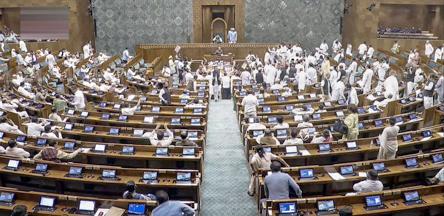
The washout of the recent monsoon session of Parliament has again drawn attention to the institutional crisis that stares India in the face today, for any democracy is only as strong or weak as the institutions that uphold it.
In the summer of 1787, when the founding fathers of the United States of America met in Philadelphia, they were obsessed with transforming the loose alliance of twelve states into a nation and creating a governing architecture that would be the antithesis of monarchy, which was the template across practically the entire known and discovered world at that time.
They resuscitated the doctrine of separation of powers conceptualized by Aristotle and John Locke and refined by Montesquieu to ensure that power does not get concentrated in a single person or an institution, for they were mortified by the tyranny of power. This led to the institutionalization of three separate branches of the government — the executive, the legislature and the judiciary — to ensure that they checked and balanced one other.
The paranoia against an overbearing ‘State’ was of such an order in the newly created nation that in 1791, when the Bill of Rights was incorporated into the American Constitution, its 2nd Amendment said: “A well-regulated Militia, being necessary to the security of a free State, the right of the people to keep and bear Arms, shall not be infringed.” This amendment, designed to protect the liberty of the individual, holds the field even today, despite all the school shootings across the US.
Every Constitution written subsequently across the world has the doctrine of separation of powers hard-coded into its very structure. This was also the model that India adopted when wise men and women conceptualized the Constitution between December 1946 and January 1950.
This model, however, has collapsed in India. The biggest casualty has been the legislature. The first Lok Sabha (1952-57) met on average for 135 days every year. The 17th (2019-24) averaged only 55 sitting days annually. The 18th Lok Sabha is all set to outdo its predecessor in terms of dysfunctionality.
State assemblies have fared no better. For instance, the Punjab Vidhan Sabha met for only 17 days in 2022, 12 days each in 2023 and 2024, 15 days in 2025 and only 15 days this year so far. Between 2017 and 2022, the Vidhan Sabha met for a mere 85 days out of its 1,825-day term.
Parliamentarians and legislators have been reduced to mere intercessors between the people and the executive. This is not their job, notwithstanding the fact that they are elected by the popular will of the masses. Their primary responsibility is to make good laws for the nation or their respective states and deliberate on the grave challenges that fall within their respective remits.
However, disruptions and sloganeering have been the norm and not the exception since the mid-1980s in legislative institutions. Political parties across the board take pride in wiping out entire sessions of Parliament rather than debating laws and issues premised on rational arguments. Parliamentarians and legislators are adjudged on the basis of their ability to scream and shout in the Well of the House or outside rather than the strength of cogent submissions they should be making.
Parliament and legislative assemblies have therefore become virtually irrelevant to the national discourse. These institutions are now nothing more than gladiatorial arenas rather than hallowed chambers of calm and meditative deliberations.
As far as the judiciary is concerned, India is perhaps the only country where judges of constitutional courts appoint other judges, notwithstanding the Memorandum of Procedure.
The attempts made by the UPA government and its successor, the NDA, to enforce judicial accountability and create a ‘say’ for the executive in judicial appointments, respectively, came to nought. The Judicial Standards and Accountability Bill that was passed in the Lok Sabha on March 29, 2012, failed to get through the Rajya Sabha and subsequently lapsed. The National Judicial Appointments Commission Bill, introduced in conjunction with the 121st Constitution Amendment Bill, was near-unanimously passed by the Lok Sabha and Rajya Sabha on August 13 and 14, 2014. It was ratified by 16 states and notified as law on December 31, 2014. The Supreme Court struck it down on October 16, 2015.
As of August 1, 2026, out of a sanctioned strength of 1,122 judges in the High Courts, 341 posts (30.39%) were vacant. There are 4.98 crore cases pending in district courts, 64.61 lakh in High Courts and 95,469 in the Supreme Court. Out of the 5.3 lakh people in prisons across India, 3.9 lakh (about 73%) are undertrials; 49% are in the age group of 18-30 years; 31% belong to Scheduled Castes and Scheduled Tribes, and 10-15% are from Other Backward Classes.
The executive’s performance has been no better. Out of a population of 140 crore, around 94 crore people live in rural India. For the bulk of these residents, the interface with the State regarding civil matters takes place through a patwari, kanungo or at best a tehsildar. In the criminal/penal sphere, it’s through a havildar or an assistant sub-inspector (ASI), who is the police chowki in-charge. In urban areas, the interface is through a municipal officer in the civil arena and at best a havildar/ASI in the legal domain.
The citizen’s experience is never pleasant. The State and its instrumentalities invariably come across as exploitative, extractive and oppressive. The situation is far worse in militancy-prone areas, where the State apparatus is usually clad in olive green.
The 73rd and 74th Constitutional Amendments that were supposed to bring governance closer to the grassroots have not really taken off even three decades later. They might have widened the representational pool at the local level, but states have been extremely chary of devolving powers or providing financial autonomy to the Panchayati Raj institutions, thereby effectively crippling their efficacy and functioning.
A section of the mainstream media has earned the sobriquet ‘Godi media’, seriously undermining the collective credibility of the Fourth Estate.
About the Election Commission of India, the less said the better. What was once an autonomous institution is now perceived as another government department. It has lost the confidence of an overwhelming majority of the Opposition.
In the 80th year of Independence, the doctrine of separation of powers, the institutional balance of power and the confidence that people have in the institutions of governance are in tatters.
Is anyone even thinking where we are headed as a nation?
(Manish Tewari is Lok Sabha MP and former I&B Minister)
(Source: The Tribune)



Be the first to comment