
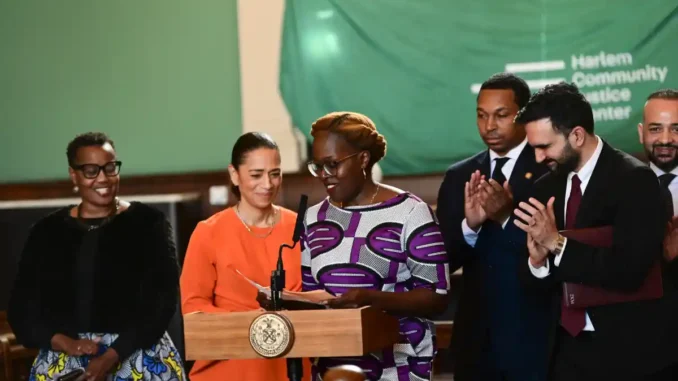

NEW YORK (TIP): New York City plans to incorporate a racial equity review into future budget planning under its first citywide racial equity plan, released Tuesday, September1 by ’s administration.
According to the amNY, the final plan spans 45 city agencies and includes more than 200 agency goals and outcomes, more than 800 implementation strategies and more than 600 indicators used to track progress.
“For too long, government has been willing to acknowledge inequality without setting goals for ending it. This plan changes that,” Mayor Mamdani said in a statement.
The Mayor’s Office of Management and Budget and the Mayor’s Office of Equity and Racial Justice are developing an “equity budget review” with the goal of applying it to the fiscal year 2028 preliminary budget.
Chief Equity Officer Afua Atta-Mensah said the process would examine where the city invests money, who benefits and whether spending is advancing the outcomes outlined in the plan.
“The objective is not to create a separate budget process,” Atta-Mensah said during a briefing with reporters Tuesday.
The written plan says agencies have been asked to consider how their budgets could address past disinvestment and inequities. That could include reallocating funding to meet the needs of historically marginalized communities or expanding services in neighborhoods experiencing longstanding disparities.
The plan also establishes eight overarching citywide goals, including reducing racial disparities in unemployment, rent burden and homelessness; increasing school integration; improving broadband and transportation access; reducing the jail population; and improving pregnancy-related health outcomes for Black New Yorkers.
Unlike some individual agency commitments, those citywide goals do not yet have specific numerical targets.
Atta-Mensah described them Tuesday as “directional commitments for now” and said the administration will attach specific targets as the plan becomes more closely aligned with the city’s budget cycle.
“For now, our citywide goals do not have specific targets, but we will attach specific targets that will be backed by real investments as we align better with the budget cycle,” she said.
Individual agency plans include short-, medium- and long-term goals, along with timelines and indicators, with some setting numerical benchmarks.
Asked during the briefing what goals and data the city would use to measure success, Atta-Mensah pointed to those agency-level measures.
The Mayor’s Office of Criminal Justice, for example, plans by the end of fiscal year 2028 to establish baselines and numerical reduction targets for at least three racial disparities at points in the criminal justice system, potentially including jail admissions, pretrial detention, diversion access and case-processing times.
A plan years in the making
The final plan follows a 30-day public comment period on a preliminary version released in April. The administration said it received hundreds of survey responses and engaged hundreds of residents through 10 community conversations.
Among the changes were the addition of the eight citywide goals, greater use of data broken down by race, ethnicity, gender identity or neighborhood where possible, and stronger links between agency goals and indicators.
The racial equity planning process stems from ballot measures approved by NYC voters in 2022 that amended the City Charter, created the Office of Racial Equity and required the city to regularly produce racial equity plans.
Tuesday’s release came days after Manhattan Supreme Court Justice Phaedra Perry-Bond ruled that former Mayor Eric Adams and Mamdani failed to meet Charter deadlines governing the process.
Perry-Bond found that Adams’ inaction thwarted the required planning process and said Mamdani’s administration also missed a January deadline that fell days after Mamdani took office, though “to a lesser extent.” Mamdani released the preliminary plan in April.
Asked Tuesday whether publication of the final plan fulfilled the city’s requirements for the current cycle, Atta-Mensah said the Charter required a preliminary plan, a public comment period and a final plan.
“We’ve done all of those,” she said, adding that the administration plans to return to the regular two-year schedule.
The Commission on Racial Equity, or CORE, which brought the lawsuit over the missed deadlines, had also criticized the preliminary plan as failing to meet “core requirements.” Atta-Mensah on Tuesday called the commission an “accountability partner” and said the administration would continue working with it.
Mamdani released the preliminary racial equity plan in April alongside the city’s first “true cost of living” measure, which found that 62% of New Yorkers, or about 5.04 million people, lacked sufficient resources to cover basic costs.
At the April rollout, Mamdani described the preliminary plan as the first step toward a “whole-of-government approach” to addressing those conditions. Public Advocate Jumaane Williams said at the time that city budgets would need to reflect the plan’s findings.
DEI questions linger
The preliminary plan also drew scrutiny over its treatment of diversity, equity and inclusion language. City & State reported in April that internal documents showed the city Law Department had pushed to remove references to DEI and soften other language as officials considered potential legal exposure from the Trump administration.
Council Speaker Julie Menin responded that “diminishing or erasing equity-centered frameworks is not the path forward.”
Asked Tuesday about changes to DEI and minority- and women-owned business language, Atta-Mensah did not directly explain the specific edits. She said the final plan explicitly identifies racial disparities and the communities affected by them and said the city remains committed to minority- and women-owned businesses.
Asked about the Trump administration’s rollback of similar federal racial equity efforts, Deputy Mayor for Economic Justice Julie Su said New York intends to play a leadership role. She said other cities and states are watching the city and that New York can demonstrate what is possible when government is “full-throated behind a set of goals and outcomes” that include combating deep racial inequities.
City agencies will now begin implementing their plans and tracking results with support from MOERJ. The city will report on progress every two years, and Atta-Mensah said strategies can be changed if data shows they are not producing the intended results.
(Source: any)


Be the first to comment