
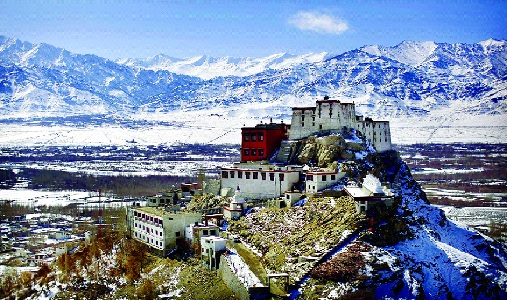

There are landscapes that impress you, and then there are landscapes that leave you speechless. Ladakh belongs firmly to the second category.
Set high in the Himalayas, the Union Territory is a land of stark mountains, vast valleys, turquoise lakes, ancient monasteries and seemingly endless skies. Often described as a high-altitude cold desert, Ladakh is dramatically different from most other destinations in India. In summer, its roads fill with travelers and motorcyclists. But come winter, a different Ladakh emerges – quieter, colder and more austere. The crowds disappear, the mountains turn white and the landscape seems to return to an older, slower rhythm.
For travellers prepared to embrace extreme weather and high-altitude conditions, winter offers an opportunity to experience Ladakh in a remarkably serene setting.
Leh and Ladakh: understanding
the difference
The names Leh and Ladakh are often used interchangeably, but they refer to different places.
Ladakh is the Union Territory, while Leh is a town and district headquarters and one of its principal tourist centres. The Union Territory is divided into the Leh and Kargil districts.
Leh serves as an important base for exploring the region. Its attractions include the historic Leh Palace, Shanti Stupa, monasteries, traditional markets and the colourful Leh Bazaar.
Beyond Leh lies a vast landscape dotted with Buddhist monasteries, mountain passes, remote villages and high-altitude lakes.
A land of monasteries and prayer flags
Ladakh’s cultural landscape is as compelling as its mountains.
Ancient Buddhist monasteries, known locally as gompas, rise dramatically from hillsides and rocky outcrops. Their interiors contain colourful murals, sculptures, thangkas and prayer halls, while prayer flags flutter in the mountain wind.
Places such as Thiksey, Hemis, Alchi, Lamayuru and Diskit offer glimpses into the region’s rich Buddhist heritage.
The monasteries are not simply tourist attractions. They remain living centers of faith, meditation, learning and community life.
For visitors, the experience can be deeply atmospheric: the sound of prayer, the scent of incense and the sight of monks in traditional robes against a backdrop of barren mountains.
Why winter changes everything
Ladakh in winter is not for everyone.
Temperatures can fall well below freezing, particularly at night, and conditions can be challenging at high elevations. Water may freeze, roads can become slippery or temporarily blocked by snow, and weather disruptions can affect travel plans.
Yet the harshness is also part of the attraction. With fewer visitors, the region becomes quieter. Roads carry less traffic, tourist centers are less crowded and landscapes that are busy during the summer can appear almost untouched.
Snow-covered peaks, frozen streams and icy valleys create a version of Ladakh that feels stark, beautiful and timeless.
Getting there in winter
When the major mountain passes are closed because of heavy snowfall, flying into Leh is generally the practical option for winter visitors.
Flights connect Leh with major Indian cities, although schedules can be affected by weather. Travelers should therefore avoid tight onward connections and keep some flexibility in their itinerary.
The approach by air can itself be spectacular. On a clear day, the flight offers sweeping views of snow-covered Himalayan ranges and rugged valleys.
One important point: arriving in Leh means arriving at high altitude. Acclimatisation is essential. Visitors should take it easy after arrival and allow their bodies time to adjust before undertaking strenuous activity.
Dress for the conditions
Winter in Ladakh demands serious preparation. Layering is more effective than relying on a single heavy jacket. Thermal innerwear, insulating mid-layers, a windproof and waterproof outer layer, warm socks, gloves, a cap and sturdy footwear are useful.
Don’t forget protection from the sun. At high altitude, sunlight can feel deceptively mild while UV exposure remains strong. Sunglasses, sunscreen and lip balm can be valuable companions.
And remember: winter conditions can change quickly.
Getting around
Winter transportation requires patience. Local buses may operate on selected routes, but services can be less frequent and dependent on weather and road conditions. Taxis and four-wheel-drive vehicles are generally more practical for travellers exploring beyond Leh. Motorcycling, a popular summer experience in Ladakh, is considerably less suitable in severe winter conditions because of freezing temperatures, snow and icy roads.
When hiring a vehicle, choosing an experienced local driver can be particularly useful. Local drivers are familiar with changing road conditions and the challenges of travelling through the region in winter.
A simple rule makes sense: reach your destination before darkness whenever possible.
Winter accessibility varies considerably across Ladakh. Leh and several nearby areas remain accessible, while conditions on higher passes and remote routes can change rapidly.
Popular destinations such as Nubra Valley and Pangong Lake may be accessible depending on weather and road conditions, but travelers should never assume that a route will remain open simply because it was open the previous day.
High passes such as Khardung La and Chang La can experience severe weather and temporary closures.


Be the first to comment