
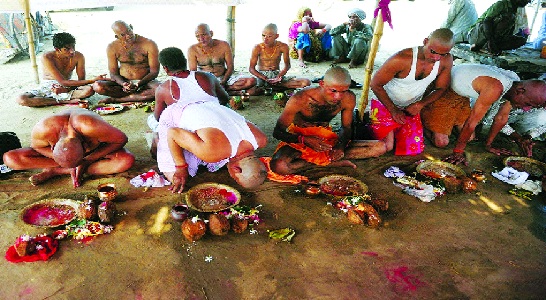

Every year, as the lunar calendar enters the waning phase of Bhadrapada, Hindu families turn their thoughts towards those who came before them. Homes become quieter, memories of parents and grandparents return, and simple acts of food offerings, prayers and charity acquire a deeper meaning.
This period, known as Pitru Paksha, is a sacred fortnight dedicated to the remembrance and honouring of departed ancestors. The rituals performed during this time are collectively associated with Shraddha, a Sanskrit word derived from shraddha, meaning faith, devotion and sincere reverence.
For many Hindus, Shraddha is not merely a ritual performed for the dead. It is an expression of gratitude towards the generations whose lives, sacrifices and values have shaped the family that exists today.
A bridge between generations
Hindu tradition places considerable importance on the relationship between the living and their ancestors. The family is viewed not simply as a group of individuals living in the present, but as part of a continuing lineage connecting past, present and future.
The ancestors, or pitrs, occupy an important place in this tradition. Remembering them is considered an act of duty as well as gratitude.
Pitru Paksha generally lasts for 16 lunar days, beginning with the full moon or the day after it, depending on the regional calendar, and concluding with Sarva Pitru Amavasya, also known as Mahalaya Amavasya. The exact dates vary each year according to the lunar calendar.
During these days, families perform Shraddha on the tithi, or lunar date, corresponding to the death anniversary of an ancestor.
The legend of Karna and the
world of ancestors
One of the most famous stories associated with Pitru Paksha comes from the Mahabharata.
According to the legend, when Karna, the great warrior and son of Surya, died in the Kurukshetra war, his soul reached the ancestral realm. There, he was offered gold and precious objects rather than food.
Karna was puzzled and asked why he was not being given nourishment. He was told that during his life he had donated immense wealth and performed acts of generosity, but he had never offered food or performed Shraddha for his ancestors because he did not know their identity.
Karna then asked for an opportunity to correct this omission. He was allowed to return to Earth for a period of time, during which he performed offerings for his ancestors. The period became associated in popular tradition with the observance of Pitru Paksha.
The story conveys an important message: charity and generosity are meaningful, but remembering those from whom we received life is also considered a sacred responsibility.
Why food is offered to ancestors
Food occupies a central place in Shraddha rituals. Traditionally, offerings may include cooked rice, sesame seeds, water and other foods prepared according to family and regional customs. The food is offered with prayers and reverence before being given to Brahmins, family members, cows, birds or other recipients, depending on local practice.
The ritual is not necessarily understood literally as the departed consuming physical food. Rather, the offering represents the family’s gratitude and remembrance.
The act also reflects an important Hindu principle: food is sacred and sharing it is an act of compassion and duty.
The ritual of Tarpan
One of the most recognisable practices associated with Pitru Paksha is Tarpan, the offering of water to the ancestors.
Water is offered while remembering the names and lineage of departed family members. In many traditions, sesame seeds are also used.
The gesture is simple, yet deeply symbolic. Water sustains life, and offering it to the ancestors represents respect, remembrance and the continuation of the bond between generations.
The ritual is generally performed by family members according to prescribed customs, often under the guidance of a priest.
Pind Daan: symbolic offerings
of nourishment
Another important ritual is Pind Daan, in which pindas, traditionally made from cooked rice and other prescribed ingredients, are offered as part of ancestral rites.
The word pinda refers to a rounded offering. It symbolises nourishment and is associated with prayers for the peaceful onward journey of the departed.
Places such as Gaya in Bihar, especially the Vishnupad Temple and the banks of the Phalgu River, have been associated with ancestral rites for centuries. Many families undertake pilgrimage there to perform Pind Daan.
Other sacred places, including Varanasi, Prayagraj, Haridwar and Siddhpur, are also associated with rituals for ancestors.
The significance of the death tithi
A distinctive feature of Shraddha is that families traditionally perform the ceremony according to the lunar date on which a person died rather than simply following the corresponding Gregorian calendar date.
Each day of Pitru Paksha is associated with particular lunar dates. Families perform the ritual on the tithi corresponding to the death of a parent, grandparent or other relative.
If the exact death date is unknown, Sarva Pitru Amavasya provides an important opportunity to remember ancestors collectively.
This final day is therefore especially significant for families who may not know the precise lunar date of an ancestor’s death.
Sarva Pitru Amavasya: remembering
all ancestors
The concluding day of Pitru Paksha is known as Sarva Pitru Amavasya, or Mahalaya Amavasya.
It is traditionally regarded as an occasion to honour all departed ancestors, particularly those whose Shraddha could not be performed on their specific tithi.
The day carries a sense of completion. Families offer prayers, prepare food, make donations and remember relatives who are no longer physically present.
In Bengal and some other regions, Mahalaya also has a special cultural significance because it marks the traditional beginning of the period associated with Durga Puja.



Be the first to comment