

Political parties and their benefactors thrive within the system even if it seems reprehensible, unlawful & disturbing
The study also found that in the last decade, the exchequer ‘lost’ Rs 11,813 crore in taxes due to exemptions for political donations in which individual donors and Hindu undivided families (HUFs) have overtaken corporates in donating to parties. In FY 2022-23, individual donors claimed exemptions worth Rs 2,275.85 crore, dwarfing corporate claims (Rs 514.4 crore) and those by firms/associations (Rs 115.71 crore).

The recent BBC investigation regarding extraordinary donations received by six registered unrecognized political parties (RUPP) exposes a well-known but intriguing aspect of Indian politics. It is ugly but ubiquitous. Political parties and their benefactors thrive within this system, even if it seems reprehensible, unlawful and disturbing.
Earlier, the Association for Democratic Reforms (ADR) released a report on July 18, 2025 that found a 223% rise in the declared income of RUPPs during FY 2022-23. It noted that out of 2,764 RUPPs, only 739 submitted their financial records for the year to the Election Commission of India (ECI), the sole custodian of the fate and fortunes of political parties as per law.
In the press note Cleaning up the Electoral System (August 9, 2025), the ECI said it ‘delisted’ 334 RUPPs out of 2,854 RUPPs as “part of a comprehensive and continuous strategy…to clean up the electoral system.” It would be interesting to see if the six parties in question are a part of the ECI’s “continuous strategy”.
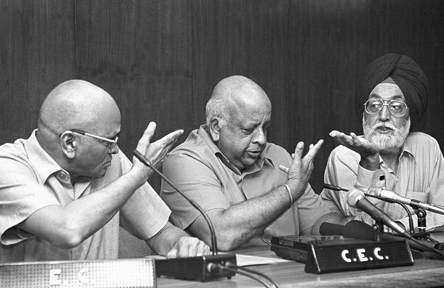
On October 16, 1994, in an order under the Election Symbols (Reservation and Allotment) Order, 1968, Chief Election Commissioner late TN Seshan highlighted the “the sorry state of affairs prevailing in almost all political parties in the country, whether recognized National or State parties or registered-unrecognized parties.” He observed: “I have yet to come across any party whose affairs are being run in accordance with the provisions of its constitution or rules and regulations.” Through that order, he put all political parties on “notice” to set their house in order, declaring that the ECI would not remain a “mute spectator”.
In subsequent guidelines prescribing the format for registration under Section 29A of the Representation of the People Act, (RPA) 1951, the ECI stated in para 3 (xxiii) that the party seeking registration must declare in its constitution that it would contest elections within five years of its registration and that if the party did not “contest elections continuously for six years”, it would “be automatically taken off the list of recognized parties.”
‘Taking off’ or “delisting” doesn’t mean deregistration as the ECI is not empowered to do so. Similarly, even if the RUPPs are ‘unrecognized’, they qualify to receive contributions as per Section 29-B and income tax exemption under Section 29-C. “Recognition” is governed by para 6 of the Election Symbols Order, which distinguishes between ‘recognized’ and ‘unrecognized’ political parties for the purpose of allotting symbols and lays down the criteria for their classification.
Hence, whether “delisted” or “unrecognized”, the parties remain eligible for receiving contributions. It is a matter of investigation whether such donations continued to receive tax exemptions as the intent behind the delisting was to disqualify them.
A paper published by Venkatesh Nayak of the Commonwealth Human Rights Initiative revealed that collectively, 22 political parties had Rs 18,742.31 crore at their disposal for the General Elections in 2024, which included funds in their kitty at the time of announcement of the elections and donations of Rs 7,416.31 crore they raised between the dates of announcement and the completion of elections. After the elections, these parties had Rs 14,848.46 crore (including cash in hand and money held in bank accounts and fixed deposits) remaining in their custody after covering all election-related expenditure of Rs 3,861.57 crore during the campaign period, as per the accounts submitted to the ECI.
The study also found that in the last decade, the exchequer ‘lost’ Rs 11,813 crore in taxes due to exemptions for political donations in which individual donors and Hindu undivided families (HUFs) have overtaken corporates in donating to parties. In FY 2022-23, individual donors claimed exemptions worth Rs 2,275.85 crore, dwarfing corporate claims (Rs 514.4 crore) and those by firms/associations (Rs 115.71 crore). Declared donations to parties increased from Rs 714 crore (43 parties) in 2015-16 to Rs 7,203 crore (27 parties) in 2023-24. Yet, only 41.76% of the total donations (Rs 28,287 crore over nine years) were claimed as tax-exempt, leaving questions about the remaining 58%. Nayak wonders “What incentives are driving them to donate without tax relief? The lack of transparency obscures answers.”
What added the thickest layer of secrecy was the so-called reform of the electoral bonds brought by the ruling party in 2018, making the entire business of political finance murky. Although declared unconstitutional by the Supreme Court in 2024, the details of the donations subsequently divulged raised questions that remain unanswered. Most RUPPs were not qualified to receive the electoral bonds as it was restricted to parties that “secured at least 1% of the votes in the latest Lok Sabha or State Legislative Assembly elections.” Who then made these contributions and why?
Parties have shown scant interest in transparency. They united in dodging the 2013 order of the Central Information Commission that brought them under the Right to Information Act. The Income Tax Department might not consider it a priority to scrutinize the accounts of the parties as it does of ordinary taxpayers. The ECI lacks the mandate, the intent or wherewithal to do so.
It is, therefore, incumbent upon the SC to order a court-monitored probe in the entire saga of electoral bonds and the alleged quid pro quo, including the phenomenon of ‘insignificant’ parties receiving and spending huge contributions without participating in the electoral process in any substantial manner.
Exercising its powers under Article 324, the ECI should order political parties to have their accounts audited by the Comptroller & Auditor General of India or its nominee. It should also consider imposing a limit on expenditure by political parties during elections, something it has recommended repeatedly. Tax exemptions on donations should be limited to the expenditure limit. All other donations that enrich the parties must be fully taxed.
The ECI should set up an automatic procedure to ‘delist’ any RUPP that doesn’t contest elections as per its guidelines and develop a digital portal where all registered parties upload their financial data in standardized formats.
Let the ECI spend its energy in ‘purifying’ the electoral environment rather than chasing genuine electors out of the electoral rolls. Till then, ‘We the People’ must continue to scream like the people trapped in Nepal tunnels: “Hunuhuncha” (“we are here”).
(Ashok Lavasa is a former Election Commissioner of India)


Be the first to comment