
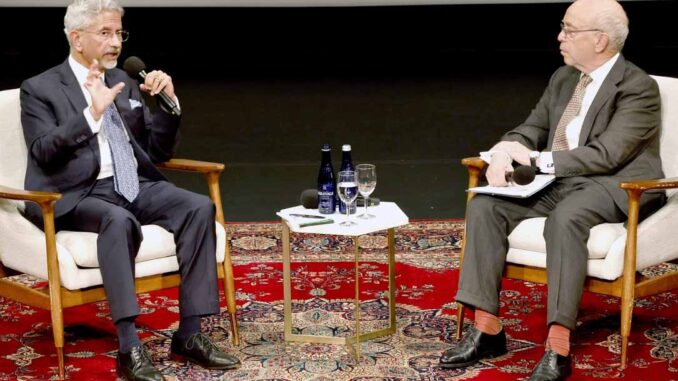

Everybody is openly dealing with everybody else. That is where we are heading toward multipolarity.
-
I.S. Saluja
NEW YORK (TIP): India’s External Affairs Minister Dr. S. Jaishankar offered a wide-ranging assessment of a world undergoing profound geopolitical and economic change during a conversation with former U.S. diplomat Daniel Russel at the Asia Society in New York on September 28, 2026.
Speaking at the conclusion of a busy United Nations General Assembly High-Level Week, during which he said he had met 85 ministers from different countries over ten days, Jaishankar described an international system increasingly shaped by competition, interdependence, strategic autonomy and the emergence of multiple centers of power.
The old playbook, he suggested, is being rewritten.
Countries that once expected others to align themselves more rigidly with particular blocs are themselves pursuing multiple relationships. Trade arrangements are changing. Conflicts in Ukraine and the Gulf are producing consequences far beyond the countries directly involved. Developing nations are confronting pressures involving energy, food, fertilizer and finance. And governments are increasingly seeking multiple partnerships rather than placing their interests entirely in one relationship.
For India, Jaishankar argued, the answer lies neither in isolation nor rigid alignment, but in maintaining stable and reliable relationships across a broad spectrum of powers while preserving strategic autonomy.
In an engaging conversation, Russel challenged the Minister on whether such multipolarity could deteriorate into a “Hobbesian” world dominated by raw national self-interest. Jaishankar acknowledged the risks but argued that countries’ own need for stability and predictability would ultimately encourage balancing arrangements and new partnerships.
The discussion also turned candidly to India-U.S. relations. Jaishankar identified trade, terrorism and mobility among issues affecting the relationship, while expressing hope that bilateral ties would return to an upward trajectory. On China, he said relations had improved as the border situation moved toward greater normalcy, although he stopped short of describing the change as structural. With Japan, he saw considerable potential in investment, technology, defense, supply-chain diversification and greater societal exchanges.
Edited excerpts from the conversation follow:
Bharat Khera
DANIEL RUSSEL: Minister, welcome back to Asia Society. In your opening remarks you spoke about the competitive spirit colliding with the realities of interdependence and weaponization.
When we spoke on this stage two years ago, I asked you about the paradox of India dealing simultaneously with Washington, Beijing, Moscow and others. You explained that one could “walk and chew gum at the same time.”
Looking at the world you have described today, I would like a piece of that gum.
Let me begin with the United States. You have spoken previously about consequential changes in the international system and an erosion of established rules. What changes do you see, what has been their impact, and who have been the winners and losers?
S. JAISHANKAR: That piece of gum is now in pretty big supply in Washington.
This was a question people normally asked us: How are you dealing with China, Russia, Ukraine, other parts of Asia and Europe simultaneously?
Today Washington itself is practicing that approach with a great deal of gusto.
There was a time when the narrative was: “We don’t like you having too many options. We want you to focus your relationship on us”—even though the United States, being a global power, kept more of its own options open.
Today that pretense has dropped for everybody.
Everybody is openly dealing with everybody else. That is where we are heading toward multipolarity.
Everybody is going to try to get the best deal possible from a given situation based upon a sharper definition of national interest. We may like it or not, but once Washington takes the lead in that direction, it becomes something of a global fashion.
On rules, however, I think there may be some confusion. I did not say that the United States was primarily responsible for departing from the rules.
My point has been that rules—particularly economic rules—have been continuously eroded over time.
We have trading structures based on market assumptions, while trading practices have departed sharply from those assumptions. A great many non-market practices entered the trading system, and for whatever reasons the world looked away.
So the observance of rules was gradually corroded rather than simply rejected.
Now we are seeing new positions from the world’s largest economy and a different trading template based increasingly on one-to-one deals. That strikes at some of the assumptions underlying the earlier system.
We are therefore seeing greater realism, a different template and a renegotiation of many arrangements.
What emerges will be a new set of bargains, understandings and possibly relationships. Countries will agree on some issues and cooperate to different degrees on others.
We have to throw away the old playbook and start writing a new one.
That will not happen overnight.
RUSSEL: The postwar international system rested, at least in principle, on the strongest country accepting that rules were binding on it as well. That provided predictability and safeguards, particularly for smaller countries.
If the major powers are no longer prepared to accept broadly common rules, what prevents multipolarity from becoming a Hobbesian jungle—a survival-of-the-fittest, dog-eat-dog environment?
JAISHANKAR: From the perspective of a country such as India, there is another problem.
Complaints about the trading system may arise from the behavior of one country, but the reactions are then visited upon us as well. That is rather unfair.
There is one conversation about how the trading system was gamed, how trading practices evolved, how surpluses were created, market shares increased and production shifted.
But what has now happened is something closer to the United States versus everybody else—including countries that had no role in gaming that system.
Whether we like it or not, that is American policy today.
How do we prevent this from becoming utterly Hobbesian? We will have to see whether checks and safety nets emerge that limit the competition, or whether the United States deals individually with 190-odd countries and the aggregate of those bilateral arrangements itself becomes the system.
We could end up much more in the direction you describe.
If you are negotiating in today’s world, you need that sense of realism.
RUSSEL: Then what would a healthier version of multipolarity look like—one that respects, for example, the interests of developing countries? How can the self-interest of major powers be tempered into something more stable and equitable?
JAISHANKAR: That is really at the heart of the foreign-policy thinking of countries of our size and range of interests.
First, you build a reputation for being stable, consistent and reliable, so that in a dynamic and volatile world others see you as a steadying factor. Partners then tend to gravitate toward you.
Second, the more you diversify relationships and identify common interests and common ground, the greater the possibility of creating a balancing structure.
We need to temper self-interest with long-term predictability and stability—which are themselves part of intelligent self-interest.
Take India. We would ask: how do we achieve the right balance in our relationships with the United States, Europe, Japan, China, Russia, the Gulf, ASEAN and the Global South?
It is almost a portfolio-management approach.
The Hobbesian scenario you describe is extremely volatile and risky. Countries will not want to expose their trade and economies indefinitely to that degree of volatility.
They will seek relationships offering stability and predictability, even where the immediate returns may be lower.
I am therefore not pessimistic.
The world is becoming more competitive. It is tough. A new dynamic and a new culture will emerge. New negotiations will take place and new bargains will be struck.
When the smoke clears, the different points will be joined by lines of different lengths, and a new geometry will emerge.
RUSSEL: There are at least two forces complicating that vision. One is the ripple effect from conflicts—whether Ukraine or the Gulf—which creates enormous consequences for energy, grain and other necessities in countries far removed from those wars.
The second is the increasing extraterritorial application of sanctions and rules by major powers, which can force third countries to choose sides.
How does India view those pressures?
JAISHANKAR: They are a major concern for us.
The Ukraine conflict and now the Iran-Gulf conflict have had a devastating impact on Global South economies.
Energy markets are already extremely tight. If politics is added to the security-of-supply problem, prices rise precisely when countries should be trying to stabilize them.
Food is another concern. Major grain exporters may be unable to send shipments, particularly through the Black Sea. We are also looking at significant fertilizer shortages because important producers are located in Russia and the Middle East and production has been affected.
If you combine an energy crunch with pressures involving food, fertilizer and finance—because money moves toward safe havens whenever conflict erupts—the result is extraordinarily stressful for developing economies.
Policymakers cannot simply say these consequences were unintended.
They have a responsibility to consider the impact their decisions will have on other countries.
Countries cannot be so self-centered that they make decisions entirely within their own world and then tell everyone else: “It wasn’t my intention to make your life difficult.”
We also cannot allow countries to be left behind.
We have seen at great cost to global security what happens when governance breaks down across significant geographies. We should not repeat that mistake.
Concern for the Global South is therefore not a platitude or merely a humanitarian appeal. It is sound common sense.
As a post-colonial society, India naturally feels a degree of solidarity. But I would argue that it is also in the self-interest of developed countries not to allow widespread distress and instability.
On pressure upon countries to choose sides, yes, that is a reality.
Some countries will be able to maintain greater independence and autonomy. Others will find that more difficult.
Those of us who are autonomous would like to see more countries remain autonomous.
But it will not be black and white. Much will depend upon the particular issue and the stakes involved. In some cases countries will adjust; in others they will push back.
RUSSEL: Let us turn to India-U.S. relations. A year or so ago expectations were quite high, but not everything has proceeded as anticipated. The trade agreement remains unfinished and tariffs have complicated matters.
What needs to happen to put the relationship on a better track?
JAISHANKAR: If I stand back and look at the relationship, I would first note that much of the world has had a more difficult relationship with the United States. That may not be much consolation, but it is a reality.
In India’s case, there are several specific issues.
The first is the trade negotiation.
India is a society of small producers—small agricultural producers and small factories. Apart from the large per-capita income gap between India and the United States, the nature of production and society is very different.
A trade negotiation therefore requires patience and considerable attention to detail.
The expectation that it could move forward very rapidly was tested against a much more complicated ground reality.
Today, there is more or less an understanding on the trade agreement. The question concerns developments on the American side and the basis upon which tariffs will now be imposed.
The agreement is very far advanced. If it can be concluded, that would certainly contribute to a better relationship.
The second issue concerns the sensitivities of each country.
For India, terrorism is particularly important.
There are perhaps very few countries that have been subjected to the kind of terrorism we have faced from a neighbor as part of a deliberate and conscious policy over many decades.
If something that matters so deeply to us does not receive sufficient understanding, appreciation or empathy, that creates a problem.
If one of my primary concerns is not fully appreciated by my partner, clearly that has an impact upon the relationship.
Another issue is mobility.
For many years mobility was regarded principally as an economic gain. Today, in some quarters, the economics of mobility and the politics of mobility are at odds.
We also have to recognize that foreign policy is no longer conducted solely by governments, leaders, ministers or diplomats. In the age of social media, public opinion has become an important factor, particularly in democratic societies.
We certainly hope and expect the India-U.S. relationship to return to an upward trajectory. But we also have to be realistic about the issues confronting us.
Progress on those issues will produce a better relationship.
RUSSEL: Let us apply that lens to India-China relations. Compared with two years ago, there are more flights, greater diplomatic engagement and considerable disengagement along the border.
Are we seeing structural improvement in the relationship?
JAISHANKAR: Compared with 2025, is the relationship better today? I would say yes. Compared with 2024, even more so.
But I would not describe it as structural change.
Part of the reason relations have improved is simply that they had gone so badly off track.
After what happened in 2020 and the prolonged border standoff, the relationship was deeply affected. Most normal contacts between the Indian and Chinese systems came to a halt. Trade continued, but official exchanges, visas, flights and other interactions were affected.
Once the border standoff was resolved, it was natural for those things to begin improving.
We had also consistently told the Chinese that a prolonged standoff between us did not benefit either country. In fact, third parties could benefit from it.
There is a very elementary principle of statecraft here: do not remain locked into a problem that benefits others.
For India, the fundamental principle has been that the state of the border determines the state of the relationship.
You cannot have tension—or worse—on the border and simultaneously say that the broader relationship should be normal.
As the border moves toward normalcy, the relationship moves toward normalcy. And if the relationship becomes more normal, that benefits both countries.
RUSSEL: Finally, let us turn to Japan, a country in which both of us have served. What role can the growing India-Japan partnership play in Asia and the Indo-Pacific?
JAISHANKAR: I would make four points.
First is the economic relationship.
Many relationships are predominantly trade-centered. India’s relationship with Japan is much more investment-centered, and investment is growing fairly rapidly.
There is increasing recognition in Japan that it is in its interest to have multiple sources of production. This is part of diversifying supply chains, and we are seeing Japanese companies becoming more interested in India.
Second is technology—semiconductors in particular, but also chemicals and other areas of advanced manufacturing.
Japanese companies increasingly recognize the value of establishing operations in India and working with Indian talent and Indian companies.
Third is security and defense.
India and Japan are both maritime and Indo-Pacific powers, and we have a long and positive history.
The historical dimension of the relationship is sometimes underappreciated. Japan has been consistently well regarded in India across the political spectrum.
Given that history, the political consensus and the challenges emerging in the region, our defense and security relationship is growing.
We are conducting more exercises and more shared activities. These are significant developments by Japanese standards.
Japan also increasingly recognizes the value of having more partners in addition to its traditional partner. The Quad provides a useful institutional framework within which this can develop.
Fourth is societal interaction.
We are trying to promote more exchanges and more students. The number of Indian students in Japan remains very low, while demand for Japanese-language education in India is growing.
I expect that human connection to expand as well.
RUSSEL: Minister, we have covered only a fraction of the subjects everyone here would like to discuss. But you have given us an opportunity to look through your very clear and logical eyes at a world that is undergoing rebalancing—a world certainly in considerable churn.
Thank you very much for your time.
JAISHANKAR: Thank you.


Be the first to comment