
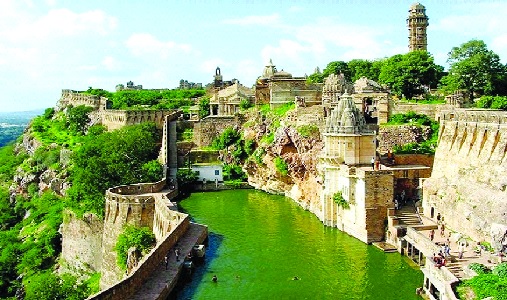

Rising 590 feet above the surrounding plains of Southeastern Rajasthan, the massive plateau of Chittorgarh Fort sprawls across nearly 700 acres, encompassing a 13-kilometer perimeter wall. As the largest fort complex in India and a UNESCO World Heritage Site, this ancient citadel is a living monument to medieval military engineering, royal grandeur, and the storied martial pride of the Kingdom of Mewar.
The fort’s strategic position atop an isolated outcrop made it the ultimate prize in Western India. Built originally by local Maurya rulers in the 7th century A.D., it grew into a thriving fortified city complete with 84 water bodies, royal palaces, ornate temples, and victory towers. Over its long history, Chittorgarh endured three catastrophic sieges-in 1303 by Alauddin Khilji, in 1535 by Bahadur Shah of Gujarat, and in 1567 by the Mughal Emperor Akbar-each ending in fierce resistance and the historic practice of Jauhar (mass self-immolation by royal women to preserve honor) and Saka (a final battle to the death by Rajput warriors).
Padmini Palace: The Mirror of
Beauty and Bravery
Located in the southern expanse of the fort complex, the two-story Padmini Palace stands gracefully at the edge of a large lotus pool. Built as the royal residence for Queen Padmini after her marriage to Rawal Ratan Singh (who ruled Mewar from 1302 to 1303 CE), the palace is famous for its open pavilion set directly in the center of the water moat. It was here in 1303 that Sultan Alauddin Khilji laid siege to the fortress. According to historic lore, Khilji was permitted to view Rani Padmini’s reflection through a complex system of mirrors aligned across the water before launching his assault. When the fall of the fort became inevitable after months of blockade, Queen Padmini led hundreds of women in the historic first Jauhar of Chittorgarh. The surrounding garden courtyards and water structures remain among the most visited sites in the fort.
Rana Kumbha Palace: The Imperial Heart
The largest structural complex within Chittorgarh, Rana Kumbha Palace was the power seat of Maharana Kumbha (1433-1468 CE), a visionary monarch who transformed Mewar into a cultural and military power. Built over older 8th-century foundations, this sprawling palace once featured three stories supported by carved stone columns, grand audience halls (Darbar Hall), and royal zenana quarters.
– Underground Labyrinth: Below the ground floor lies an extensive network of subterranean chambers and interconnecting tunnels designed for secret movement during military sieges.
– Cultural Legacy: The palace complex includes a shrine dedicated to Lord Shiva, royal stables for horses and elephants, and the birthplace space attributed to Maharana Pratap.
– Evening Experience: A nightly sound-and-light show held among the palace ruins narrates the history of the Mewar dynasty under the stars.
Kalika Mata Temple: Architectural Masterpiece
Standing on an elevated stone plinth, the Kalika Mata Temple is one of the oldest and artistically significant structures inside Chittorgarh. Originally constructed in the 8th century as a Surya (Sun) Temple, it was destroyed during early medieval raids and later restored in the 14th century, rededicated to Goddess Kalika (an incarnation of Durga). The shrine showcases classic Pratihara architectural design. Its exterior walls, lofty shikhara (spire), and interior pillars are adorned with intricate relief carvings depicting celestial beings, floral motifs, and Hindu deities. The temple remains an active pilgrimage site today, drawing devotees and art historians alike.
Monuments of Victory and Faith
Beyond its primary palaces, the fort features two towering stone monuments that define its skyline:
– Vijay Stambha (Tower of Victory): Constructed by Rana Kumbha between 1440 and 1448 CE to commemorate his victory over the combined armies of Malwa and Gujarat. Rising 122 feet across 9 stories, the tower is covered from base to summit with detailed stone sculptures of Hindu gods and mythological scenes.
– Kirti Stambha (Tower of Fame): A 72-foot, 7-story tower built in the 12th century by a Jain merchant, Jija Bhagerwala. Dedicated to Adinath, the first Jain Tirthankara, it features delicate figures of Jain ascetics carved into its outer niches.

Be the first to comment