

India’s development ambitions, regional disparities, youth opportunities and Punjab’s drug menace feature in community interaction
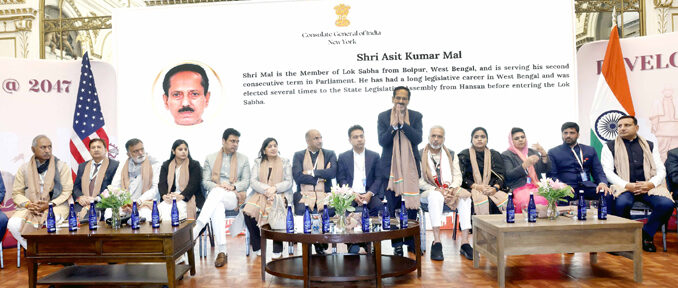
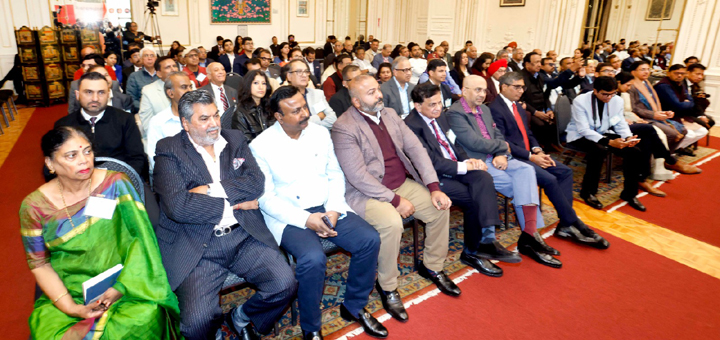
NEW YORK (TIP): An all-party delegation of Indian parliamentarians met members of the Indian diaspora at the Consulate General of India in New York on October 7, bringing elected representatives from different states and political parties together for an exchange on the community’s achievements abroad and its concerns about developments in India.
Consul General Ambassador Binaya Srikanta Pradhan extended a warm welcome to the visiting lawmakers. Before his opening remarks, a Consulate official introduced the delegation members, outlining their parliamentary responsibilities and backgrounds in public life.
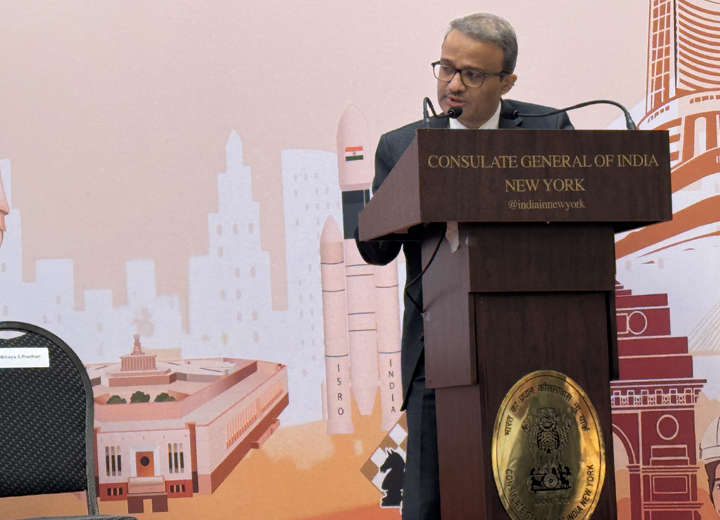
In his welcome address, Pradhan described the Consulate’s historical significance and its engagement with the Indian community across the northeastern United States. He said it was the first Indian consulate opened after independence and had occupied its present building since May 1948.
Pradhan placed the Indian diaspora within the Consulate’s region at approximately 2.2 million. His presentation outlined the scale of the community’s presence and the breadth of its contributions to American life.
He highlighted Indian-origin leadership in technology, finance and business, alongside achievements in medicine, scientific research, higher education and the arts. He also drew attention to the substantial number of Indian students in the United States and the economic connections maintained with India through remittances.
His remarks extended beyond professional accomplishments to India’s cultural influence, including the popularity of yoga and interest in Ayurveda. Together, these examples illustrated the community’s participation in American society while maintaining connections with India.
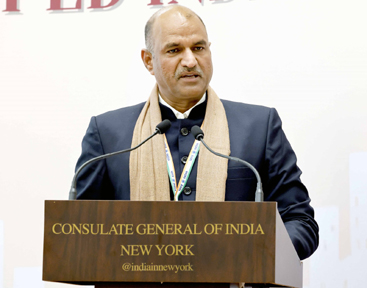
Pradhan explained that the delegation had requested a program emphasizing direct engagement rather than formal speeches by every parliamentarian. Following his welcome, he invited Shri Chandra Prakash Joshi, leader of the Parliamentary delegation, to address the gathering before opening the floor for questions.
Speaking in Hindi, Shri Joshi praised Indians abroad for distinguishing themselves in the professions and businesses they pursued. He said their success raised their own standing while enhancing India’s reputation in the countries where they lived.
Turning to India’s development, Joshi described the country’s rapid progress and credited initiatives of Prime Minister Narendra Modi’s government with advancing prosperity. He discussed the ambition to achieve Viksit Bharat, or a developed India, by 2047, when India completes a century of independence.
A substantial part of his address concerned young people. He emphasized the importance of improved educational facilities and expanded employment avenues, linking India’s development ambitions with opportunities for the next generation.
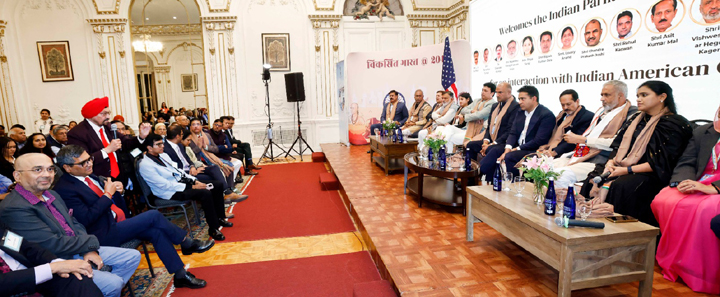
Apart from Joshi, the delegation members did not deliver separate formal speeches. They participated in the question-and-answer session, with most speaking in Hindi.
Audience interventions brought attention to disparities in development, including concerns about Bihar and Jharkhand. Alok Kumar, who comes from Bihar, questioned the state’s slow economic progress and raised the problems of poverty and unemployment. He asked what the government proposed to do to accelerate economic growth and improve opportunities for its people.
Prof. Indrajit Saluja, publisher and chief editor of The Indian Panorama, made an impassioned plea for stronger action against the drug menace in Punjab. He described the problem as a grave threat whose consequences extended beyond the state and posed concerns for India as a whole.
Other participants questioned whether Hindi was receiving its due place and recognition in India.
The interaction gave community members an opportunity to place their concerns directly before elected representatives from different political backgrounds. Appreciation of the diaspora’s accomplishments and discussion of India’s development ambitions were accompanied by questions about regional inequality, employment, language and drug abuse.
The visiting delegation included:
C. P. Joshi (BJP Lok Sabha member from Chittorgarh, Rajasthan; a third-term parliamentarian and chairperson of the Lok Sabha Committee on Petitions); Rahul Kaswan (Congress Lok Sabha member from Churu, Rajasthan. He has represented the constituency in the 16th, 17th and 18th Lok Sabhas); Lovely Anand (Janata Dal (United) Lok Sabha member from Sheohar, Bihar; serving her second Lok Sabha term, following an earlier parliamentary tenure in the 1990s); Asit Kumar Mal (Lok Sabha member from Bolpur, West Bengal, elected on a Trinamool Congress ticket. Published reporting identifies him as a second-term MP); Biplab Kumar Deb (BJP Lok Sabha member from Tripura West; a former chief minister of Tripura, bringing state executive experience to the delegation); Vishweshwar Hegde Kageri (BJP Lok Sabha member from Uttara Kannada, Karnataka; a former Karnataka Assembly Speaker and former minister for primary and secondary education); Priya Saroj (Samajwadi Party Lok Sabha member from Machhlishahr, Uttar Pradesh. A lawyer by profession, she entered the Lok Sabha following the 2024 election); Dr. Gumma Thanuja Rani (YSR Congress Party Lok Sabha member from Araku, Andhra Pradesh. A medical doctor with experience in epidemiology, she was elected in 2024); Rajabhau Parag Prakash Waje (Shiv Sena Uddhav Balasaheb Thackeray Lok Sabha member from Nashik, Maharashtra; serving his first term in the Lower House); Mahima Kumari Mewar (BJP Lok Sabha member from Rajsamand, Rajasthan; a first-term parliamentarian elected in 2024); Dr. Sikander Kumar (BJP Rajya Sabha member representing Himachal Pradesh. An economist and academic, he previously served as vice-chancellor of Himachal Pradesh University); Anil Kumar Yadav Mandadi (Congress Rajya Sabha member representing Telangana; one of the five Upper House members identified in the visiting delegation); Banshilal Gurjar (BJP Rajya Sabha member representing Madhya Pradesh; serving his first term in the Upper House); Sanjay Yadav (Rashtriya Janata Dal Rajya Sabha member representing Bihar, contributing another regional-party perspective to the delegation); and L. K. Sudhish (Desiya Murpokku Dravida Kazhagam (DMDK) Rajya Sabha member representing Tamil Nadu; identified in current delegation reporting as a first-term MP).

Be the first to comment