
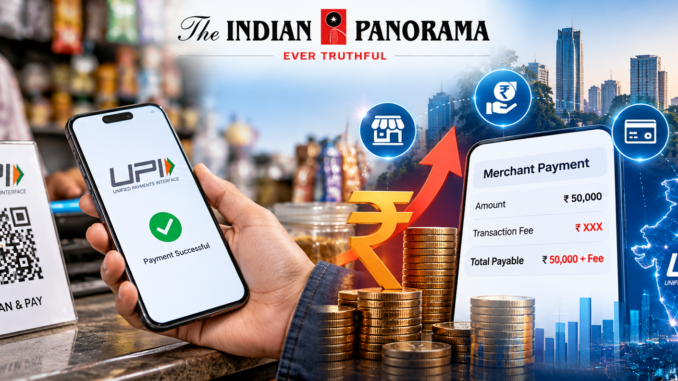

Starting October 15, India’s UPI will no longer be free for large merchant transactions. The National Payments Corporation of India will introduce a 0.4 percent Merchant Discount Rate on UPI payments over 2,000 rupees, ending six years of free service for merchants.
NPCI announced the change on September 15 after a recent amendment to India’s payments law allowed merchant fees on some UPI transactions. The new 0.4 percent fee only applies to person-to-merchant payments over 2,000 rupees, or about 21 dollars, and is capped at 300 rupees for transactions of 75,000 rupees or more. This means even the biggest UPI merchant payments will have a relatively small fee compared to traditional card networks.
How Will the New Fee Structure Actually Work in Practice?
NPCI has made it clear that regular consumers will not have to pay the new fee. Person-to-person transfers will stay free, no matter the amount, and merchant payments of 2,000 rupees or less are also exempt. NPCI says this protects over 95 percent of all UPI transactions from any fee. UPI app providers cannot charge customers extra, and merchants are not allowed to pass the 0.4 percent fee to buyers. For example, if you pay 3,000 rupees using UPI, you will still pay 3,000 rupees. The 12-rupee fee will be covered by banks, payment apps, or other participants in the payment system.
Small merchants and street vendors who get up to 100,000 rupees per month through UPI QR codes will not have to pay the fee. This rule is meant to protect India’s large informal retail sector from any negative impact.
Why Is NPCI Introducing Fees After Six Years of Free Service?
This change is due to financial pressures NPCI has faced for years. In August 2026 alone, UPI handled 24.51 billion transactions worth about 29.9 lakh crore rupees, or over 335 billion dollars. NPCI says it now costs around 20,000 crore rupees each year to run the system, including servers, cybersecurity, and fraud prevention. India removed merchant fees on UPI in January 2020 to boost early adoption, which helped UPI become central to digital payments. However, as usage grew, the costs became harder to manage.
NPCI plans to use the money from the new fee to create a fund that will help more small merchants in Tier-3 towns and smaller markets accept UPI. They see this not just as a way to recover costs, but also as an investment to bring digital payments to more underserved areas.
Here are some details on how the new fee system is set up to protect different types of users:
- Capital market transactions carry a separate 0.02 percent fee, also capped at 300 rupees, distinct from the standard merchant rate.
- Essential services such as railways and utility bill payments above 2,000 rupees attract a flat 5-rupee fee rather than the percentage-based rate applied elsewhere.
- UPI AutoPay recurring payment mandates attract no MDR at all, regardless of transaction value, protecting subscription-based payment flows from the new charge.
- The Finance Ministry has stated that neither the government nor NPCI will retain any portion of the new fee for profit, with proceeds distributed among ecosystem participants including banks and payment app providers.
- The framework gives acquiring banks, payment aggregators, fintech apps, and corporate platforms roughly one month between the September 15 announcement and the October 15 implementation date to prepare their systems.
What Concerns Have Merchants and Experts Raised?
Despite NPCI’s assurances, tEven with NPCI’s reassurances, the announcement has sparked debate among merchants and policy experts. Some worry the new fee could slow adoption in rural areas where financial knowledge and infrastructure are limited. Others wonder if merchants will try to avoid the fee by breaking up large payments into smaller ones under 2,000 rupees. Politically, some critics say ending free UPI for merchants is a step back for India’s digital payments progress, while government officials argue that a small fee on big transactions is needed to keep the system strong and secure as it grows. What’s the story for India’s Digital Economy?
For a payments system that has become both a domestic success story and an export model India is actively promoting abroad, from Singapore to the UAE to France, the shift to a modest, carefully calibrated merchant fee represents a maturation point rather than a retreat. UPI’s zero-fee origins were always undUPI has become a success story in India and is now being promoted in other countries like Singapore, the UAE, and France.
The move to a small, carefully planned merchant fee is seen as a sign of growth, not a step backward. Indian policymakers always saw the zero-fee model as a temporary way to encourage adoption, not as a long-term plan. By protecting most transactions from fees and only charging high-value payments, NPCI aims to make UPI a self-sustaining part of India’s digital infrastructure instead of relying on ongoing subsidies.
Be the first to comment