
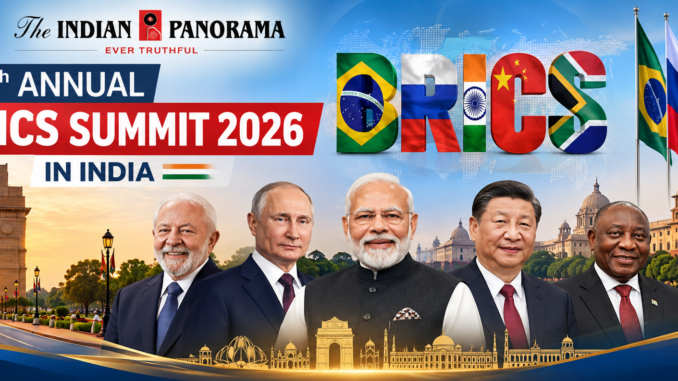

The 18th BRICS Summit ended in New Delhi on September 13 with all members agreeing on a joint declaration. This was India’s most significant diplomatic success of the year, especially considering the deep divisions among the eleven members over issues in West Asia, Ukraine, and the growing global tariff war.
The summit took place at the new Bharat Mandapam convention centre with the theme Building for Resilience, Innovation, Cooperation and Sustainability. Leaders from Brazil, Russia, India, China, Egypt, Ethiopia, Indonesia, Iran, Saudi Arabia, South Africa, and the UAE attended. Together, these countries make up almost half the world’s population, 40 percent of global GDP, and about a quarter of global trade. This was India’s fourth time leading BRICS, after 2012, 2016, and 2021. Over the past year, Indian diplomats held more than 350 meetings and high-level events in 25 cities to prepare for the summit.
How Did India Navigate the Deep Divisions Inside BRICS?
India’s biggest diplomatic challenge as host was managing tensions between Iran and the UAE, who are on opposite sides of the ongoing US-Israeli military campaign against Iran that began in February. Instead of pushing either country into a difficult joint condemnation, India spent weeks working quietly to agree on neutral language. The final statement called for restraint in the Middle East and showed serious concern about rising tensions, but did not name any specific country. The New Delhi Declaration also avoided directly criticizing the US-Israeli strikes on Iran. On Ukraine, it simply called for disputes to be settled through dialogue and diplomacy, and criticized sanctions not approved by the UN Security Council, again without naming Russia’s invasion.
Experts following the talks said the final declaration was modest but acceptable to most members, who mainly wanted to keep the group together. Indian officials relied on New Delhi’s good relationships with Tehran, Abu Dhabi, Moscow, and Washington—connections that few other BRICS countries have—to help all eleven members agree on one document.
What New Financial Infrastructure Did the Summit Launch?
At the summit, leaders officially launched BRICS Pay, a cross-border payment system that connects India’s UPI, China’s CIPS, and Russia’s SPFS. This system lets members settle trade without using the dollar-based SWIFT network. The New Delhi Declaration did not mention de-dollarisation or a shared BRICS currency. This allowed India to say the summit did not provoke Washington, while still giving countries like Russia and Iran an alternative way to settle payments. Soon after the launch, US President Donald Trump warned on social media that any BRICS country trying to replace the dollar would face 100 percent tariffs on exports to the US, a threat he has repeated since 2024.
External Affairs Minister S Jaishankar has repeatedly said that India does not support de-dollarisation and does not want to weaken the currency used by its biggest trading partner. Reserve Bank officials have also said this publicly several times this year. This careful approach shows how India tried to balance supporting other BRICS members facing Western sanctions while avoiding language that could lead to US tariffs against India.
Several other developments from the summit show how much India accomplished as host:
- More than 350 ministerial meetings and high-level engagements were held across 25 Indian cities during India’s year-long chairship, according to figures released by the Press Information Bureau.
- Chinese President Xi Jinping made his first visit to India in seven years to attend the summit, though he skipped Prime Minister Modi’s gala dinner at the last minute, reportedly due to feeling unwell.
- Bangladesh, whose Prime Minister Tarique Rahman was invited only in his capacity as BIMSTEC chair rather than as head of government, chose not to send any representative, exposing the continued strain in Dhaka-Delhi relations since 2024.
- BRICS agreed on a Centres of Excellence on Agro-Ecology as a platform for joint research on climate-resilient farming practices, one of several practical, development-oriented outcomes to emerge from India’s chairship.
- Ten partner countries, including Belarus, Kazakhstan, Nigeria, and Vietnam, participated in outreach sessions alongside the core eleven members.
Why Should This Summit Be Read as a Win for India’s Global Standing?
For India, the real success of the summit was not the content of the declaration, which avoided the most difficult issues, but the fact that New Delhi kept eleven countries with opposing interests together. The summit did not end in open disagreement or a failed statement, even though that seemed likely just weeks before.
Reaching a consensus declaration while two members were at war shows India’s strong diplomatic skills. This achievement supports India’s argument for a bigger role in global decision-making, a point Jaishankar took from Bharat Mandapam to the UN General Assembly just two weeks later.
Be the first to comment