
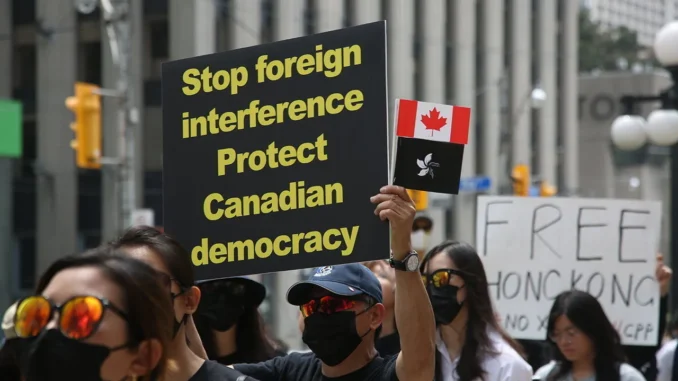


TORONTO (TIP): Elections, the festival of democracy, have started losing both their credence and sheen the world over. Serious doubts have started questioning the credibility of the traditionally accepted mode of determining the popularity of political parties as well as their key players, the leaders.
The United States, considered one of the world’s most vibrant democracies, has been rocked over the way the election of the most powerful man of the world – the President of the United States – is held. It became the subject matter of several petitions even in the Supreme Courts of the United States.
Rigging the polls is one of the oldest allegations facing the democratic process that gives each registered voter a right to exercise his franchise in a free and fair manner. The system, however, came under severe criticism over the way the voters are registered with accusations running high that the political bosses stoop so low to leave out their opponents from the voters’ lists.
As the system keeps evolving to get rigged of its drawbacks and to make it as transparent as possible, the concept of electronic voting machines (EVMs) was introduced about a couple of decades ago.
The EVMs, too, could not stay clear of the controversies.
Another issue that has great political ramifications and that has been threatening the credibility of the national electrons is the “foreign interference.
Canada, for example, has been on forefront in accusing both China and India for interfering in its political processes. Though both India and China have declared the allegations “outrageous” but there cannot be any smoke without a fire.
Now, Canada is in the middle of holding municipal elections to five of its pro vines, including Ontario, British Columbia and Manitoba.
It is not Artificial Intelligence (AI). It is a common social media handle – Face Book – that has been cornering attention in the Municipal Elections being held in some provinces of Canada this month.
While posting news content on Facebook is prohibited in Canada, yet allegations are going wild over some Facebook pages – “I Love Surrey”, “I Love Delta”, and “Delta Speaks” – that have been the talking point in Surrey, Delta and Vancouver in British Columbia.
The reason: Allegations of foreign interference.
Interestingly, while India as a nation is witnessing a fierce campaign to seek ouster of the Chief Election Commissioner on allegations of “managing voters’ lists through SIRs and malpractices. The agitation has been spreading as hundreds of preventive detentions were made.
The eruption of violent protests may have nothing to do with the Municipal elections in several Canadian provinces, including British Columbia, Manitoba, Ontario, Prince Edward Islands, and parts of Saskatchewan and North Wester Territories. Yet accusations supported by the India-based social media handles has given credence to the allegations.
The alleged foreign interference in political affairs of a friendly sovereign nation has been a major irritant that led to. bitterness and even snapping of diplomatic ties between India and Canada less than wo years ago. And the Canadian Municipal elections have been alluring a substantial number of candidates of Indian descent in the fray.
The month of October will keep people in these provinces busy to elect their Mayors, Councilors and School Board Trustees. Each province has chosen a special day like first Monday or second Monday or fourth Saturday to hold the elections.
Members of the Indian Diaspora have been evincing keen interest in municipal elections. A former Member of Parliament and legislator Jinny Sims is in the run for Mayoral post. In one municipal zone in Manitoba, there are four Patels in the ran from different wards. Candidates of Indian origin are contesting for Mayoral and Councilor positions.
In Ontario, Brampton, Mississauga, Toronto, Etobicoke, Milton, and many other areas have several candidates in the fray.
In fact, the number of candidates of Indian origin in all six provinces where all or some areas are in the severe grip of electioneering. Interestingly, polling in these civic elections have been dripping over the years.
This time these civic elections have assumed special significance for more than one reasons. The foremost is the ongoing conflict over tariffs with the oldest trading partner and neighbor the USA.
The “tariffs” war apart, another disturbing trend that has shaken the municipal elections in British Columbia is the allegation of foreign interference with fingers pointed out at India. I am reproducing verbatim a social media post that has been hawking media attention in parts of British Columbia.
Here goes the post:
“Rupees for Reach? The Overseas Facebook Network Targeting B.C. Voters
Former Surrey Mayor Doug McCallum and the Safe Surrey Coalition have dropped a political bombshell, demanding an immediate federal investigation into alleged foreign election interference ahead of the October municipal elections.
Here is what is currently unfolding in B.C. politics:
The Network: A network of at least four to six Facebook pages—bearing names like “I Love Surrey,” “I Love Delta,” and “Delta Speaks”—has been posing as grassroots local news for Surrey, Delta, and Vancouver.
The Foreign Tie: According to the Safe Surrey Coalition, these pages are actually being operated out of India. The group claims the operations are funded in Indian rupees and billed to “ACTS at C-DAC Innovation Park, Pune,” an entity linked to a Government of India research facility.
The Political Angle: McCallum’s camp alleges this coordinated overseas content aims to sway Canadian voters and specifically paints current Surrey Mayor Brenda Locke in a positive light. For her part, Mayor Locke responded that she has absolutely no knowledge of these accounts or the alleged interference.
The Official Stance: McCallum is calling on CSIS, the RCMP, and Elections BC to investigate and demanding Meta take the pages down. However, Elections BC stated that because the paid “boosted” posts occurred outside of the official pre-campaign period, an initial review shows they do not violate the Local Elections Campaign Financing Act.
With the municipal elections rapidly approaching, the line between global digital marketing and election interference is under the microscope.
Should federal authorities be stepping in to regulate overseas pages operating in local elections? Share your thoughts below!”
After going through this post, you can draw your own conclusions.
(Prabhjot Singh is a Toronto-based senior journalist. Awarded a number of times for his journalistic performances, particularly in the field of sports, Prabhjot writes with equal ease on any subject under the Sun. He can be reached at prabhjot416@gmail.com)



Be the first to comment