


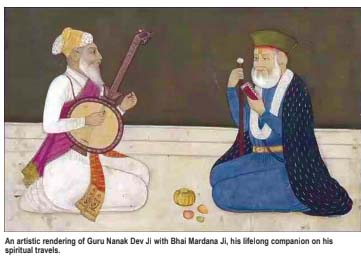
Accompanied by Bhai Mardana Ji, the First Sikh Guru travelled across distant lands, engaging with religious leaders, questioning empty rituals and spreading the message of one Creator and one humanity
The spiritual mission of Guru Nanak Dev Ji was never confined to a particular region, religious community or geographical boundary. His vision was universal, and he believed that the message of the One Creator belonged to every human being. To communicate this understanding, he undertook extensive journeys across different parts of the Indian subcontinent and beyond, engaging with people from diverse religious, cultural and philosophical backgrounds.
These journeys are traditionally known as the four Udasis. They occupy an important place in Sikh historical and devotional literature and demonstrate the extraordinary geographical reach of Guru Nanak Dev Ji’s spiritual mission.
The word Udasi is associated with a journey or period of spiritual wandering. Traditional Sikh accounts describe four major journeys undertaken by the Guru, accompanied by Bhai Mardana Ji, his close companion and a talented rabab player. Together, they travelled to places of religious importance, met saints and scholars, and interacted with ordinary people.
The significance of these journeys was not simply that Guru Nanak Dev Ji visited distant destinations. He used these encounters to question social injustice, religious formalism, superstition and divisions between communities. His message consistently emphasised that genuine spirituality could be attained through remembrance of God, honest living, humility and compassion.
Bhai Mardana Ji: The companion who travelled with the Guru
Any account of the Udasis remains incomplete without understanding the contribution of Bhai Mardana Ji.
Born into a Muslim Mirasi family at Talwandi, Bhai Mardana Ji developed a close association with Guru Nanak Dev Ji from an early age. He was a gifted musician who played the rabab, a stringed instrument traditionally associated with devotional music.
During their travels, Bhai Mardana Ji accompanied the Guru and provided musical accompaniment to his compositions. The combination of the Guru’s spiritual poetry and Mardana’s music helped communicate profound philosophical ideas in an accessible and emotionally powerful manner.
Their relationship also represented a living example of the Guru’s rejection of religious divisions. A Hindu-born spiritual teacher and his Muslim companion travelled together, sharing a common commitment to the Divine.
Their companionship demonstrated that friendship, respect and spiritual understanding were not restricted by religious identity.
THE FIRST UDAASI: THE EASTERN JOURNEY
The first traditional Udasi is generally associated with Guru Nanak Dev Ji’s travels towards eastern India. Accounts describe visits to several important religious and cultural centres, including Haridwar, Delhi, Varanasi, Patna, Bengal, Assam and other regions.
During these journeys, the Guru encountered different forms of religious practice, philosophical traditions and social customs. His discussions focused on the difference between genuine devotion and mechanical observances.
Haridwar: Questioning the meaning of rituals
One of the best-known traditional episodes from the eastern journey is associated with Haridwar, an important Hindu pilgrimage centre on the banks of the Ganges.
 According to the Janamsakhi tradition, Guru Nanak Dev Ji arrived during a religious observance when devotees were offering water towards the rising Sun, believing that the ritual would benefit their ancestors.
The Guru began throwing water in the opposite direction. Surprised by his actions, people questioned him.
He reportedly explained that he was sending water towards his fields in Punjab. When people questioned how the water could reach such a distant destination, he challenged them to consider how their offerings could reach ancestors in another world.
The episode was a powerful lesson in critical thinking. Guru Nanak Dev Ji was not simply criticising a religious ceremony; he was asking people to understand the meaning of their actions rather than performing rituals without reflection.
Varanasi: Spirituality beyond outward appearances
Varanasi was another important centre associated with the traditional eastern journey.
The city had a long history of religious scholarship, philosophy and spiritual practice. Guru Nanak Dev Ji’s interactions with religious scholars and seekers are remembered for their emphasis on the difference between external religious identity and inner spiritual awareness.
He questioned the belief that religious knowledge or ritual expertise automatically made a person spiritually enlightened.
For Guru Nanak Dev Ji, a person’s character was the true measure of spiritual progress. Compassion, humility, honesty and remembrance of God were more important than outward displays of religious authority.
Bengal and Assam: A message for diverse communities
Traditional accounts also associate Guru Nanak Dev Ji’s eastern travels with Bengal and Assam.
These regions had diverse religious traditions and thriving centres of cultural exchange. His message of universal spirituality offered an opportunity to connect with people beyond the boundaries of established religious institutions.
The first Udasi thus represented an extensive effort to communicate the message of one Creator and challenge the limitations imposed by ritualism and social divisions.
THE SECOND UDAASI: THE SOUTHERN JOURNEY
The second traditional Udasi is associated with Guru Nanak Dev Ji’s travels towards southern India and regions beyond the peninsula.
Traditional Janamsakhi narratives connect this journey with several destinations across central and southern India, including important centres of religious and philosophical activity. Some accounts also associate the journey with Sri Lanka.
The southern regions had rich traditions of temple worship, devotional movements, philosophical discussions and spiritual scholarship. Guru Nanak Dev Ji’s interactions with these traditions reflected his interest in understanding different approaches to the Divine while questioning practices that encouraged discrimination or empty ritualism.
The importance of inner devotion
One of the central themes associated with the southern journey was the distinction between external worship and inner spirituality.
Guru Nanak Dev Ji taught that God was not restricted to temples, pilgrimage centres or sacred objects. The Divine could be remembered in every place and through every sincere action.
He encouraged people to cultivate a relationship with the Creator through Naam and truthful living rather than relying exclusively on ceremonies.
His message also challenged the idea that spiritual liberation was available only to people who withdrew from ordinary responsibilities.
A person could remain engaged in family life, work and society while maintaining spiritual awareness.
Encounters with different traditions
The southern Udasi is traditionally associated with encounters involving ascetics, religious teachers and seekers.
These discussions provided opportunities to explain the importance of humility and ethical conduct.
Guru Nanak Dev Ji did not consider the mere abandonment of worldly possessions a guarantee of spiritual achievement. He believed that ego could remain within a person even after giving up material comforts.
True renunciation, according to his teachings, involved overcoming selfishness, greed, anger and attachment.
The traditional accounts of the southern journey also illustrate the geographical reach of his message and his ability to communicate with people from different cultural backgrounds.
THE THIRD UDAASI: THE NORTHERN JOURNEY
The third Udasi is traditionally associated with Guru Nanak Dev Ji’s travels towards the northern regions, particularly the Himalayas and areas connected with yogic and ascetic traditions.
These journeys brought him into contact with spiritual seekers who believed that meditation, physical austerities and withdrawal from society were essential to attaining liberation.
Guru Nanak Dev Ji respected sincere spiritual inquiry but questioned the belief that isolation from the world was the only path to spiritual fulfilment.
Sidh Gosht: A dialogue on the nature of spirituality
One of the most significant compositions associated with Guru Nanak Dev Ji’s philosophical discussions is Sidh Gosht, preserved in Sri Guru Granth Sahib Ji.
The composition presents a dialogue with Siddhas, spiritual practitioners associated with yogic traditions.
The discussion explores fundamental questions: What is the nature of the Divine? How can a person attain spiritual awareness? Is withdrawal from society necessary for liberation? What role do meditation, discipline and the Guru play in spiritual life?
Guru Nanak Dev Ji emphasised that the Divine could be realised while living within the world.
He encouraged people to overcome ego and cultivate Naam rather than considering physical isolation or extreme austerities as the only route to spiritual fulfilment.
The mountains and the search for truth
The traditional northern journeys are associated with regions where spiritual seekers pursued meditation and ascetic practices.
Guru Nanak Dev Ji’s message challenged the assumption that spirituality was limited to people who lived in forests, caves or mountain retreats.
He believed that the real challenge was to remain spiritually conscious while dealing with everyday responsibilities.
A person who earned honestly, served others, controlled selfish desires and remembered God could live a spiritually meaningful life without abandoning society.
This principle became one of the defining characteristics of Sikh philosophy.
THE FOURTH UDAASI: THE WESTERN JOURNEY
The fourth traditional Udasi is associated with travels towards western regions, including destinations connected with the Islamic world.
Accounts describe Guru Nanak Dev Ji’s visits to Mecca, Medina and Baghdad, among other places.
These journeys are especially significant because they illustrate his willingness to engage with religious communities beyond the Indian subcontinent.
Mecca: The Divine is everywhere
One of the most famous traditional Janamsakhi accounts concerns Guru Nanak Dev Ji’s visit to Mecca.
According to the narrative, the Guru was resting with his feet towards the Kaaba when a religious attendant objected to the direction in which he was lying.
Guru Nanak Dev Ji is traditionally said to have asked the person to turn his feet towards a direction where God was not present.
The episode conveys a fundamental principle of Sikh philosophy: the Divine is omnipresent and cannot be confined to one direction or geographical location.
The story is remembered not as a rejection of another religion but as an expression of the universality of God.
Baghdad: A meeting of spiritual traditions
Traditional accounts also associate Guru Nanak Dev Ji with Baghdad, an important centre of Islamic scholarship and spiritual thought.
His interactions with religious figures there are remembered for their discussions about the nature of God, the meaning of devotion and the importance of humility.
These accounts illustrate his willingness to engage in dialogue rather than hostility.
He encouraged people to look beyond religious divisions and recognise the shared spiritual questions that unite humanity.
The enduring significance of the Udasis
The four Udasis represent one of the most remarkable aspects of Guru Nanak Dev Ji’s life. They demonstrate the extraordinary geographical and intellectual scope of his mission.
He travelled to engage with people rather than impose a rigid religious identity. His approach was based on dialogue, questioning and spiritual reflection.
The Udasis also help explain why his teachings developed a universal appeal. His message was not restricted to one language, culture or community. It spoke to the common human desire for truth, dignity and spiritual fulfilment.
Bhai Mardana Ji’s companionship added another dimension to these journeys, showing that different religious backgrounds need not become barriers to friendship and shared purpose.
The exact chronology and geographical routes of the four Udasis remain subjects of historical discussion, as many details are preserved in traditional Janamsakhi literature. Nevertheless, their importance in Sikh memory is undeniable.
More than five centuries later, the journeys of Guru Nanak Dev Ji continue to offer an example of how dialogue can overcome prejudice, how questioning can challenge injustice and how spiritual conviction can bring people together.
Four journeys, countless encounters and one universal message: the Creator is One, and all humanity belongs to that creation.

Be the first to comment