
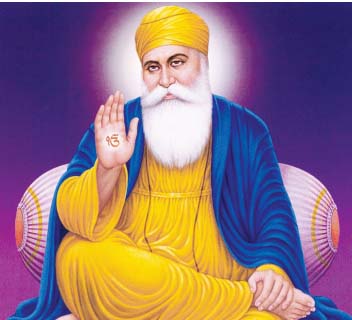

A spiritual visionary, a social reformer and a messenger of universal humanity, Guru Nanak Dev Ji transformed the way people understood religion, society and their relationship with the Divine. More than five centuries after his birth, his teachings continue to offer guidance to a world divided by religious intolerance, discrimination, conflict and inequality. The 557th anniversary of the first Sikh master will be celebrated on Tuesday, November 24, this year. The Indian Panorama wishes its readers happy Gurpurb.
In the history of humanity, certain spiritual figures leave behind teachings that transcend the boundaries of their own time. Their words continue to inspire generations, their ideas challenge established conventions, and their message becomes a guiding force for societies far removed from the circumstances in which they first emerged. Guru Nanak Dev Ji was one such extraordinary personality. Born in 1469, he introduced a spiritual vision centred on the oneness of God, the equality of humanity, honest living and selfless service. His message challenged social divisions and religious formalism while offering a universal understanding of spirituality rooted in truth, humility and compassion.
As the world commemorates the 557th Parkash Purab of Sri Guru Nanak Dev Ji, his life and philosophy invite renewed reflection. His teachings are not merely part of Sikh religious history; they represent a profound contribution to humanity’s understanding of justice, dignity, coexistence and spiritual responsibility.
A birth that illuminated the world
Guru Nanak Dev Ji was born in 1469 at Rai Bhoi Ki Talwandi, a settlement in the Punjab region that is now known as Nankana Sahib in Pakistan. His parents were Mehta Kalyan Das, popularly known as Mehta Kalu, and Mata Tripta Ji. His elder sister, Bebe Nanaki Ji, was particularly close to him and is traditionally remembered as one of the first people to recognize his exceptional spiritual nature.
The society into which Guru Nanak Dev Ji was born was characterized by rigid caste distinctions, religious divisions and deeply established social hierarchies. Religious practices often revolved around rituals and outward observances, while social status frequently determined how individuals were treated. Against this background, the spiritual vision that he would eventually articulate represented a remarkable departure from conventional thinking.
Traditional Janamsakhi accounts describe several incidents from his childhood that illustrate his inclination towards spirituality and his questioning of established practices. He was interested in understanding the meaning of life, the nature of God and the purpose of human existence. Rather than accepting customs without reflection, he encouraged people to look beyond external appearances and discover the truth within themselves.
One frequently narrated episode concerns the Janeu ceremony, during which he questioned the significance of wearing a sacred thread. He argued that true spiritual purity could not be achieved through an external symbol alone. What mattered was cultivating compassion, contentment, truthfulness and good conduct. The episode captures a central feature of his philosophy: religious identity must be reflected in the quality of one’s actions.
The revelation of one universal Creator
The central principle of Guru Nanak Dev Ji’s teachings is expressed through Ik Onkar, the belief in one universal Creator. It establishes that the Divine is beyond human divisions and that all creation belongs to the same spiritual reality.
The Mool Mantar, which appears at the beginning of Sri Guru Granth Sahib Ji, expresses this understanding through a profound description of the Divine:
Ik Onkar, Satnam, Karta Purakh, Nirbhau, Nirvair, Akaal Moorat, Ajooni, Saibhang, Gur Prasad.
These words describe the One Universal Creator as eternal truth, the Creator of all, without fear, without enmity, timeless, beyond birth and self-existent, realised through the Guru’s grace.
This understanding challenged the idea that God could be restricted to a particular religious community, geographical location or form of worship. Guru Nanak Dev Ji taught that the Divine is present everywhere and that genuine devotion requires a transformation of the human mind.
His philosophy did not encourage hostility towards other faiths. Instead, it questioned religious hypocrisy and emphasised the importance of understanding the deeper purpose of spirituality. For him, the value of a person was determined not by religious labels but by truthfulness, humility and compassion.
A spiritual journey that crossed boundaries
Guru Nanak Dev Ji did not limit his message to the people of his immediate surroundings. He undertook extensive journeys, traditionally known as the four Udasis, travelling to different regions and engaging with people from diverse religious and cultural backgrounds.
Accompanied by Bhai Mardana Ji, his close companion and musician, he visited places associated with Hindu, Muslim and other spiritual traditions. Their travels are traditionally linked with regions across the Indian subcontinent, the Himalayan areas and destinations farther west.
These journeys were opportunities for dialogue and spiritual discussion. Guru Nanak Dev Ji met religious leaders, ascetics, scholars and ordinary people. He questioned practices that had lost their spiritual meaning and encouraged individuals to discover the Divine through truthful living.
The famous traditional account of his visit to Haridwar illustrates his approach. Observing people offering water towards the rising Sun, he performed the act in the opposite direction. When questioned, he explained that if water could reach distant ancestors through such an offering, his water could reach his fields hundreds of miles away. The episode exposed the limitations of mechanical ritualism and encouraged people to reflect upon the purpose behind religious practices.
Similarly, the traditional account of his visit to Mecca highlights his teaching that the Divine is omnipresent. Through such encounters, he encouraged people to move beyond narrow religious assumptions and recognise the universality of God.
The revolution of equality
Perhaps the most significant social contribution of Guru Nanak Dev Ji was his uncompromising rejection of inequality. He challenged caste discrimination and the belief that birth determined a person’s spiritual or social worth.
His philosophy placed every human being within the same creation. No individual could claim superiority merely because of family background, wealth, social standing or religious identity.
This principle found practical expression in the institutions of Sangat and Pangat. Sangat refers to the congregation that gathers to remember the Divine, while Pangat represents the practice of sitting together in rows, particularly during Langar, without distinctions of caste or social status.
Guru Nanak Dev Ji also challenged the social attitudes that diminished the dignity of women. His celebrated verse in Asa Di Var asks:
So kio manda aakhiye jit jammeh raajaan.
Why call her inferior, from whom even kings are born?
The verse questions the very foundations of gender discrimination and recognises the essential role of women in human society.
His teachings were not abstract declarations of equality. They encouraged people to practise equality in their homes, communities and everyday interactions.
Naam, honest work and sharing
Guru Nanak Dev Ji’s philosophy is commonly explained through three central principles: Naam Japo, Kirat Karo and Vand Chhako.
Naam Japo encourages remembrance of the Divine and the cultivation of spiritual awareness. It is a reminder that human beings should remain conscious of the Creator and overcome ego, greed and selfishness.
Kirat Karo emphasises earning a livelihood through honest labour. Guru Nanak Dev Ji considered work dignified and believed that spiritual life must be supported by integrity in one’s professional and personal conduct.
Vand Chhako encourages people to share their resources with others. Wealth and material possessions, according to this principle, should not become instruments of selfishness but should be used to support the community and those in need.
Together, these teachings created a practical spiritual philosophy. They demonstrated that devotion was not separate from work, family responsibilities or social obligations.
Kartarpur: Building a community of shared values
Towards the later part of his life, Guru Nanak Dev Ji settled at Kartarpur, situated on the banks of the Ravi river in present-day Pakistan.
There, he established a community where people gathered for prayer, worked honestly and shared their resources. His followers participated in collective activities, and the principles of equality and service became part of everyday life.
Kartarpur represented the practical expression of his spiritual vision. It demonstrated that a society could be organised around devotion, honest work and mutual responsibility rather than social hierarchy.
The tradition of Langar, which developed further under the subsequent Sikh Gurus, became one of the most visible expressions of this philosophy.
Before his passing in 1539, Guru Nanak Dev Ji appointed Bhai Lehna Ji as his successor. He became Guru Angad Dev Ji, ensuring continuity of the spiritual mission.
A legacy that belongs to humanity
Guru Nanak Dev Ji’s teachings were carried forward by nine successive Sikh Gurus and ultimately preserved in Sri Guru Granth Sahib Ji, which Guru Gobind Singh Ji established as the eternal Guru of the Sikhs.
Today, the message of Guru Nanak Dev Ji continues to find expression through Gurdwaras, Langar, Seva, Gurbani and the everyday lives of millions of people across the world.
His philosophy has particular relevance in an age marked by religious polarisation, economic inequality, environmental degradation and social discrimination. His emphasis on the oneness of humanity challenges divisions, while his teachings on honest work and sharing offer an ethical framework for economic life.
His reverence for nature, expressed in Japji Sahib through the verse describing air as the Guru, water as the father and earth as the great mother, offers a spiritual foundation for environmental responsibility.
The 557th Parkash Purab is therefore an occasion not merely to celebrate the birth of a great spiritual personality but to examine how his teachings can shape contemporary society.
Guru Nanak Dev Ji did not ask humanity simply to speak about truth, equality and compassion. He encouraged people to practise these values through their conduct.
More than five centuries later, his message remains a timeless reminder that the path to spiritual fulfilment lies in remembering the Divine, earning honestly, sharing generously and recognising the dignity of every human being.
The light of Guru Nanak Dev Ji continues to shine wherever humanity chooses truth over falsehood, compassion over hatred and service over selfishness.



Be the first to comment