

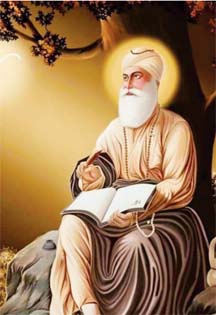
 The story of Guru Nanak Dev Ji is inseparable from the history of Punjab and the spiritual evolution of the Indian subcontinent. Born into a society marked by religious divisions, social inequalities and rigid customs, he emerged as a voice that questioned established conventions and offered an alternative understanding of faith.
His life was not simply a sequence of spiritual experiences or religious teachings. It was a journey through which he demonstrated how devotion could become a force for social transformation. From his childhood at Talwandi to his final years at Kartarpur, every phase of his life contributed to the development of a philosophy that continues to inspire humanity.
Birth and family background
Guru Nanak Dev Ji was born in 1469 at Rai Bhoi Ki Talwandi, in the Punjab region. The settlement is now known as Nankana Sahib and lies in Pakistan.
His father, Mehta Kalyan Das, popularly known as Mehta Kalu, was associated with revenue administration, while his mother, Mata Tripta Ji, cared for the family. He had an elder sister, Bebe Nanaki Ji, with whom he shared a close relationship.
Bebe Nanaki Ji occupies a special place in traditional Sikh accounts because she is remembered as one of the earliest people to recognise the spiritual qualities of her younger brother. Her encouragement and affection played an important role in his early life.
The world into which Nanak was born was experiencing considerable religious and social change. The Punjab region was a meeting ground of different cultures and faith traditions. Yet social hierarchies and religious divisions remained deeply established.
From an early age, Nanak displayed an unusual interest in questions concerning the Divine and human existence. His curiosity extended beyond conventional education and everyday expectations.
A childhood marked by spiritual questioning
Traditional Janamsakhi literature preserves numerous accounts of Guru Nanak Dev Ji’s childhood. While individual narratives are part of the devotional tradition and must be distinguished from independently established historical evidence, they collectively portray a child deeply concerned with spiritual truth.
One famous account describes his encounter with the teacher at school. Instead of limiting himself to conventional learning, Nanak is traditionally said to have reflected on the deeper meaning of letters and their relationship with the Divine.
Another well-known episode concerns the sacred thread ceremony. When preparations were made for the Janeu ritual, Nanak questioned whether an external thread could make a person spiritually pure.
He argued that the true sacred thread should be made of compassion, contentment, self-control and truthfulness. His objection was not simply to a ritual but to the belief that religious observances could replace ethical conduct.
These traditional accounts reveal an important feature of his later teachings: spirituality must be reflected in the quality of one’s character.
The influence of Bebe Nanaki Ji
Bebe Nanaki Ji’s role in Guru Nanak Dev Ji’s life deserves special attention.
In traditional Sikh narratives, she is recognised as someone who understood his spiritual nature and supported him when others found his behavior unusual.
Her life also represents the important place of women in the early Sikh story. She was among the earliest individuals to appreciate the depth of Nanak’s spiritual inclination and remained an important figure in his family history.
Her association with the Guru reminds us that the development of spiritual movements is also shaped by the encouragement, affection and contributions of those around their central figures.
Marriage and family life
Guru Nanak Dev Ji married Mata Sulakhani Ji, traditionally associated with Batala, in the late 15th century. The couple had two sons, Sri Chand and Lakhmi Das.
His family life is important because it helps explain one of the defining characteristics of his philosophy.
Unlike spiritual traditions that placed exclusive emphasis on renunciation and withdrawal from society, Guru Nanak Dev Ji demonstrated that spiritual fulfilment could be pursued while fulfilling family and social responsibilities.
He believed that a person did not need to abandon the world to remember the Divine. Instead, spiritual awareness should guide one’s actions within the world.
This approach became a defining aspect of Sikh philosophy, which places great importance on the life of a householder who earns honestly, serves others and remains devoted to the Creator.
Sultanpur Lodhi: An important turning point
An important chapter in Guru Nanak Dev Ji’s life began when he moved to Sultanpur Lodhi, in present-day Kapurthala district of Punjab.
He worked there in the service of the local administration, traditionally associated with Daulat Khan Lodi. During this period, he spent time in prayer and spiritual contemplation.
Traditional accounts also associate Sultanpur Lodhi with his close companion Bhai Mardana Ji, a Muslim musician who accompanied him on his travels and provided musical accompaniment to his hymns.
The relationship between Guru Nanak Dev Ji and Bhai Mardana Ji is significant because it reflects the Guru’s understanding of humanity beyond religious identity. Their companionship became an enduring symbol of friendship and spiritual cooperation across religious boundaries.
The Bein river episode and spiritual awakening
One of the most important traditional narratives in Guru Nanak Dev Ji’s life is associated with the Kali Bein, a rivulet near Sultanpur Lodhi.
According to Sikh tradition, Nanak disappeared while bathing in the Bein and returned after an extraordinary spiritual experience. Following this episode, he expressed a profound message that challenged the religious divisions of the time.
The declaration traditionally remembered as “There is no Hindu, there is no Muslim” has often been understood as a challenge to religious exclusivism and the tendency to identify spirituality solely through outward religious labels.
It should not be interpreted as a denial of the existence of religious communities. Rather, it reflects the Guru’s teaching that the Divine is universal and that genuine spirituality cannot be measured by labels alone.
The experience marked the beginning of a wider mission through which Guru Nanak Dev Ji shared his understanding of God and humanity.
The beginning of the Udasis
After his spiritual awakening, Guru Nanak Dev Ji undertook extensive travels to spread his message.
These journeys are traditionally known as the four Udasis. Accompanied by Bhai Mardana Ji, he travelled to places associated with different religious traditions and engaged with people from diverse communities.
The traditional accounts describe visits to Haridwar, Varanasi, regions of eastern India, the Himalayas, southern India and destinations towards the west, including Mecca and Baghdad.
The journeys were not undertaken merely to visit sacred places. They provided opportunities to engage with people, discuss spiritual questions and challenge practices that lacked genuine understanding.
At Haridwar, the traditional account of his interaction with people offering water to the Sun illustrates his method of questioning rituals.
In the Himalayan region, his dialogues with Siddhas explored the relationship between spiritual discipline and ordinary life.
The traditional accounts of his travels to Mecca and Baghdad highlight his teaching that God is present everywhere.
Throughout these journeys, Bhai Mardana Ji remained an important companion. His music complemented the Guru’s hymns and helped communicate spiritual teachings through the power of the Shabad.
The establishment of Kartarpur
After his travels, Guru Nanak Dev Ji settled at Kartarpur, on the banks of the Ravi river.
This settlement became the centre of a spiritual community organised around three essential principles: remembrance of the Divine, honest labour and sharing.
People gathered to listen to his teachings and participate in collective prayer. They also worked and shared their resources.
Kartarpur represented a major development in the evolution of Sikhism because it demonstrated that spiritual ideals could be translated into an organised community life.
The principles of equality, honest work and service were not restricted to sermons. They became part of the community’s everyday activities.
The tradition of Langar, further developed under the subsequent Sikh Gurus, reflected the same commitment to equality and sharing.
Guru Angad Dev Ji and the continuity of Guruship
Towards the end of his life, Guru Nanak Dev Ji selected Bhai Lehna Ji as his successor.
Bhai Lehna had initially approached Guru Nanak Dev Ji as a spiritual seeker. Through his devotion, humility and service, he became one of the most trusted followers of the Guru.
He was appointed the Second Sikh Guru and became known as Guru Angad Dev Ji.
The appointment was significant because it established the principle that spiritual succession was based on devotion, humility and understanding rather than family inheritance.
Guru Angad Dev Ji continued the mission of Guru Nanak Dev Ji and strengthened the Sikh community.
The passing of the First Guru
Guru Nanak Dev Ji passed away at Kartarpur in 1539. His life had established the foundations of a spiritual tradition that would continue to develop through the succeeding Gurus.
Traditional Sikh narratives describe how both Hindu and Muslim followers wished to honour his final rites according to their respective traditions. The account symbolises the broad appeal of his message and the affection he inspired among people of different religious backgrounds.
His passing did not bring an end to his mission. The teachings he left behind continued through Guru Angad Dev Ji and the subsequent Gurus, eventually becoming the foundation of Sikh religious and social institutions.
A life that continues to inspire
The life of Guru Nanak Dev Ji demonstrates that spirituality can be a transformative force in society.
He challenged discrimination without promoting hatred, questioned religious hypocrisy without rejecting the search for spiritual truth and encouraged equality through practical community institutions.
His life also offered a different understanding of religious leadership. He was not interested in establishing personal authority through wealth or social status. Instead, he encouraged people to discover the Divine through humility and truthful living.
From Talwandi to Sultanpur Lodhi, from the Udasis to Kartarpur, his life was a continuous expression of a universal message.
For the Sikh community, the 557th Parkash Purab is an opportunity to revisit this remarkable journey. For the wider world, it is an invitation to understand a spiritual visionary whose teachings continue to speak to the deepest questions of human existence.


Be the first to comment