

A spiritual philosophy that connects devotion with daily life, honest work with dignity and personal prosperity with the responsibility to share
Guru Nanak Dev Ji offered humanity a spiritual philosophy that was both profound and practical. He believed that religion should not remain confined to places of worship, ceremonies or formal observances. It should influence how people think, earn their livelihood, treat others and contribute to society.
His teachings challenged the belief that spirituality required withdrawal from ordinary life. Instead, he encouraged individuals to discover the Divine while fulfilling their responsibilities as members of families and communities.
The principles commonly summarised as Naam Japo, Kirat Karo and Vand Chhako express this practical dimension of his philosophy. Together, they provide a framework for a life based on spiritual awareness, integrity, generosity and social responsibility.
These three principles are widely used to explain the foundations of Guru Nanak Dev Ji’s teachings, although they should be understood as a later pedagogical summary rather than a formally enumerated three-part formula in his own compositions.
NAAM JAPO: THE PATH OF DIVINE REMEMBRANCE
Naam Japo refers to remembering and meditating upon the Divine Name. It is one of the central ideas in Guru Nanak Dev Ji’s spiritual philosophy.
The word Naam carries a deeper meaning than simply repeating a religious expression. It represents awareness of the Divine presence and the cultivation of a spiritual relationship with the One Creator.
Guru Nanak Dev Ji taught that God is eternal, formless, beyond human limitations and present throughout creation. Human beings, however, often become distracted by material desires, ego and the pursuit of temporary pleasures.
Naam encourages individuals to rise above these distractions and develop an awareness that shapes their thoughts and actions.
Remembering God in everyday life
For Guru Nanak Dev Ji, remembrance of God was not restricted to a particular place or time. It was a way of living.
A person could remember the Divine while working, raising a family, helping others or participating in community life.
This understanding distinguished his philosophy from approaches that considered spiritual life possible only through isolation or renunciation.
Naam Simran involves more than verbal repetition. It requires sincerity, concentration and an effort to align one’s behavior with spiritual values.
A person who remembers God but treats others unjustly cannot claim to have understood the deeper meaning of devotion.
The Mool Mantar and the understanding of God
The foundation of Sikh spiritual understanding is expressed in the Mool Mantar, which begins with Ik Onkar.
The opening words of Sri Guru Granth Sahib Ji describe the One Universal Creator as eternal truth, the Creator of all, without fear and without enmity.
The description is significant because it establishes a spiritual vision in which God is beyond religious divisions and human limitations.
The Divine is not confined to a particular image, direction or geographical location. The entire creation belongs to the One Creator.
Naam Japo therefore encourages individuals to recognize this universal presence and live with humility.
Overcoming ego through remembrance
One of the major obstacles to spiritual development, according to Guru Nanak Dev Ji, is Haumai, or ego.
Ego creates the illusion that an individual is separate from others and superior because of wealth, knowledge, status or achievement.
It encourages selfishness, arrogance and the desire for recognition.
Through Naam, individuals are encouraged to overcome this sense of separation and recognize their dependence upon the Divine.
The result is not withdrawal from society but a more compassionate relationship with the world.
KIRAT KARO: THE DIGNITY OF HONEST LABOR
The second principle, Kirat Karo, emphasizes earning one’s livelihood through honest work.
Guru Nanak Dev Ji considered labour dignified and believed that people should support themselves through integrity rather than exploitation, deception or unjust means.
This teaching was particularly significant in a society where social status and inherited privilege often determined a person’s position.
By emphasizing honest work, he placed moral value on everyday occupations and challenged the assumption that wealth automatically indicated spiritual greatness.
Work as a spiritual responsibility
Kirat Karo teaches that professional life and spirituality are interconnected.
A person should perform work with sincerity, responsibility and fairness. The nature of the occupation is less important than the honesty with which it is carried out.
Whether someone works as a farmer, artisan, laborer, teacher, trader or administrator, the essential requirement is integrity.
This principle also challenges the tendency to separate religious devotion from economic conduct.
A person cannot claim to follow a spiritual path while exploiting workers, cheating customers or earning through dishonest means.
The story of Bhai Lalo and Malik Bhago
One of the most well-known traditional narratives illustrating Kirat Karo concerns Bhai Lalo and Malik Bhago.
Bhai Lalo was a humble carpenter known for earning his livelihood through honest labour. Malik Bhago, on the other hand, was a wealthy official associated in the traditional account with a lavish feast.
Guru Nanak Dev Ji accepted the simple food offered by Bhai Lalo rather than the elaborate meal associated with Malik Bhago.
When questioned, the Guru is traditionally said to have demonstrated the difference between food earned through honest labour and wealth accumulated through exploitation.
The story communicates a powerful moral principle: the value of earnings is determined not merely by their quantity but by the means through which they are acquired.
It remains a reminder that economic success should never come at the expense of another person’s dignity.
The relevance of honest work today
In contemporary society, Kirat Karo has relevance across professions and economic systems.
It encourages ethical business practices, fair wages, responsible leadership and respect for workers.
It also reinforces the dignity of labour, challenging the tendency to judge individuals according to their occupation or income.
The principle reminds people that success must be accompanied by honesty and social responsibility.
VAND CHHAKO: THE SPIRIT OF SHARING
The third principle, Vand Chhako, encourages people to share their resources with others.
Guru Nanak Dev Ji believed that human beings should not live exclusively for personal gain. Material resources, knowledge and opportunities should also be used to support others.
The principle is rooted in the recognition that all people belong to one creation and that the suffering of another individual should not be treated with indifference.
Sharing as an expression of humanity
Vand Chhako is not limited to distributing money or food.
It can include sharing knowledge, helping someone find employment, supporting an elderly person, educating children or assisting families facing difficult circumstances.
The principle challenges excessive attachment to possessions and encourages individuals to understand that material wealth carries social responsibility.
It also promotes a community-based understanding of prosperity.
A society becomes stronger when people support one another rather than pursuing individual success at the expense of others.
Langar: The living expression of sharing
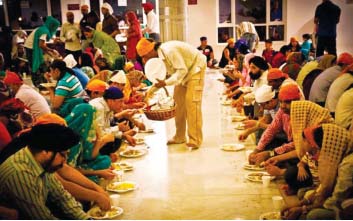
The Sikh institution of Langar is among the most visible expressions of Vand Chhako.
At Gurdwaras, people from different religious, economic and social backgrounds sit together and share a meal.
Volunteers prepare, serve and distribute food without discrimination.
The institution demonstrates that sharing is not simply a moral instruction but something that can be practised collectively.
Langar also reflects the principle of equality because no one is considered superior or inferior while participating in the communal meal.
The tradition was established in the Sikh community under Guru Nanak Dev Ji and strengthened by the subsequent Gurus, with Mata Khivi Ji playing a particularly important role in its development.
Sharing in a world of inequality
The relevance of Vand Chhako is especially clear in a world where economic disparities remain significant.
While some communities enjoy considerable prosperity, millions continue to struggle with hunger, poverty and limited access to education and healthcare.
The principle encourages individuals and institutions to use their resources responsibly.
It reminds people that generosity should not depend solely on wealth. Even small acts of assistance can improve lives and strengthen communities.
THE FIVE INNER VICES: OVERCOMING THE OBSTACLES TO SPIRITUAL LIFE
Naam Japo, Kirat Karo and Vand Chhako are closely connected with another important dimension of Sikh philosophy: the effort to overcome the five inner vices.
These are Kaam, Krodh, Lobh, Moh and Ahankar.
Kaam – Uncontrolled desire: Excessive desire can dominate the mind and prevent individuals from recognising their responsibilities.
Krodh – Anger: Uncontrolled anger damages relationships, encourages hostility and clouds judgement.
Lobh – Greed: Greed creates endless dissatisfaction and encourages people to acquire wealth without considering the consequences.
Moh – Attachment: Excessive attachment to temporary possessions and relationships can prevent individuals from recognising the deeper purpose of life.
Ahankar – Ego: Pride and arrogance create a false sense of superiority and separate people from humility.
Guru Nanak Dev Ji’s teachings encourage individuals to recognise these tendencies and overcome them through remembrance, self-discipline and truthful living.
HUKAM: ACCEPTING THE DIVINE ORDER
Another important concept in Guru Nanak Dev Ji’s philosophy is Hukam, which refers to the Divine order or command.
In Japji Sahib, the Guru explores the relationship between creation and the Divine order.
Hukam encourages individuals to understand that the universe operates within the Creator’s order and that human beings must cultivate humility rather than assume complete control over existence.
Acceptance of Hukam does not mean abandoning responsibility or refusing to work towards social improvement. Instead, it encourages individuals to act with wisdom, recognise their limitations and remain conscious of the larger order of creation.
It also helps develop resilience and spiritual balance during difficult circumstances.
A COMPLETE WAY OF LIVING
The three principles are interconnected and cannot be understood in isolation.
Naam Japo develops spiritual awareness. Kirat Karo translates that awareness into ethical action. Vand Chhako ensures that personal effort and prosperity contribute to the welfare of others.
Together, they offer a balanced approach to life in which spiritual devotion, economic integrity and social responsibility reinforce one another.
In a world increasingly driven by competition, material ambition and individual success, Guru Nanak Dev Ji’s philosophy offers an alternative vision.
It encourages people to pursue prosperity without greed, remain ambitious without arrogance and enjoy material comforts without forgetting their responsibility towards others.
His teachings also remind humanity that religious identity has little meaning if it does not lead to better conduct.
The 557th Parkash Purab provides an opportunity to reflect on these principles and examine how they can be incorporated into contemporary life.
Remember the Divine, earn through honest labour and share with others: in these simple yet profound teachings lies a philosophy that can transform individuals, strengthen communities and bring humanity closer to a more compassionate world.



Be the first to comment