


On July 4, 2026, the United States commemorates one of the most remarkable milestones in modern history-the 250th anniversary of the adoption of the Declaration of Independence. Known as the Semiquincentennial, the occasion marks a quarter of a millennium since thirteen British colonies declared themselves free and independent states, embarking on an unprecedented experiment in democratic self-government.
The anniversary is far more than a birthday celebration. It is a moment to reflect upon a journey that transformed a narrow strip of settlements along North America’s Atlantic coast into one of the world’s most influential nations. During these 250 years, America has experienced revolution, civil war, territorial expansion, industrialization, economic prosperity, social upheaval, scientific discovery, and technological innovation. It has inspired democratic movements across continents while continually striving to fulfil the ideals proclaimed in 1776-liberty, equality, justice, and government by the consent of the governed.
As fireworks illuminate the skies over Washington, New York, Boston, Philadelphia, and thousands of communities across the country, Americans are celebrating not only their nation’s birth but also the resilience of institutions and values that have endured through triumphs and trials alike.
The Road to Revolution
The American Revolution did not begin overnight. It was the culmination of decades of political tension, economic grievances, and philosophical debate between Great Britain and its North American colonies.
By the mid-eighteenth century, Britain possessed thirteen prosperous colonies stretching from New Hampshire in the north to Georgia in the south. These colonies enjoyed relative autonomy. Colonial assemblies managed local affairs, merchants prospered through Atlantic trade, and farmers cultivated fertile lands. Many colonists considered themselves loyal British subjects.
However, the conclusion of the Seven Years’ War (1756-1763), known in North America as the French and Indian War, dramatically altered relations between Britain and its colonies. Although Britain emerged victorious and gained vast new territories, the war left the British government burdened with enormous debt.
Seeking additional revenue, Parliament introduced a series of taxes directly affecting the colonies. Among the most controversial were:
– The Sugar Act (1764)
– The Stamp Act (1765)
– The Townshend Acts (1767)
– The Tea Act (1773)
Colonists argued that Parliament had no authority to tax them because they had no elected representatives in London. Their famous slogan-
“No Taxation Without Representation”
-became the defining principle of colonial resistance.
Political organizations such as the Sons of Liberty organized protests, distributed pamphlets, and encouraged boycotts of British goods. Newspapers became powerful tools for spreading revolutionary ideas, while taverns, churches, and town meetings served as centres of political discussion.
The Boston Massacre and Rising Tensions
Relations deteriorated further in March 1770 when British soldiers stationed in Boston fired upon a crowd of protesting colonists.
Five civilians were killed in what became known as the Boston Massacre.
Although relatively small in scale, the incident became a powerful symbol of British oppression. Colonial leaders, including Samuel Adams and Paul Revere, used pamphlets and engravings to rally public opinion against British rule.
The event intensified anti-British sentiment throughout the colonies.
The Boston Tea Party
One of the Revolution’s defining moments occurred on the evening of December 16, 1773.
Disguised as Native Americans, members of the Sons of Liberty boarded three British East India Company ships anchored in Boston Harbor. They dumped 342 chests of tea into the icy waters, protesting taxation and the Tea Act.
The dramatic act of civil disobedience shocked Britain.
King George III responded with severe punitive laws known as the Intolerable Acts, which closed Boston Harbor, restricted self-government in Massachusetts, and expanded British military authority.
Instead of intimidating the colonies, these measures united them.
Many colonists now believed reconciliation with Britain had become impossible.
The First Continental Congress
Representatives from twelve colonies met in Philadelphia in September 1774 for the First Continental Congress.
Although they still hoped to avoid war, delegates agreed to coordinate resistance against British policies.
They organized economic boycotts, petitioned the king for redress, and declared that colonial rights must be respected.
For the first time, the colonies began acting collectively.
The Shot Heard Around the World
On April 19, 1775, British troops marched toward Concord, Massachusetts, intending to seize colonial military supplies.
Instead, they encountered armed colonial militia at Lexington.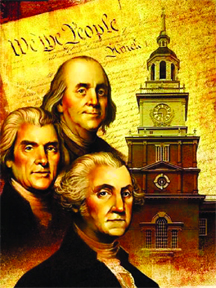
The first shots fired that morning marked the beginning of the American Revolutionary War.
Poet Ralph Waldo Emerson later immortalized the opening gunfire as
“the shot heard round the world”
because its consequences extended far beyond America, inspiring later democratic revolutions across Europe and Latin America.
The Battles of Lexington and Concord demonstrated that many colonists were prepared to fight rather than surrender their rights.
The road to independence had become irreversible.
The Second Continental Congress
Only weeks after fighting began, colonial representatives reconvened in Philadelphia.
The Second Continental Congress assumed the responsibilities of a national government.
Among its most important decisions was appointing George Washington of Virginia as Commander-in-Chief of the Continental Army.
Washington possessed extensive military experience from the French and Indian War and enjoyed broad respect across the colonies.
His leadership would prove indispensable during the difficult years ahead.
The Declaration That Changed History
By the summer of 1776, hopes of reconciliation with Britain had faded.
The colonies required a formal declaration explaining why independence had become necessary.
A committee consisting of:
– Thomas Jefferson
– John Adams
– Benjamin Franklin
– Roger Sherman
– Robert R. Livingston
was appointed to draft the document.
The principal author was the young Virginian Thomas Jefferson.
Drawing upon Enlightenment thinkers such as John Locke, Jefferson argued that all individuals possess natural rights which governments exist to protect.
Governments derive their legitimacy from the consent of the governed-not from kings or inherited privilege.
When governments become destructive of these rights, the people possess the authority to replace them.
On July 4, 1776, delegates gathered inside Philadelphia’s Independence Hall formally adopted the Declaration of Independence.
Among history’s most famous political statements were Jefferson’s immortal words:
“We hold these truths to be self-evident, that all men are created equal…”
The Declaration proclaimed rights to life, liberty, and the pursuit of happiness.
Although these ideals were imperfectly applied at the time-particularly regarding enslaved people, women, and Native Americans-they established principles that future generations would invoke in expanding freedom.
The Declaration fundamentally transformed political philosophy by asserting that legitimate governments derive their authority from ordinary citizens rather than monarchs.
Its influence spread far beyond America, inspiring democratic revolutions in France, Latin America, Europe, Asia, and Africa.
George Washington: The
Reluctant Revolutionary
Among America’s founders, no figure occupies a more revered position than George Washington.
Born into a Virginia plantation family in 1732, Washington gained military experience during the French and Indian War before emerging as leader of the Continental Army.
Washington faced extraordinary challenges.
His army often lacked:
– adequate food
– proper uniforms
– ammunition
– medicine
– shelter
– reliable funding
Many soldiers enlisted for short terms and frequently deserted.
Yet Washington’s greatest strength lay in perseverance.
Rather than seeking dramatic battlefield victories, he focused on preserving the army until circumstances favoured the American cause.
His calm leadership, integrity, and willingness to share hardships with ordinary soldiers inspired immense loyalty.
Washington later became the first President of the United States, establishing traditions that continue to shape the American presidency today.
Winning Independence
Declaring independence did not guarantee freedom.
Britain remained determined to suppress the rebellion.
The Revolutionary War continued for another seven difficult years.
The Continental Army was significantly smaller than Britain’s professional military.
British forces possessed superior equipment, experienced officers, and the world’s strongest navy.
Despite these disadvantages, the Americans benefited from:
– local knowledge
– widespread popular support
– effective guerrilla tactics
– determined political leadership
– growing international assistance
Several battles proved decisive.
The Battle of Trenton (1776)
After suffering repeated defeats, Washington launched a daring surprise attack by crossing the icy Delaware River on Christmas night.
The victory at Trenton dramatically boosted American morale and convinced many soldiers to remain in the army.
The Battle of Saratoga (1777)
Often called the turning point of the Revolution, Saratoga ended in a major American victory over British General John Burgoyne.
The triumph persuaded France that the American cause had genuine prospects of success.
France Enters the War
France had long sought revenge against Britain following its defeat in the Seven Years’ War.
After Saratoga, King Louis XVI agreed to provide extensive military assistance.
French contributions included:
– troops
– naval power
– artillery
– military advisers
– financial support
Without French intervention, historians widely believe American independence would have been far more difficult to achieve.
Spanish and Dutch assistance also strengthened the revolutionary cause.
Valley Forge: The Winter of Endurance
One of the Revolution’s defining episodes occurred during the harsh winter of 1777-78 at Valley Forge.
Thousands of soldiers endured freezing temperatures, inadequate clothing, hunger, and disease.
Nearly 2,000 soldiers died.
Yet the army emerged stronger.
Prussian military officer Baron Friedrich von Steuben introduced rigorous training that transformed inexperienced volunteers into disciplined soldiers.
Valley Forge became a lasting symbol of sacrifice, perseverance, and national unity.
The Siege of Yorktown
The decisive campaign unfolded in Virginia during 1781.
Washington coordinated American and French forces to trap British General Charles Cornwallis at Yorktown.
Meanwhile, the French navy prevented British reinforcements from arriving by sea. Surrounded and heavily outnumbered, Cornwallis surrendered on October 19, 1781.
Although isolated fighting continued, Yorktown effectively ended major military operations.
The Treaty of Paris
Two years later, the Treaty of Paris formally recognized the independence of the United States.
Britain acknowledged the sovereignty of the new nation and granted generous territorial boundaries extending westward to the Mississippi River.
America had achieved what many considered impossible-the successful overthrow of one of history’s greatest empires.
Building a New Republic
Winning independence created a new challenge.
How could thirteen former colonies unite under one stable government while preserving liberty?
Initially, the Articles of Confederation created only a weak national government.
Congress lacked authority to levy taxes, regulate interstate commerce, or enforce national laws effectively.
Economic instability and political disputes soon revealed the system’s weaknesses.
Recognizing the need for reform, delegates assembled once again in Philadelphia during 1787.
Rather than merely revising the Articles, they drafted an entirely new Constitution.
The Constitutional Convention became one of history’s most significant political gatherings.
Delegates debated representation, executive authority, federal powers, slavery, and individual liberties.
Their compromise produced a framework that has remained the world’s oldest written national constitution still in continuous use.
The United States Constitution
The Constitution introduced several revolutionary principles that continue to influence governments worldwide.
These included:
– Separation of powers
– Federalism
– Checks and balances
– An independent judiciary
– An elected executive
– Representative democracy
Power was deliberately divided among the legislative, executive, and judicial branches so that no individual or institution could dominate government.
The Constitution also balanced authority between the federal government and individual states.
This system created stability while allowing regional diversity.
The Bill of Rights
Many Americans feared that the Constitution did not sufficiently protect individual freedoms.
To address these concerns, the first ten amendments-known collectively as the Bill of Rights-were adopted in 1791.
They guaranteed fundamental liberties including:
– Freedom of speech
– Freedom of religion
– Freedom of the press
– Peaceful assembly
– The right to petition government
– Protection against unreasonable searches
– Due process of law
– Fair trials
These constitutional protections have become among the most influential guarantees of civil liberty in modern democratic history.
A Republic Begins Its Journey
When George Washington took the presidential oath in 1789, the United States was a fragile republic of fewer than four million people. Many observers doubted that such an ambitious democratic experiment could survive. Monarchies still dominated Europe, and republican governments were widely viewed as unstable.
Yet Washington’s administration laid the foundations of a durable constitutional order. He formed the first Cabinet, supported the establishment of a national financial system under Alexander Hamilton, and voluntarily stepped down after two terms, setting a precedent for the peaceful transfer of power that became one of the hallmarks of American democracy.
Although political disagreements soon emerged between the Federalists and the Democratic-Republicans, the young republic demonstrated that fierce debate could coexist with constitutional governance. This peaceful balancing of competing ideas would become one of the defining features of the American political system.
From a loose alliance of thirteen colonies, the United States had become an independent constitutional republic built upon revolutionary ideals. Yet its greatest tests-including westward expansion, sectional conflict, slavery, and the struggle to define equality-still lay ahead. Those challenges would shape the nation’s destiny in the nineteenth century and ultimately determine whether the promise of 1776 could endure.



Be the first to comment