

“We Are Here to Serve the Diaspora, to Work With You”
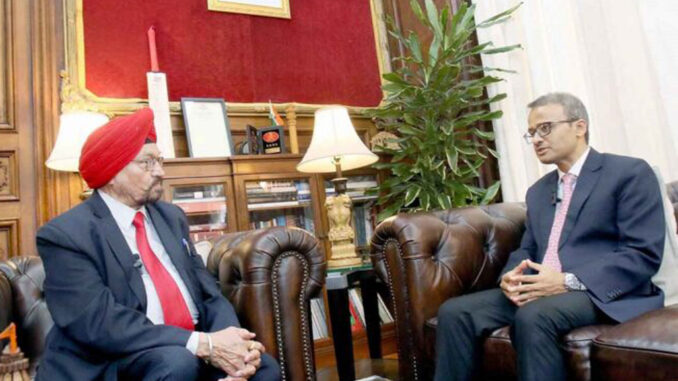
In a wide-ranging Independence Day conversation with Prof. Indrajit S. Saluja, Editor of The Indian Panorama, Ambassador Binaya Srikanta Pradhan speaks about India-U.S. relations, consular reforms, trade and technology, Indian students, family concerns within the diaspora, and why the next generation of Indian Americans should discover “the opportunity called India.”
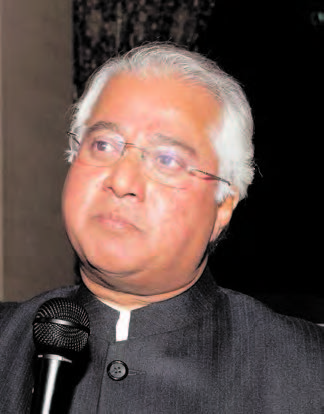
Nine days before India celebrates its 80th Independence Day, I sat down on August 6 with Ambassador Binaya Srikanta Pradhan, Consul General of India in New York.
It was probably my sixth or seventh interview with Ambassador Pradhan. I remember with pleasure our first conversation soon after he assumed office in New York in January 2024. My first impression then endured: he is cordial and unassuming, but sure of his ground – a career diplomat who knows his brief without feeling the need to advertise that knowledge.
Ambassador Pradhan is a 2002-batch officer of the Indian Foreign Service. His diplomatic career has included assignments in Moscow, Turkmenistan and Pakistan; responsibility at the Ministry of External Affairs for India’s relations with Afghanistan and Iran; service as Deputy Chief of Mission in Moscow; and, immediately before New York, service as India’s High Commissioner to Tanzania.
The New York assignment is an unusually demanding one. The Consulate serves a vast Indian community while operating in one of the world’s foremost centers of finance, commerce, education, technology and culture.
Over the past two and a half years, I have watched Ambassador Pradhan travel extensively through the consular jurisdiction, attend community and university events, promote economic engagement, and emphasize accessibility of consular services.
Our hour-long conversation ranged from India at 80 and America at 250 to electronic OCI, fraudulent consular agents, India-U.S. trade, MSMEs, education, Indian students, distressed families, philanthropy and the place of second- and third-generation Indian Americans in the evolving India-America relationship.
What follows is an edited version of that conversation. Spoken repetitions have been removed and passages condensed for clarity, while the substance and spirit of the exchange have been preserved.
A SPECIAL MONTH – INDIA AT 80, AMERICA AT 250
Saluja: Good afternoon, Ambassador. Here I am once again, just as we approach India’s 80th Independence Day. This time I have deliberately not brought a formal questionnaire. Let me give you the freedom to begin with whatever is uppermost in your mind.
AMBASSADOR PRADHAN: I feel elated to see so many Independence Day events being organized by the Indian diaspora and by friends of India across our consular jurisdiction.
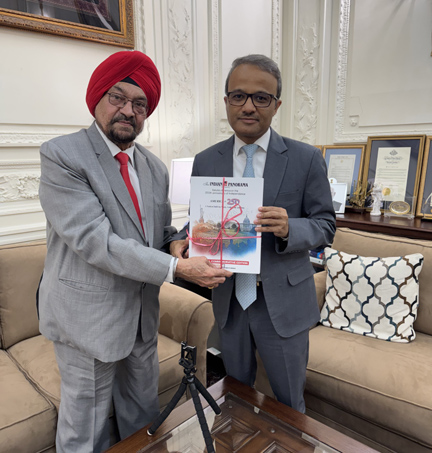
Many friends are celebrating the two occasions together – America at 250 and India at 80. You have come out with a beautiful publication on America at 250, and I find many events being woven around these two milestones.
It is a beautiful tradition: to celebrate the two democracies, the friendship between our two countries, and the common ideals and values in which we believe.
So, I would say this is a special month.
From our side, one of my priorities in speaking through The Indian Panorama is to reach your readers with information about some important new consular initiatives.
E-OCI, E-PASSPORTS AND FASTER IMMIGRATION
Saluja: What are the initiatives our readers should particularly know about?
AMBASSADOR PRADHAN: The first is the electronic OCI – e-OCI. People who already have OCI cards have traditionally carried the physical booklet. Now the Government of India has introduced electronic OCI. You can access the OCI portal, update the required information and have the document available digitally.
This is especially useful when somebody is traveling in a third country and suddenly needs to go to India.
The second initiative is expedited immigration at major Indian airports. If travelers register in advance, they can use the digital immigration facility and complete the immigration process very quickly. It is somewhat comparable to Global Entry in the United States, though the Indian facility is free.
We are also issuing chip-enabled Indian passports – e-passports. It remains a physical passport, but the embedded chip facilitates electronic processing at immigration counters around the world.
BEWARE OF FRAUDULENT CALLS
AMBASSADOR PRADHAN: There is another matter I want to emphasize through your platform.
We continue to find people impersonating officials of Indian consulates and calling members of the community asking for personal information. We have issued advisories and videos, but it continues.
Let me reiterate clearly: Indian consulates, the Embassy and Government of India organizations do not call people asking them to provide personal information in this manner.
Please do not fall for such calls. Report them.
“NOBODY NEEDS TO GO TO AN AGENT”
SALUJA: That brings me to something that has concerned me for years. Private visa and consular-service operators sometimes create an impression among members of the community that they have some connection with the Consulate. People can end up paying substantial amounts unnecessarily. Can something more be done?
AMBASSADOR PRADHAN: Let us be very clear. We are trying to provide our services in the most efficient manner possible and to reach the community directly.
We have opened satellite centers and we organize consular camps. The whole idea is to reach the community.
We repeatedly tell people that they can reach the Indian Consulate directly. They do not need to go to anybody else.
Under the new arrangements, even if somebody has difficulty filling out an application, assistance is available at the service centers. Photographs and help in filling out applications are included within the prescribed service arrangement.
Practically speaking, nobody needs to go to an agent to avail himself or herself of Indian consular services.
If somebody believes an agency has cheated them, however, we need a written complaint. If I receive such a complaint, I am prepared to act. What we often hear instead are anecdotal accounts.
Community organizations and media organizations such as yours therefore have an important responsibility to spread awareness.
SALUJA: Then perhaps we in the community and media have also failed to publicize these facilities sufficiently.
AMBASSADOR PRADHAN: It is a collective responsibility. We know the limitations of our own reach. That is why we ask community organizations and friends like you, who have a larger reach, to repeat this information so people know where legitimate services are available.
WHAT DOES A CONSULATE REALLY DO?
SALUJA: Trade and commerce appear to receive considerable attention from Indian missions abroad. How central are they to your work?
AMBASSADOR PRADHAN: Economic engagement is important, but it would be wrong to say that everything revolves around money.
I would describe three core areas of our work.
First is consular service. We serve a 2.4-million-strong Indian diaspora in this jurisdiction. Last year alone, we provided about 120,000 consular services, including passports and OCI-related services.
Second is the economic track – trade, investment and technology. We support Indian private-sector companies, investment groups, MSMEs and small businesses.
Third is political outreach. We engage political leaders, explain Government of India policies and discuss developments in India.
Beyond these three, we work extensively with the diaspora on cultural, educational and student-related activities.
THE $500-BILLION AMBITION
SALUJA: What are the principal thrust areas in the India-U.S. economic relationship?
AMBASSADOR PRADHAN: The leadership of the two countries has spoken about taking bilateral trade to $500 billion by 2030.
We asked ourselves how the Consulate could contribute.
Working with the Embassy, other consulates and the Ministries of Commerce and External Affairs, we created the India-USA Trade Facilitation Portal.
Through the portal, we connect Indian exporters directly with American importers, including major buyers. We have organized engagements involving companies such as Costco, Walmart and Amazon, bringing exporters from different Indian sectors into contact with American buyers.
The portal also enables digital exhibitions. Travel to the United States and participation in exhibitions can be prohibitively expensive, particularly for MSMEs. Digital exhibitions allow Indian exporters to display their catalogs, brochures and products and interact directly with American importers without incurring those costs.
Artificial intelligence is also being used to help exporters and importers identify suitable matches.
I believe the India-U.S. trade corridor has enormous, untapped opportunity because in many areas our economies are complementary rather than directly competitive.
TRADE, INVESTMENT – AND TECHNOLOGY
AMBASSADOR PRADHAN: Trade is only one dimension. Investment is another.
India benefits tremendously from American investment, but America is also benefiting from Indian investment. At SelectUSA this year, the Indian contingent was the largest delegation.
Then there is technology.
Across frontier technologies – AI, biotechnology, defense, aerospace and others – you see growing collaboration. Governments facilitate it, but private companies, universities and research institutions increasingly participate.
That is why I look at the economic relationship through three connected lenses: trade, investment and technology.
MSMEs AND ONE DISTRICT, ONE PRODUCT
SALUJA: How important are India’s small and medium enterprises to this expanding economic relationship?
AMBASSADOR PRADHAN: Extremely important. A large part of Indian exports comes directly or indirectly from the MSME sector – agriculture, seafood, engineering goods, pharmaceuticals and many other products.
The potential is huge.
The same is true of One District, One Product – ODOP. We believe every district in India has products that should find a place in the global market. The Consulate has actively promoted ODOP products through exhibitions.
Helping smaller producers enter global supply chains is also an objective of our trade initiatives. We need to educate businesses that may not yet know how to become part of those supply chains and connect them with opportunities.
INDIAN STUDENTS: “WE DON’T WANT EVEN ONE TO FACE DIFFICULTIES”
SALUJA: Education is a subject close to both of us. What challenges do Indian students face here, and what can the Consulate do?
AMBASSADOR PRADHAN: We treat engagement with Indian students as a priority.
Today we have about 340,000 Indian students in the United States. The number has risen substantially.
The initial months can be challenging. Students arrive from India and may not know American laws, cyber laws or cultural practices. Universities and Indian student associations provide support, and the Consulate also works with universities and student associations, organizes events, and issues guidance on dos and don’ts.
The feedback we receive from universities is very positive. Indian students are generally regarded as law-abiding and culturally sensitive and often adapt successfully.
But we don’t want even a single student to face difficulties unnecessarily.
EDUCATION IS BECOMING A TWO-WAY STREET
AMBASSADOR PRADHAN: Something else important is happening.
For many years, India-U.S. education cooperation was largely understood in one direction: Indian students coming to the United States.
That is changing.
American universities are showing interest in establishing programs and campuses in India. Institutions on the two sides are also undertaking concrete collaborative projects.
Columbia Engineering and IIT Bombay, for example, have created a collaboration involving artificial intelligence and manufacturing.
These are the models we need – universities from both countries working together on solutions to industrial, technological and developmental challenges while also giving students opportunities for research and internships.
Education cooperation is becoming much broader than student mobility.
YOUNG AMERICANS ARE DISCOVERING INDIA
SALUJA: Academic cooperation is important, but what about cultural understanding and youth exchanges?
AMBASSADOR PRADHAN: It is already happening quite robustly.
During the last two and a half years, I have seen more than a dozen university student groups from here travel to India for summer programs and other study experiences. They include Indian-origin and non-Indian-origin students.
Universities, philanthropic organizations, community organizations and faith-based groups are facilitating exchanges.
We would certainly like to see even more American students going to India, but the trend is encouraging.
WHEN INDIAN FAMILIES IN AMERICA FACE CRISIS
SALUJA: I want to raise a more difficult community issue. We sometimes see serious disputes within Indian families, including cases involving women who need protection or legal assistance. Can the Consulate play a preventive as well as remedial role?
AMBASSADOR PRADHAN: We do encounter such cases.
When a dispute reaches us at an early stage, we sometimes reach out and try to encourage resolution before matters become more difficult. Unfortunately, some cases eventually enter the legal system.
We maintain a panel of lawyers, many of whom provide pro bono assistance, and in appropriate circumstances we provide modest financial assistance toward legal support.
But this is a very large community, and many family matters never reach the Consulate.
I am encouraged that many diaspora organizations, legal forums and philanthropic groups are active in helping people, including women facing difficulties.
Your suggestion that we should find additional ways to educate families and encourage well-meaning organizations to become involved is something I take very seriously.
THE NEXT GENERATION AND “THE OPPORTUNITY CALLED INDIA”
SALUJA: You have often spoken about bringing second- and third-generation Indian Americans more closely into the diaspora. What exactly do you have in mind?
AMBASSADOR PRADHAN: Out of the roughly 5.4 million-strong Indian diaspora in the United States, more than a million are second- and third-generation young people.
They are uniquely endowed.
They are born here. They are proud American citizens, and they are also proud of their Indian heritage.
But I believe their connection with India should not remain limited to cultural, linguistic or religious identity alone.
They should also be exposed to the opportunity called India.
India is among the fastest-growing major economies. Imagine the opportunities it could offer ten years from now.
Young Indian Americans have a special advantage. They understand America, which is one of the world’s most dynamic economic, startup and technology environments. At the same time, their heritage and the OCI framework give many of them unusual access to India – to study, innovate, conduct business and participate in its economic growth.
They should be encouraged to understand and leverage both worlds.
That is what I mean when I speak about bringing the second and third generations into the diaspora in a more meaningful way.
INDIA, PHILANTHROPY AND EDUCATION
SALUJA: Let me end with a personal observation. America has a remarkable tradition of educational foundations and private philanthropy. India has created enormous private wealth in recent decades. Should we not encourage more of that wealth toward education?
AMBASSADOR PRADHAN: Since you describe it as a personal observation, let me respond in that spirit.
India does have significant examples of private philanthropy in education. BITS Pilani is one. The Tatas have made enormous contributions; the Indian Institute of Science itself reflects that tradition. Many religious and philanthropic organizations have contributed substantially to education.
We should also remember where India began.
At Independence in 1947, literacy was around 13 percent, women’s literacy was even lower, and India had only a small number of universities. From there we have reached a point where India is not merely producing talent for itself but supplying talent to the world.
People contribute differently. Some create wealth and employment. Others focus on health, education, philanthropy or skills. I don’t believe we should judge somebody who lawfully concentrates on wealth creation. Wealth creation itself generates employment and tax revenue.
I am an optimist.
When I visit American universities and see recognition of Nalanda and of the extraordinarily advanced educational tradition India possessed centuries ago, I take that as a reference point.
India was once a great center of learning.
It is only a matter of time before we come back.
SALUJA: Hats off to your optimism, Ambassador. I hope that optimism continues – and, more importantly, yields the results we all desire.
“WE ARE HERE TO SERVE THE DIASPORA”
AMBASSADOR PRADHAN: On the occasion of August 15, let me wish all our Indian American friends a very Happy Independence Day – and Happy America at 250.
We are here to serve the diaspora and to work with you.
Your feedback and suggestions matter to us greatly, and we will continue trying to improve our services.
And I again urge every member of the community: please be careful about fraudulent calls made in the name of Indian consulates. Government of India organizations do not call asking for personal information in that manner.
Stay informed, stay connected with legitimate sources, and let us continue working together.
Saluja: Thank you, Ambassador Pradhan, for your time and the valuable information you provided.
Editor’s request to readers of The Indian Panorama.
Readers are encouraged to ask any questions they may have about the consular services. Email your suggestions and complaints to editor@theindianpanorama.news. The Indian Panorama will promptly forward them to the Consulate for their attention and necessary action. Let us be friends of the Consulate if we want them to serve us well.
Thank you.

Be the first to comment