

From the founding vision of Guru Nanak Dev Ji to the eternal Guruship of Sri Guru Granth Sahib Ji, the succession of the ten Sikh Gurus shaped a faith rooted in devotion, equality, courage, service and justice
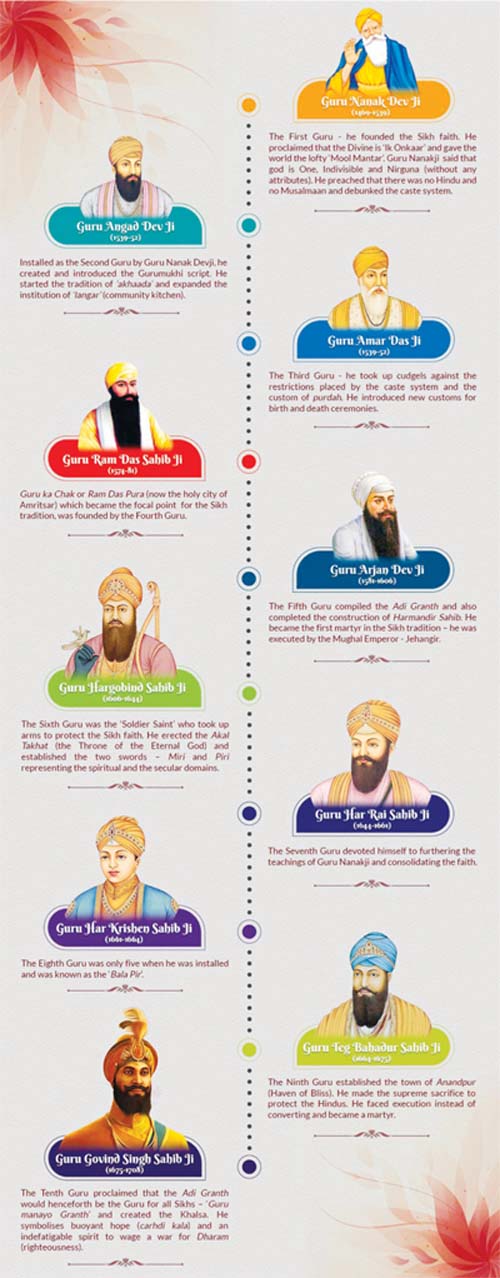 The Sikh tradition began with a message that was both deeply spiritual and profoundly social. When Guru Nanak Dev Ji proclaimed the oneness of the Creator and the equality of humanity, he offered a vision that challenged the divisions of his time. But his contribution was not limited to the teachings of one extraordinary spiritual figure. He established a community, created a way of life and set in motion a tradition that would develop through the leadership of nine successive Sikh Gurus.
Over more than two centuries, the ten Gurus strengthened the foundations of Sikhism, developed its institutions, composed sacred hymns, established centres of spiritual and community life, and guided their followers through periods of social and political upheaval.
Each Guru contributed to this continuing mission. Their work transformed the Sikh community from a congregation centred on the teachings of Guru Nanak Dev Ji into a distinct religious tradition with its own institutions, scripture and collective identity.
The story of the ten Gurus is therefore not simply a sequence of biographies. It is the story of an evolving spiritual vision whose central values remained constant: remember the Divine, live honestly, share with others, serve humanity and stand against injustice.
Guru Nanak Dev Ji: The foundation of the Sikh path
Born in 1469 at Rai Bhoi Ki Talwandi, now known as Nankana Sahib in present-day Pakistan, Guru Nanak Dev Ji laid the spiritual and ethical foundations of Sikhism.
His central teaching was Ik Onkar, the belief in one universal Creator. He rejected discrimination based on caste, religion and social status, questioned empty rituals and emphasized the importance of truthful living.
His teachings encouraged people to remember God, earn through honest work and share their resources with others. He travelled extensively, engaging with people from different religious and cultural backgrounds.
At Kartarpur, he established a community where prayer, honest labour and sharing became part of everyday life.
Before his passing in 1539, Guru Nanak Dev Ji appointed Bhai Lehna as his successor. Bhai Lehna became Guru Angad Dev Ji, marking the beginning of the succession through which the Sikh spiritual tradition would continue.
Guru Angad Dev Ji: Giving the community a stronger foundation
Guru Angad Dev Ji (1504–1552), the Second Sikh Guru, strengthened the community established by Guru Nanak Dev Ji.
One of his most significant contributions was the development and standardization of the Gurmukhi script, which helped provide a more accessible medium for recording and communicating the teachings of the Gurus.
He encouraged education, physical well-being and community participation. He also strengthened the institution of Langar, with the support of Mata Khivi Ji, whose contribution to the community kitchen is remembered in Sikh scripture.
His Guruship helped give the growing Sikh community a stronger cultural and organizational foundation.
Guru Amar Das Ji: Equality and the expansion of Sikh institutions
Guru Amar Das Ji (1479–1574), the Third Sikh Guru, expanded the institutions and organisational structure of the Sikh community.
He strengthened the traditions of Sangat, Pangat and Langar, making collective worship and shared meals important expressions of equality.
He established the Manji system, through which responsible representatives helped spread Sikh teachings and organise the community in different regions.
Guru Amar Das Ji also challenged customs that restricted women’s participation and dignity. His teachings opposed practices such as purdah and the immolation of widows, known as Sati.
His emphasis on equality and social reform carried forward Guru Nanak Dev Ji’s vision of a community in which spiritual worth was not determined by birth or social standing.
Guru Ram Das Ji: The foundation of Amritsar
Guru Ram Das Ji (1534–1581), the Fourth Sikh Guru, is closely associated with the establishment of the settlement that developed into Amritsar.
The city would become one of the most important spiritual centres of Sikhism.
Guru Ram Das Ji also contributed to Sikh devotional music and composed hymns that form part of Sri Guru Granth Sahib Ji.
His Bani includes the celebrated Lavan, the four hymns traditionally recited during the Sikh marriage ceremony, Anand Karaj. The Lavan describe the spiritual journey of a married couple, presenting marriage as a relationship that can be guided by devotion and the remembrance of the Divine.
His leadership strengthened the community’s institutional and spiritual life.
Guru Arjan Dev Ji: The first Sikh martyr and the compilation of scripture
Guru Arjan Dev Ji (1563–1606), the Fifth Sikh Guru, made a lasting contribution to the spiritual and institutional development of Sikhism.
He oversaw the construction and development of the sacred shrine at Amritsar, now known as Sri Harmandir Sahib.
One of his most significant achievements was the compilation of the Adi Granth in 1604. The scripture brought together the compositions of the Sikh Gurus and the devotional writings of several saints and spiritual figures from different backgrounds.
Baba Buddha Ji installed the scripture at Sri Harmandir Sahib, with Bhai Gurdas Ji serving as its principal scribe.
Guru Arjan Dev Ji also composed Sukhmani Sahib, a celebrated composition that reflects on peace, remembrance of God and the spiritual benefits of devotion.
His martyrdom in 1606 under the Mughal emperor Jahangir became a defining moment in Sikh history. It strengthened the community’s understanding of the need to defend religious freedom and stand against oppression.
Guru Hargobind Sahib Ji: The principle of Miri-Piri
Guru Hargobind Sahib Ji (1595–1644), the Sixth Sikh Guru, assumed leadership at a time when the Sikh community faced growing political pressure.
He introduced the principle of Miri-Piri, represented by two swords symbolising temporal responsibility and spiritual authority.
The concept expressed the idea that spirituality could not be separated from the responsibility to defend justice and protect the vulnerable.
Guru Hargobind Sahib Ji established the Akal Takht at Amritsar, which became an important centre of temporal authority in Sikh tradition.
He also strengthened the community’s martial preparedness. His leadership helped shape the understanding that devotion and courage could exist together.
Guru Har Rai Ji: Compassion and care for creation
Guru Har Rai Ji (1630–1661), the Seventh Sikh Guru, is remembered for his compassion, gentle nature and concern for the natural world.
He maintained the military tradition established by Guru Hargobind Sahib Ji while emphasising peace and spiritual discipline.
Traditional accounts associate him with maintaining medicinal gardens and extending care to the sick.
His life is often remembered as an example of the importance of compassion towards all living beings.
Guru Har Krishan Ji: The young Guru remembered for service
Guru Har Krishan Ji (1656–1664), the Eighth Sikh Guru, became Guru at a very young age.
Despite his brief life, he is remembered for his humility and service to people suffering during an epidemic in Delhi.
Sikh tradition recalls his care for the sick, irrespective of their social or religious background.
He passed away in Delhi in 1664, at the age of eight. Gurdwara Bangla Sahib in Delhi is associated with his memory and service.
His life demonstrates that compassion and spiritual greatness are not measured by age or worldly authority.
Guru Tegh Bahadur Ji: The protector of freedom of conscience
Guru Tegh Bahadur Ji (1621–1675), the Ninth Sikh Guru, is remembered for his extraordinary courage and sacrifice in defence of religious freedom.
His teachings emphasised detachment, fearlessness, compassion and remembrance of God.
He travelled extensively, spreading the Sikh message and establishing centres of spiritual life.
In 1675, he was executed in Delhi under the Mughal emperor Aurangzeb. His martyrdom is remembered as a defence of the right of people to practise their faith without coercion.
His sacrifice holds a special place in Sikh history because it represented a stand not merely for his own community but for the freedom of others to follow their religious beliefs.
His Bani, including the celebrated Saloks, forms part of Sri Guru Granth Sahib Ji.
Guru Gobind Singh Ji: The creation of the Khalsa
Guru Gobind Singh Ji (1666–1708), the Tenth Sikh Guru, transformed the Sikh community through the creation of the Khalsa in 1699.
At Anandpur Sahib on Vaisakhi, he called upon Sikhs to dedicate themselves to faith, discipline, courage and service.
The initiation of the Panj Pyare, or Five Beloved Ones, marked a defining moment in Sikh history. Guru Gobind Singh Ji initiated them into the Khalsa and, in a remarkable expression of equality, received initiation from them himself.
The Khalsa ideal emphasised spiritual commitment, moral discipline and readiness to defend justice.
Guru Gobind Singh Ji also affirmed the finality of the human Guruship. In 1708, before his passing at Nanded, he bestowed eternal Guruship upon Sri Guru Granth Sahib Ji.
This decision ensured that the Sikh community would look to the sacred scripture as its eternal spiritual guide.
Sri Guru Granth Sahib Ji: The eternal Guru
The declaration of Sri Guru Granth Sahib Ji as the eternal Guru represents one of the most distinctive features of Sikhism.
The scripture contains the Bani of Sikh Gurus and compositions by Bhagats, saints and other contributors whose writings express devotion to the one Divine.
It includes the teachings of Gurus Nanak, Angad, Amar Das, Ram Das, Arjan and Tegh Bahadur, along with the compositions of several Bhagats, Bhatt poets and other contributors.
The Adi Granth was first compiled by Guru Arjan Dev Ji in 1604. The final form of the scripture associated with Guru Gobind Singh Ji includes the Bani of Guru Tegh Bahadur Ji.
Sri Guru Granth Sahib Ji is not treated merely as a historical document or collection of hymns. It is accorded the status of the living spiritual Guru, and Sikhs seek guidance from its teachings.
One light, ten manifestations of leadership
The ten Gurus guided the Sikh community through different historical circumstances, but their spiritual mission remained connected.
Guru Nanak Dev Ji established the foundation. The succeeding Gurus strengthened the community, developed its institutions, enriched its scripture and prepared it to meet the challenges of changing times.
Their contributions included the Gurmukhi script, Langar, Sangat, Pangat, Amritsar, Sri Harmandir Sahib, the Adi Granth, the Akal Takht, Miri-Piri and the Khalsa.
These were not isolated developments. Together, they shaped a tradition that brought spirituality into everyday life and connected devotion with social responsibility.
A living legacy
The story of the ten Gurus continues to guide millions of Sikhs around the world.
Their teachings are reflected in the daily recitation of Gurbani, the practice of Langar, voluntary service, community welfare and the commitment to defend human dignity.
Their legacy also reminds people that spiritual life requires both inner discipline and outward responsibility.
As the Sikh community celebrates the 557th Parkash Purab of Guru Nanak Dev Ji, the succession of the ten Gurus offers a reminder of how one spiritual vision developed into a lasting tradition.
The light first kindled by Guru Nanak Dev Ji continued through nine successors and now shines through Sri Guru Granth Sahib Ji.
The human Guruship came to an end, but the spiritual guidance of the Guru continues.



Be the first to comment