
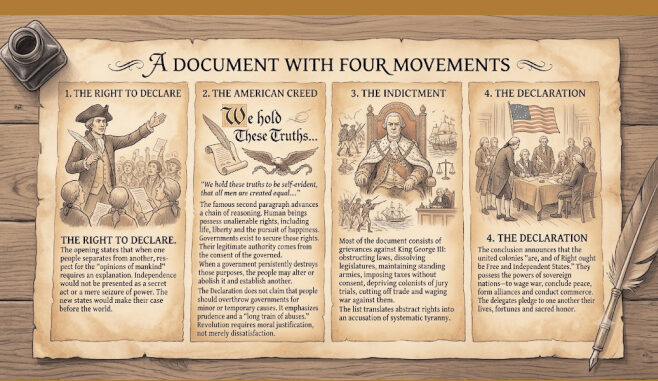

1. THE RIGHT TO DECLARE
The opening states that when one people separates from another, respect for the “opinions of mankind” requires an explanation. Independence would not be presented as a secret act or a mere seizure of power. The new states would make their case before the world.
2. THE AMERICAN CREED
“We hold these truths to be self-evident, that all men are created equal…”
The famous second paragraph advances a chain of reasoning. Human beings possess unalienable rights, including life, liberty and the pursuit of happiness. Governments exist to secure those rights. Their legitimate authority comes from the consent of the governed. When a government persistently destroys those purposes, the people may alter or abolish it and establish another. The Declaration does not claim that people should overthrow governments for minor or temporary causes. It emphasizes prudence and a “long train of abuses.” Revolution requires moral justification, not merely dissatisfaction.
3. THE INDICTMENT
Most of the document consists of grievances against King George III: obstructing laws, dissolving legislatures, maintaining standing armies, imposing taxes without consent, depriving colonists of jury trials, cutting off trade and waging war against them. The list translates abstract rights into an accusation of systematic tyranny.
4. THE DECLARATION
The conclusion announces that the united colonies “are, and of Right ought to be Free and Independent States.” They possess the powers of sovereign nations-to wage war, conclude peace, form alliances and conduct commerce. The delegates pledge to one another their lives, fortunes and sacred honor.
DRAFTED BY JEFFERSON, MADE BY CONGRESS
Adams and Franklin reviewed Jefferson’s draft and suggested changes. Congress then debated and edited it line by line on July 2, 3 and 4. The process was not an act of literary vandalism; it transformed a committee draft into the voice of thirteen states. Congress shortened passages, sharpened accusations and removed claims that could not command agreement.
The most consequential deletion concerned slavery. Jefferson’s draft condemned the king for sustaining the transatlantic slave trade and encouraging enslaved people to rise against colonists. The passage was selfserving and evasive: it blamed the Crown while ignoring colonial participation and Jefferson’s own slaveholding. Delegates from slaveholding and slave-trading interests opposed it. Congress removed it. On July 2, Congress approved Lee’s resolution for independence. On July 4, it adopted the Declaration’s final text and ordered it printed. John Dunlap produced broadsides that traveled to assemblies, armies and communities. The engrossed parchment associated with the famous signatures was prepared later. Most delegates signed it on August 2; some signed afterward, and not every signer was present on that date.
JULY 2 OR JULY 4?
July 2 was the day Congress formally voted for independence. July 4 was the day it approved the explanatory Declaration. The nation commemorates July 4 because the document gave the political decision its enduring language and public meaning.
“It began as an explanation of separation and became a philosophy of legitimate government.”



Be the first to comment