
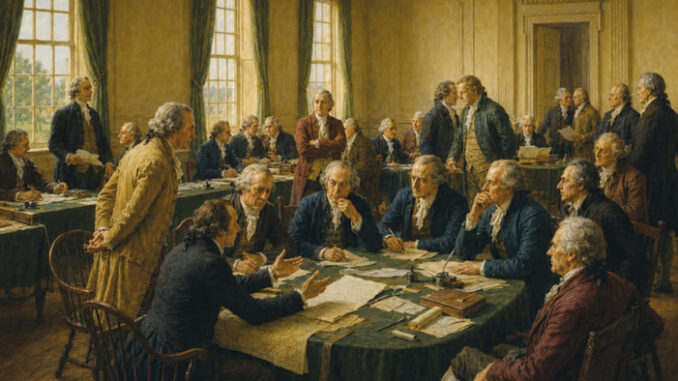

The Idea That Gave Birth to a Nation
“The war won a nation. The Declaration gave the nation its soul.”
By the spring of 1776, war had continued for a year, yet independence remained deeply contested. Many colonists still hoped for reconciliation; others feared that separation would bring military defeat, economic ruin or political disorder. Common Sense, published anonymously by Thomas Paine in January, gave direct language to the case for independence. Paine attacked monarchy, appealed to ordinary readers and argued that America could build a new political future. On June 7, Richard Henry Lee of Virginia introduced a resolution declaring that the colonies “are, and of right ought to be, free and independent States.” Congress postponed a final vote while delegates sought instructions and consensus. In the meantime, it appointed five men to prepare a declaration: Thomas Jefferson, John Adams, Benjamin Franklin, Roger Sherman and Robert R. Livingston.
WHY JEFFERSON?
Jefferson was thirty-three, a gifted writer and already known for his Summary View of the Rights of British America. The committee assigned him the first draft. He wrote in rented rooms in Philadelphia, drawing upon natural-rights philosophy, British constitutional arguments, colonial declarations and a long tradition of resistance to arbitrary power. The achievement was not the invention of every idea, but their concentration into language at once precise, memorable and morally expansive.
“The Declaration was written for a crisis-but in words meant to survive the crisis.”


Be the first to comment